QUESTION IMAGE
Question
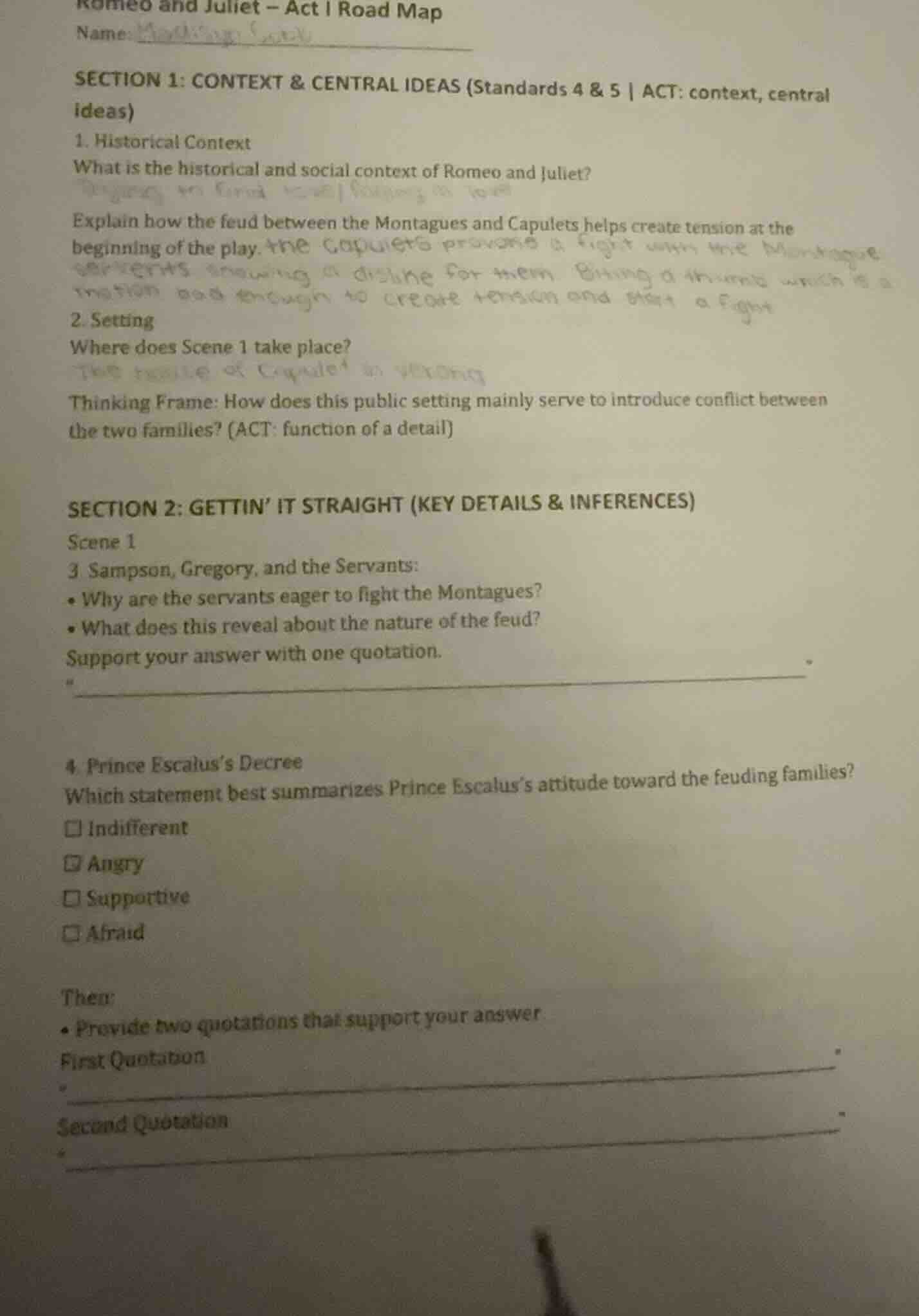
romeo and juliet – act i road map
name:
section 1: context & central ideas (standards 4 & 5 | act: context, central ideas)
- historical context
what is the historical and social context of romeo and juliet?
explain how the feud between the montagues and capulets helps create tension at the beginning of the play.
- setting
where does scene 1 take place?
thinking frame: how does this public setting mainly serve to introduce conflict between the two families? (act: function of a detail)
section 2: gettin’ it straight (key details & inferences)
scene 1
- sampson, gregory, and the servants:
- why are the servants eager to fight the montagues?
- what does this reveal about the nature of the feud?
support your answer with one quotation.
- prince escalus’s decree
which statement best summarizes prince escalus’s attitude toward the feuding families?
□ indifferent
□ angry
□ supportive
□ afraid
then:
- provide two quotations that support your answer.
first quotation
second quotation
- Historical Context: The play is set in 16th-century Verona, Italy, a time of aristocratic family rivalries and strict social hierarchies. The Montague-Capulet feud is a generational, bitter conflict that poisons public life; their immediate, aggressive hostility in the opening creates instant tension.
- Setting: Scene 1 takes place in a public Verona street. This space lets the feud spill into the community, showing the conflict is not private—it disrupts everyday life, drawing in bystanders and the prince, immediately establishing the feud's far-reaching impact.
- Sampson, Gregory, and the Servants: The servants are eager to fight because they absorb the hatred of their noble families; the feud trickles down to all levels of the households. This reveals the feud is all-consuming, not just between lords but every member of the families. Quotation: "I will show myself a tyrant: when I have fought with the men, I will be cruel with the maids, and cut off their heads." (Sampson, Scene 1)
- Prince Escalus’s Decree: The prince is angry because the feud repeatedly disrupts Verona's peace. Supporting quotations:
- First Quotation: "Rebellious subjects, enemies to peace, / Profaners of this neighbour-stained steel,-- / Will they not hear? What, ho! you men, you beasts, / That quench the fire of your pernicious rage / With purple fountains issuing from your veins,--"
- Second Quotation: "If ever you disturb our streets again, / Your lives shall pay the forfeit of the peace."

Snap & solve any problem in the app
Get step-by-step solutions on Sovi AI
Photo-based solutions with guided steps
Explore more problems and detailed explanations
- Historical Context: Set in 16th-century Verona, Italy, a society with rigid class structures and normalized aristocratic feuds. The Montague-Capulet feud is a deep, generational conflict; their immediate, violent hostility in the opening scene instantly builds tension by showing the feud's unrelenting bitterness.
- Setting: Scene 1 takes place on a public street in Verona. This public space allows the family conflict to disrupt daily life, drawing in bystanders and immediately establishing that the feud is not a private dispute but a threat to the whole community.
- Sampson, Gregory, and the Servants: The servants are eager to fight because they have adopted the intense hatred of their respective noble families, as the feud permeates every level of the households. This reveals the feud is all-consuming, affecting even the lowest-ranking members of the families. Quotation: "I will show myself a tyrant: when I have fought with the men, I will be cruel with the maids, and cut off their heads."
- Prince Escalus’s Decree:
- B. Angry
- First Quotation: "Rebellious subjects, enemies to peace, / Profaners of this neighbour-stained steel,-- / Will they not hear? What, ho! you men, you beasts, / That quench the fire of your pernicious rage / With purple fountains issuing from your veins,--"
- Second Quotation: "If ever you disturb our streets again, / Your lives shall pay the forfeit of the peace."