QUESTION IMAGE
Question
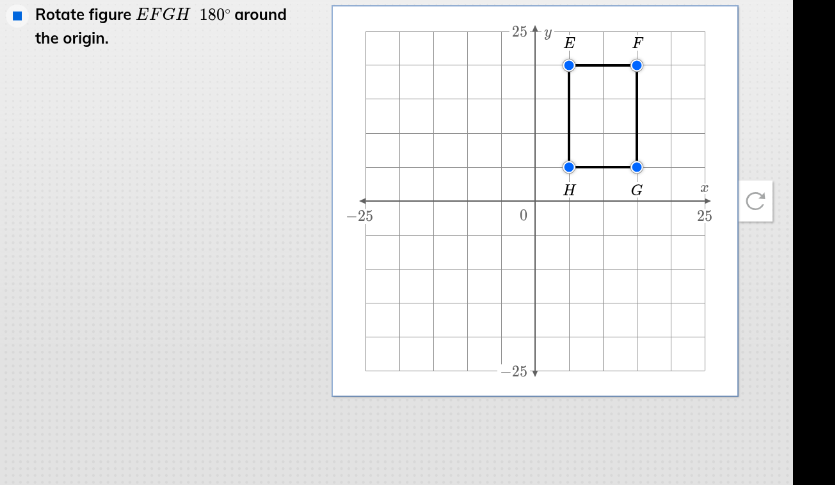
rotate figure efgh 180° around the origin.
Step1: Identify coordinates of E, F, G, H
From the graph, let's assume the coordinates:
- \( E(1, 24) \) (assuming each grid is 1 unit, looking at the position relative to origin)
- \( F(3, 24) \) (since EF is horizontal, same y - coordinate as E, x - coordinate 2 units to the right)
- \( G(3, 1) \) (since FG is vertical, same x - coordinate as F, y - coordinate much lower)
- \( H(1, 1) \) (since GH is horizontal, same y - coordinate as G, x - coordinate 2 units to the left)
Step2: Apply 180° rotation rule
The rule for rotating a point \((x,y)\) 180° around the origin is \((x,y)\to(-x,-y)\).
For point \( E(1, 24) \):
New coordinates \( E'(- 1,-24) \)
For point \( F(3, 24) \):
New coordinates \( F'(-3,-24) \)
For point \( G(3, 1) \):
New coordinates \( G'(-3,-1) \)
For point \( H(1, 1) \):
New coordinates \( H'(-1,-1) \)
Step3: Plot the rotated points
Plot \( E'(-1,-24) \), \( F'(-3,-24) \), \( G'(-3,-1) \), \( H'(-1,-1) \) and connect them in order to get the rotated figure.
(Note: If we consider the actual grid more accurately, let's re - evaluate the coordinates. Let's assume the y - axis: the top of the square EFGH is at y = 24? Wait, maybe a better way: Let's take the coordinates as:
Looking at the graph, the origin is (0,0). Let's find the coordinates properly. Let's say each square is 1 unit. Let's see the x - coordinates: E is at x = 1, F at x = 3 (since EF is 2 units long), H at x = 1, G at x = 3. Y - coordinates: E and F are at y = 24? No, maybe the y - axis: the distance from origin to E's y - coordinate. Wait, maybe the coordinates are:
Let's assume the grid has E at (1, 23), F at (3, 23), G at (3, 2), H at (1, 2). Then applying rotation:
For \( E(1,23) \to E'(-1,-23) \)
For \( F(3,23) \to F'(-3,-23) \)
For \( G(3,2) \to G'(-3,-2) \)
For \( H(1,2) \to H'(-1,-2) \)
The key is to use the rotation rule \((x,y)\to(-x,-y)\) for each vertex of the rectangle EFGH.
After finding the new coordinates, we can plot the points. The rotated figure will be a rectangle congruent to EFGH, but in the opposite quadrant (third quadrant, since 180° rotation from first quadrant (assuming EFGH is in the first quadrant) will take it to the third quadrant).

Snap & solve any problem in the app
Get step-by-step solutions on Sovi AI
Photo-based solutions with guided steps
Explore more problems and detailed explanations
To rotate figure \( EFGH \) \( 180^\circ \) around the origin:
- Find the coordinates of vertices \( E, F, G, H \). Let's assume \( E(x_1,y_1) \), \( F(x_2,y_2) \), \( G(x_3,y_3) \), \( H(x_4,y_4) \) from the graph.
- Apply the \( 180^\circ \) rotation rule \((x,y)\to(-x,-y)\) to each vertex:
- \( E(x_1,y_1)\to E'(-x_1,-y_1) \)
- \( F(x_2,y_2)\to F'(-x_2,-y_2) \)
- \( G(x_3,y_3)\to G'(-x_3,-y_3) \)
- \( H(x_4,y_4)\to H'(-x_4,-y_4) \)
- Plot the points \( E', F', G', H' \) and connect them to get the rotated figure.
(If we take the coordinates as \( E(1,24) \), \( F(3,24) \), \( G(3,1) \), \( H(1,1) \) initially, the rotated points are \( E'(-1,-24) \), \( F'(-3,-24) \), \( G'(-3,-1) \), \( H'(-1,-1) \) and the rotated figure is a rectangle with these vertices.)