QUESTION IMAGE
Question
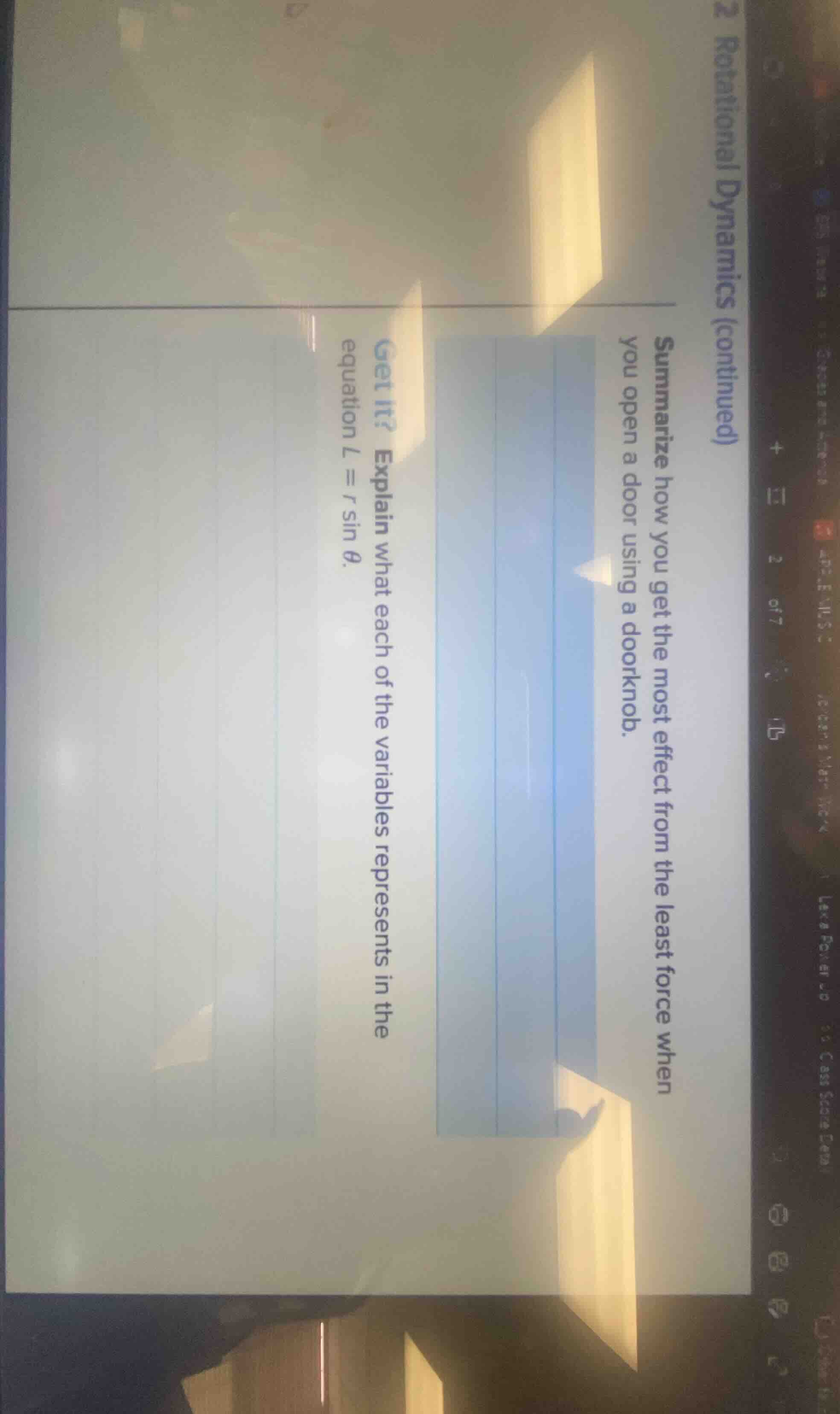
2 rotational dynamics (continued)
summarize how you get the most effect from the least force when you open a door using a doorknob.
get it? explain what each of the variables represents in the equation $l = r \sin \theta$.
Brief Explanations
- For door opening: Torque ($\tau = rF\sin\theta$) causes rotation. Max torque needs max $r$ (distance from hinge) and $\sin\theta=1$ (force perpendicular to door). Doorknobs are at the farthest point from hinges, so pulling/pushing perpendicular to the door there maximizes torque with minimal force.
- For $L = r\sin\theta$: This is the lever arm formula. $L$ is the perpendicular distance from the rotation axis (door hinge) to the line of action of the force. $r$ is the distance from the axis to the point where force is applied (from hinge to doorknob). $\theta$ is the angle between the position vector $r$ and the direction of the applied force.

Snap & solve any problem in the app
Get step-by-step solutions on Sovi AI
Photo-based solutions with guided steps
Explore more problems and detailed explanations
- To get maximum effect from minimum force opening a door: Use the doorknob (farthest from the hinge, maximizing $r$) and apply force perpendicular to the door (so $\sin\theta=1$), which maximizes the torque that rotates the door.
- In $L = r\sin\theta$:
- $L$: Perpendicular lever arm length (distance from hinge to force's line of action)
- $r$: Distance from hinge to doorknob (force application point)
- $\theta$: Angle between $r$ and the applied force direction