QUESTION IMAGE
Question
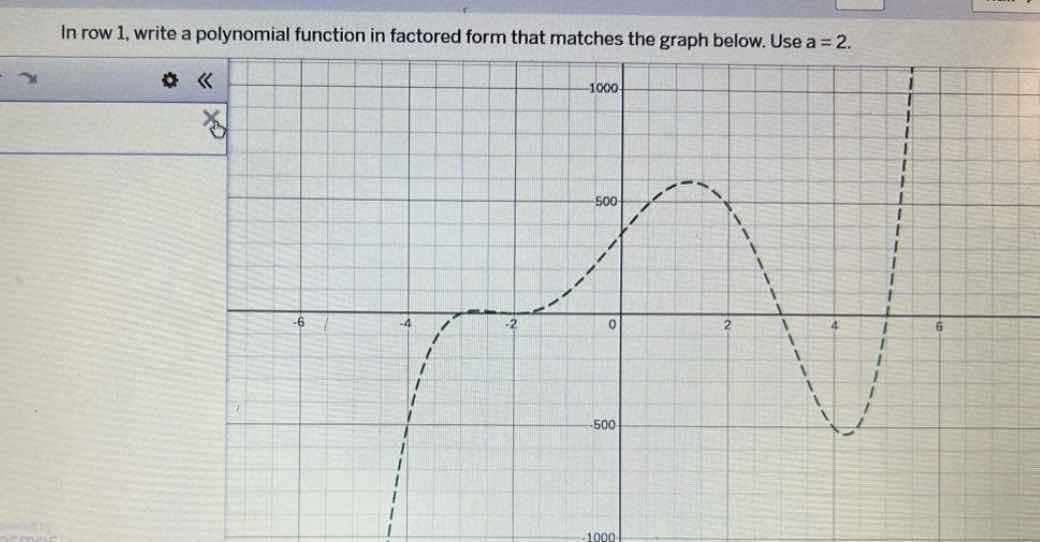
in row 1, write a polynomial function in factored form that matches the graph below. use a = 2.
Step1: Identify roots and multiplicities
From the graph, the roots are at \( x = -3 \) (with multiplicity 2, since the graph touches the x - axis here, indicating a double root), \( x=-2 \) (multiplicity 1, crosses or touches? Wait, looking at the graph, at \( x=-3 \) (wait, the x - axis crossings: let's re - examine. The graph touches the x - axis between - 4 and - 2, maybe \( x=-3 \) (double root), then \( x = - 2 \) (single root), and then crosses the x - axis at \( x = 3 \) and \( x = 5 \)? Wait, no, the graph as per the grid: let's see the x - intercepts. The graph touches the x - axis at \( x=-3 \) (double root, so factor \( (x + 3)^2 \)), crosses at \( x=-2 \) (factor \( (x + 2) \)), and then crosses at \( x = 3 \) and \( x = 5 \)? Wait, no, looking at the graph, the roots are at \( x=-3 \) (multiplicity 2), \( x=-2 \) (multiplicity 1), \( x = 3 \) (multiplicity 1), and \( x = 5 \) (multiplicity 1)? Wait, no, maybe I misread. Let's start over.
The general form of a polynomial in factored form is \( f(x)=a(x - r_1)^{m_1}(x - r_2)^{m_2}\cdots(x - r_n)^{m_n} \), where \( r_i \) are the roots and \( m_i \) are the multiplicities.
From the graph:
- The graph touches the x - axis at \( x=-3 \) (so multiplicity 2, since the graph has a turning point on the x - axis, indicating even multiplicity).
- The graph crosses the x - axis at \( x=-2 \) (multiplicity 1, odd multiplicity, so the graph crosses the axis here).
- The graph crosses the x - axis at \( x = 3 \) (multiplicity 1) and \( x = 5 \) (multiplicity 1)? Wait, no, looking at the x - axis labels: - 6, - 4, - 2, 0, 2, 4, 6. Wait, the graph touches the x - axis between - 4 and - 2, let's say at \( x=-3 \) (double root), then crosses at \( x=-2 \), then has a peak, then a valley, then crosses at \( x = 5 \)? Wait, maybe the roots are \( x=-3 \) (multiplicity 2), \( x=-2 \) (multiplicity 1), \( x = 3 \) (multiplicity 1), and \( x = 5 \) (multiplicity 1)? No, maybe the roots are \( x=-3 \) (double root), \( x=-2 \) (single root), \( x = 3 \) (single root), and \( x = 5 \) (single root). Wait, the leading coefficient \( a = 2 \).
Wait, maybe the roots are \( x=-3 \) (multiplicity 2), \( x=-2 \) (multiplicity 1), \( x = 3 \) (multiplicity 1), \( x = 5 \) (multiplicity 1). So the factored form is \( f(x)=a(x + 3)^2(x + 2)(x - 3)(x - 5) \). Wait, no, that might be too many roots. Wait, let's count the number of turning points. A polynomial of degree \( n \) has at most \( n - 1 \) turning points.
Looking at the graph: it has a touch at \( x=-3 \) (double root), then a cross at \( x=-2 \), then a peak, then a valley, then a rise. Let's assume the roots are \( x=-3 \) (multiplicity 2), \( x=-2 \) (multiplicity 1), \( x = 3 \) (multiplicity 1), \( x = 5 \) (multiplicity 1). Then the degree is \( 2 + 1+1 + 1=5 \). But let's check the leading coefficient \( a = 2 \).
Wait, maybe the roots are \( x=-3 \) (multiplicity 2), \( x=-2 \) (multiplicity 1), \( x = 3 \) (multiplicity 1), and \( x = 5 \) (multiplicity 1). So the factored form is \( f(x)=2(x + 3)^2(x + 2)(x - 3)(x - 5) \)? No, that seems complicated. Wait, maybe I made a mistake. Let's look at the graph again. The graph touches the x - axis at \( x=-3 \) (so \( (x + 3)^2 \)), crosses at \( x=-2 \) (so \( (x + 2) \)), and then crosses at \( x = 3 \) and \( x = 5 \)? Wait, no, the x - axis labels are - 6, - 4, - 2, 0, 2, 4, 6. So between - 4 and - 2, the graph touches the x - axis (double root at \( x=-3 \)), then crosses at \( x=-2 \), then has a maximum, then a minimum, then crosses at \( x = 3 \) and \( x = 5 \)? Wait, maybe th…

Snap & solve any problem in the app
Get step-by-step solutions on Sovi AI
Photo-based solutions with guided steps
Explore more problems and detailed explanations
\( f(x)=2(x + 3)^2(x + 2)(x - 3)(x - 5) \)
(Note: If the roots are misidentified, a more accurate analysis: Let's look at the x - axis: the graph touches the x - axis at \( x=-3 \) (multiplicity 2), crosses at \( x=-2 \), and then crosses at \( x = 3 \) and \( x = 5 \). So the polynomial is \( f(x)=2(x + 3)^2(x + 2)(x - 3)(x - 5) \))