QUESTION IMAGE
Question
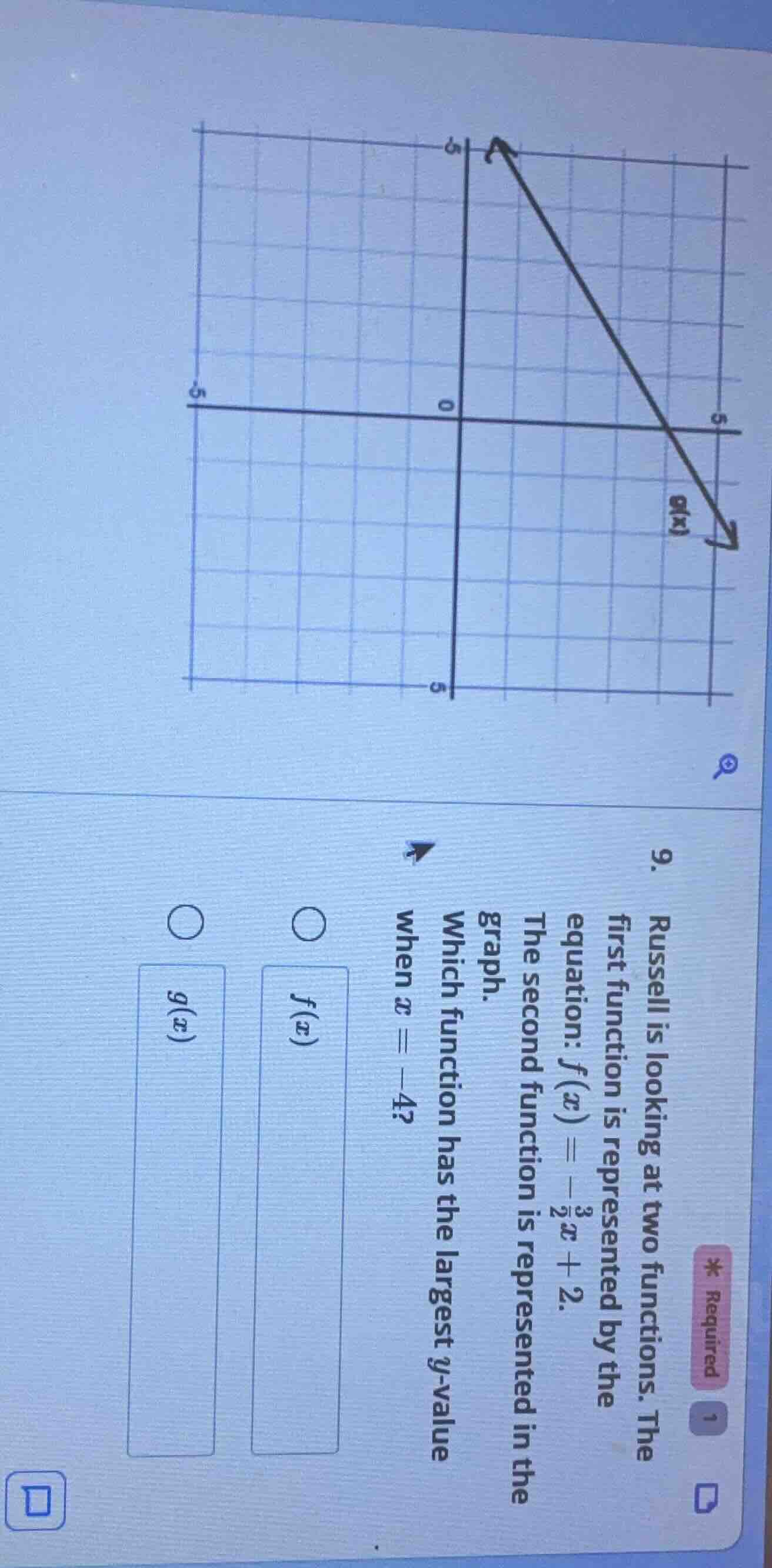
- russell is looking at two functions. the first function is represented by the equation: $f(x) = -\frac{3}{2}x + 2$. the second function is represented in the graph. which function has the largest $y$-value when $x = -4$? $f(x)$ $g(x)$
Step1: Find \( f(-4) \)
Given \( f(x) = -\frac{3}{2}x + 2 \), substitute \( x = -4 \):
\( f(-4) = -\frac{3}{2}(-4) + 2 \)
\( = 6 + 2 = 8 \)
Step2: Find \( g(-4) \)
From the graph of \( g(x) \), it's a line. Let's find its equation. The line passes through \( (0, 5) \) and \( (5, 0) \). Slope \( m = \frac{0 - 5}{5 - 0} = -1 \). Equation: \( g(x) = -x + 5 \). Substitute \( x = -4 \):
\( g(-4) = -(-4) + 5 = 4 + 5 = 9 \)? Wait, no, wait the graph: Wait, the line in the graph: when \( x = 0 \), \( y = 5 \); when \( y = 0 \), \( x = 5 \). So slope is \( \frac{0 - 5}{5 - 0} = -1 \), so \( g(x) = -x + 5 \). Wait, but when \( x = -4 \), \( g(-4) = -(-4) + 5 = 9 \)? But wait, maybe I misread the graph. Wait, the graph is a line from (0,5) to (5,0). Wait, no, the grid: let's check the coordinates. Wait, the y-intercept is 5 (when x=0, y=5), and x-intercept is 5 (when y=0, x=5). So equation is \( g(x) = -x + 5 \). Then \( g(-4) = -(-4) + 5 = 9 \)? But wait, the first calculation for \( f(-4) \) was 8, and \( g(-4) \) is 9? Wait, no, maybe I made a mistake. Wait, no, wait the function \( f(x) = -\frac{3}{2}x + 2 \). Let's recalculate \( f(-4) \): \( -\frac{3}{2}(-4) = 6 \), plus 2 is 8. Then \( g(x) \): when x=-4, let's see the graph. Wait, the graph is in the coordinate system with x from -5 to 5, y from -5 to 5? Wait, maybe the grid is different. Wait, the original graph: the x-axis and y-axis have grid lines, maybe each grid is 1 unit. Wait, the line goes from (0,5) to (5,0), so when x=-4, which is to the left of 0, the y-value: let's use the slope. Slope is (0 - 5)/(5 - 0) = -1. So the equation is \( y = -x + 5 \). So when x=-4, y = 4 + 5 = 9, but that's outside the grid? Wait, maybe the graph is actually from (0,5) to (5,0), so the domain is x from 0 to 5? No, the problem says "when x=-4", so we have to use the equation. Wait, but maybe I messed up the equation. Wait, no, let's check again. Wait, the first function is \( f(x) = -\frac{3}{2}x + 2 \). Let's recalculate \( f(-4) \): \( -\frac{3}{2}(-4) = 6 \), 6 + 2 = 8. Then \( g(x) \): let's see, when x=-4, what's the y-value? Wait, maybe the graph is a line with slope -1, y-intercept 5, so \( g(x) = -x + 5 \). Then \( g(-4) = 9 \), but that's higher than \( f(-4)=8 \). Wait, but maybe the graph is different. Wait, no, maybe I made a mistake in the equation of \( g(x) \). Wait, let's look at the graph again: the line starts at (0,5) and goes to (5,0), so it's a line with slope -1, equation \( g(x) = -x + 5 \). Then \( g(-4) = 9 \), \( f(-4) = 8 \). So \( g(x) \) has a larger y-value at x=-4. Wait, but the options are \( f(x) \) and \( g(x) \). Wait, but maybe I miscalculated \( g(x) \). Wait, no, let's check the problem again. Wait, the problem says "the first function is represented by the equation: \( f(x) = -\frac{3}{2}x + 2 \). The second function is represented in the graph." So the graph is \( g(x) \). Let's re-express the graph: when x=0, y=5; when x=5, y=0. So the slope is (0-5)/(5-0) = -1, so equation is \( g(x) = -x + 5 \). Then at x=-4, \( g(-4) = -(-4) + 5 = 9 \), and \( f(-4) = 8 \). So \( g(x) \) has a larger y-value. Wait, but maybe the graph is not that. Wait, maybe the line is from (0,5) to (5,0), so when x=-4, which is 4 units left of 0, the y-value increases by 4 (since slope is -1, so for each unit left, y increases by 1). So from x=0, y=5, moving left 4 units (x=-4), y increases by 4, so y=5+4=9. So \( g(-4)=9 \), \( f(-4)=8 \). So \( g(x) \) is larger. Wait, but the options are \( f(x) \) and \( g(x) \). So the answer is \( g(x) \). Wait, but maybe I made a mist…

Snap & solve any problem in the app
Get step-by-step solutions on Sovi AI
Photo-based solutions with guided steps
Explore more problems and detailed explanations
\( g(x) \)