QUESTION IMAGE
Question
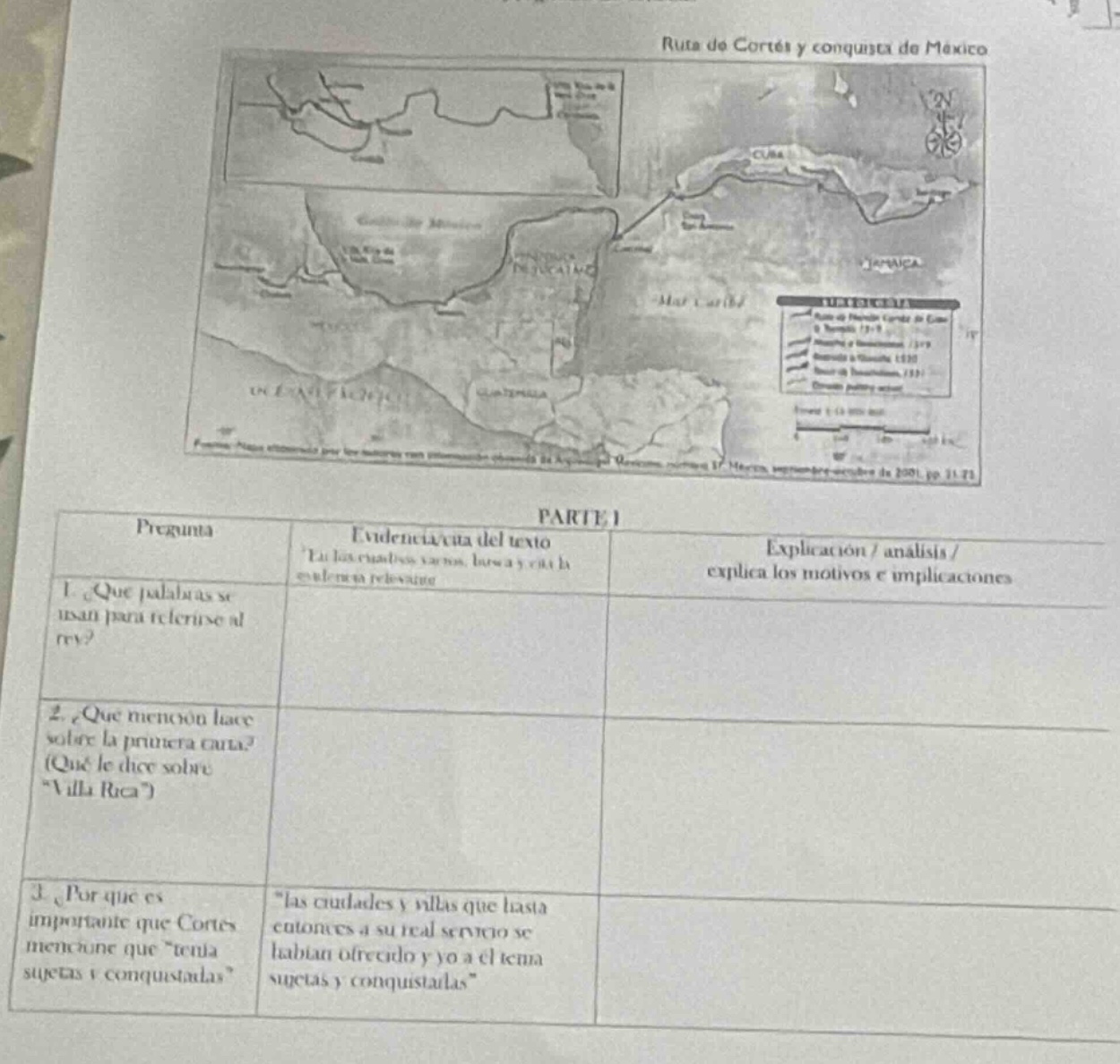
ruta de cortés y conquista de méxico
parte 1
| pregunta | evidencia/ cita del texto (en los cuadros sarán, busca y cita la evidencia relevante) | explicación / análisis / explica los motivos e implicaciones |
|---|---|---|
| 2. ¿qué mención hace sobre la primera carta? (qué le dice sobre \villa rica\) | ||
| 3. ¿por qué es importante que cortés mencione que \tenía sujetas y conquistadas\ | \las ciudades y villas que hasta entonces a su real servicio se habían ofrecido y ya a él tenía sujetas y conquistadas\ |
To solve these questions, we analyze each one based on historical context (Spanish conquest of Mexico) and the map/text:
Question 1:
To refer to the king (Spanish monarch), terms like "su real servicio" (his royal service) or "el rey" (the king) (inferred from colonial discourse, as Cortés acted under royal authority).
The first route (from the map: likely from Cuba to Mexico) mentions "Villa Rica" (a settlement). Context: Cortés landed, established Villa Rica de la Vera Cruz, and the mention relates to founding/claiming territory for Spain. The map’s legend shows routes (e.g., "Ruta de Villa Rica de la Vera Cruz")—so the mention explains the establishment of this settlement as part of the conquest route.
The phrase "tenía sujetas y conquistadas" (had them subjugated and conquered) is important because:
- Political Legitimacy: It justifies Cortés’ actions to the Spanish crown (proving he expanded royal dominion).
- Power Display: Shows control over territories, reinforcing his authority to rule them.
- Colonial Narrative: Frames the conquest as successful, emphasizing Spain’s right to claim these lands (via "just" conquest, per imperial ideology).

Snap & solve any problem in the app
Get step-by-step solutions on Sovi AI
Photo-based solutions with guided steps
Explore more problems and detailed explanations
Palabras como "su real servicio" (referencia al rey de España) y posiblemente "el rey" (implícito en el contexto de servicio real) se usan para referirse al rey.