QUESTION IMAGE
Question
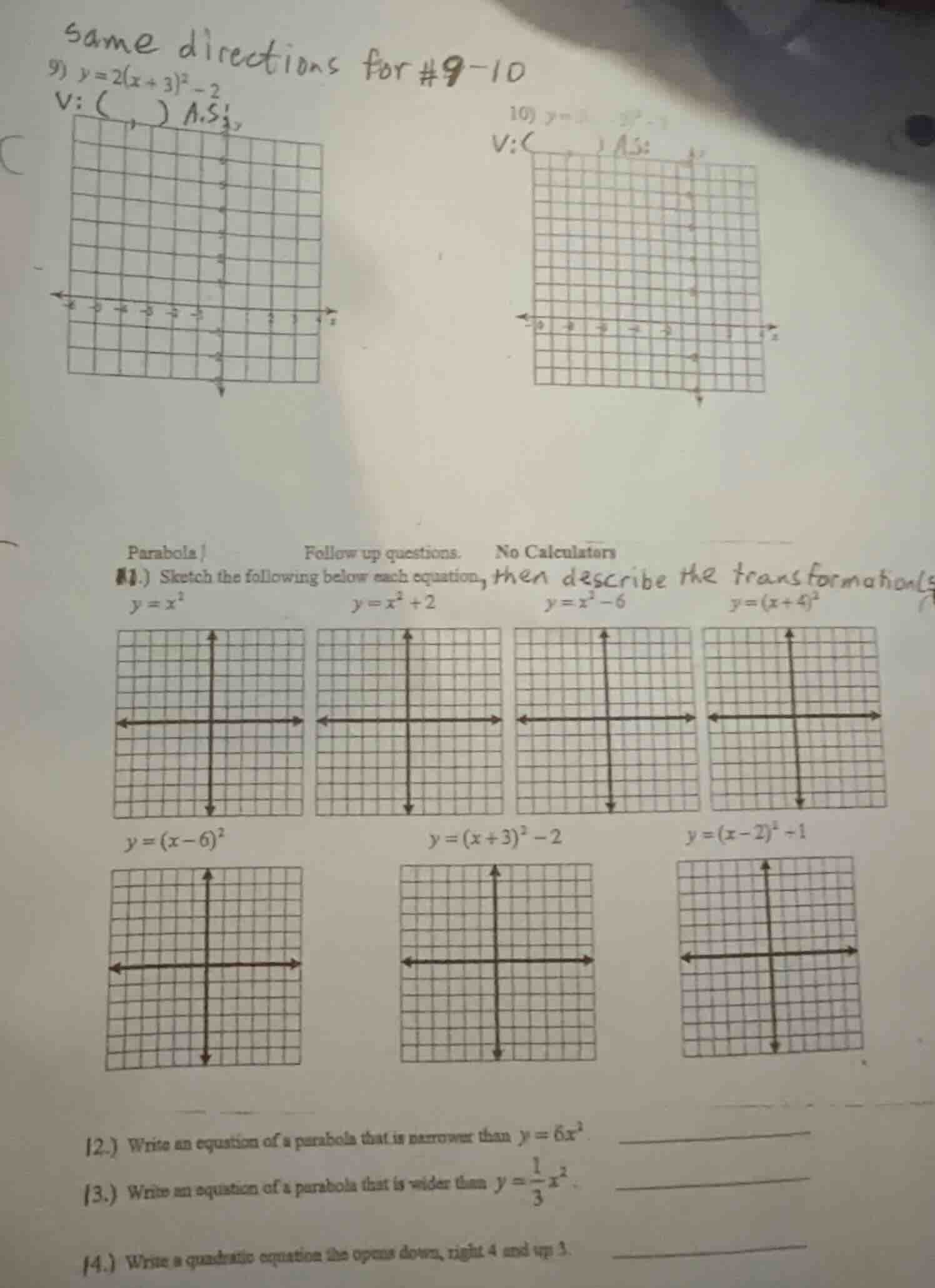
same directions for #9 - 10
- $y = 2(x + 3)^2 - 2$
v: (, ) a.s:
- $y = $
v:(, ) a.s:
parabola | follow up questions. no calculators
11.) sketch the following below each equation, then describe the transformation(
$y = x^2$ $y = x^2 + 2$ $y = x^2 - 6$ $y = (x + 4)^2$
$y = (x - 6)^2$ $y = (x + 3)^2 - 2$ $y = (x - 2)^2 + 1$
12.) write an equation of a parabola that is narrower than $y = 6x^2$.
13.) write an equation of a parabola that is wider than $y = \frac{1}{3}x^2$.
14.) write a quadratic equation the opens down, right 4 and up 3.
Let's solve problem 9 first: \( y = 2(x + 3)^2 - 2 \)
Step 1: Recall the vertex form of a parabola
The vertex form of a parabola is \( y = a(x - h)^2 + k \), where \((h, k)\) is the vertex (\(V\)) and the axis of symmetry (A.S.) is \( x = h \).
Step 2: Identify \( h \) and \( k \) from the given equation
In the equation \( y = 2(x + 3)^2 - 2 \), we can rewrite \( (x + 3) \) as \( (x - (-3)) \). So, comparing with \( y = a(x - h)^2 + k \), we have \( h = -3 \) and \( k = -2 \).
Step 3: Determine the vertex and axis of symmetry
The vertex \( V \) is \((h, k) = (-3, -2)\). The axis of symmetry is \( x = h \), so \( x = -3 \).
Step 1: Recall the effect of the coefficient \( a \) on the width of a parabola
For a parabola in the form \( y = ax^2 \), the larger the absolute value of \( a \), the narrower the parabola. If \( |a_1| > |a_2| \), then \( y = a_1x^2 \) is narrower than \( y = a_2x^2 \).
Step 2: Choose a value for \( a \) that makes the parabola narrower than \( y = 6x^2 \)
We need \( |a| > 6 \). Let's choose \( a = 7 \) (any value with absolute value greater than 6 will work, e.g., 7, 8, -7, -8, etc.).
Step 3: Write the equation
Using \( a = 7 \), the equation of the parabola is \( y = 7x^2 \). (Other valid examples: \( y = 8x^2 \), \( y = -7x^2 \), etc.)
Step 1: Recall the effect of the coefficient \( a \) on the width of a parabola
For a parabola in the form \( y = ax^2 \), the smaller the absolute value of \( a \), the wider the parabola. If \( |a_1| < |a_2| \), then \( y = a_1x^2 \) is wider than \( y = a_2x^2 \).
Step 2: Choose a value for \( a \) that makes the parabola wider than \( y = \frac{1}{3}x^2 \)
We need \( |a| < \frac{1}{3} \). Let's choose \( a = \frac{1}{4} \) (any value with absolute value less than \( \frac{1}{3} \) will work, e.g., \( \frac{1}{4} \), \( \frac{1}{5} \), \( -\frac{1}{4} \), etc.).
Step 3: Write the equation
Using \( a = \frac{1}{4} \), the equation of the parabola is \( y = \frac{1}{4}x^2 \). (Other valid examples: \( y = \frac{1}{5}x^2 \), \( y = -\frac{1}{4}x^2 \), etc.)

Snap & solve any problem in the app
Get step-by-step solutions on Sovi AI
Photo-based solutions with guided steps
Explore more problems and detailed explanations
(for problem 9):
Vertex \( V: (-3, -2) \), Axis of Symmetry (A.S.): \( x = -3 \)
Now, let's solve problem 12: "Write an equation of a parabola that is narrower than \( y = 6x^2 \)."