QUESTION IMAGE
Question
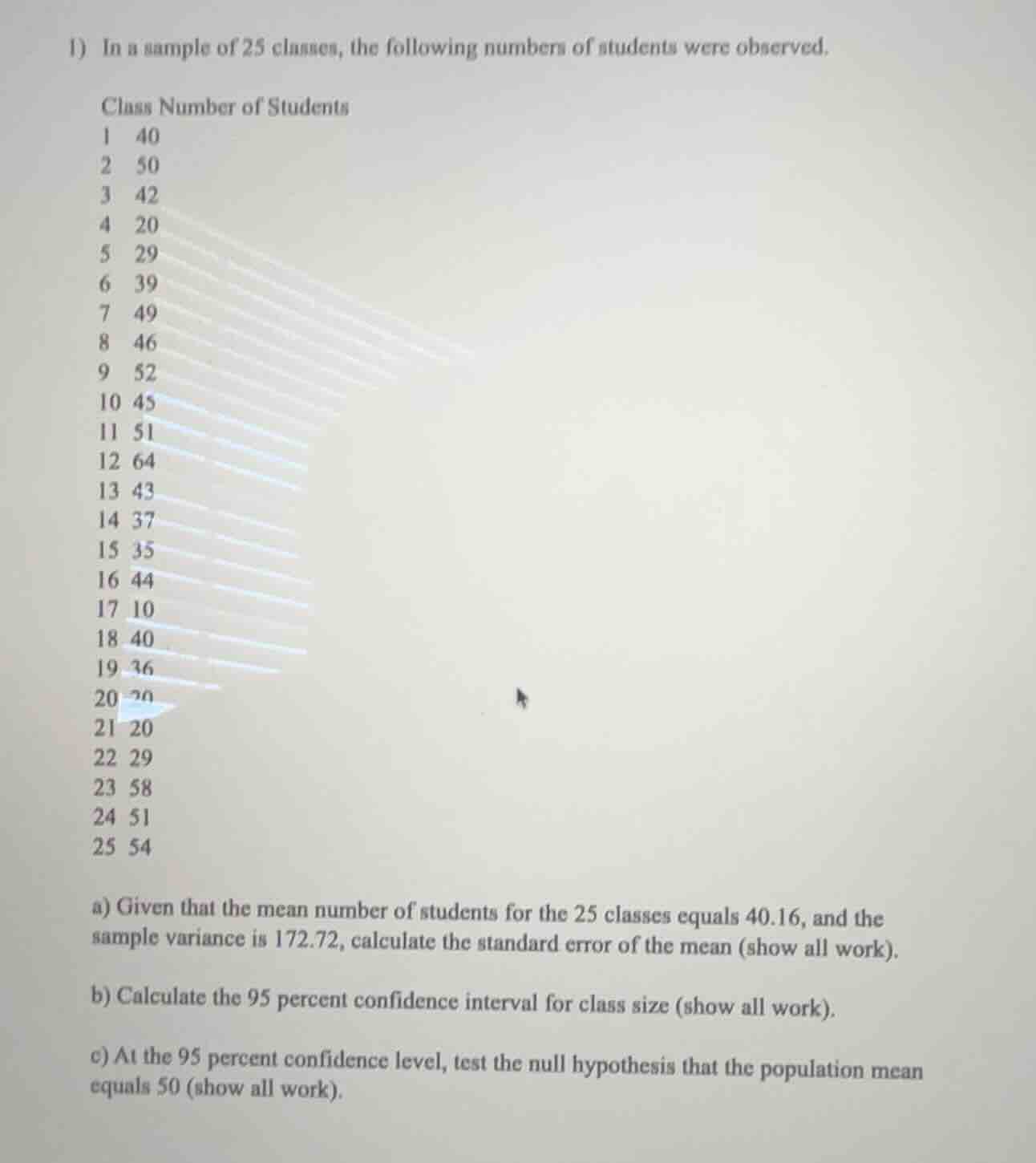
- in a sample of 25 classes, the following numbers of students were observed.
class number of students
1 40
2 50
3 42
4 20
5 29
6 39
7 49
8 46
9 52
10 45
11 51
12 64
13 43
14 37
15 35
16 44
17 10
18 40
19 36
20 20
21 20
22 29
23 58
24 51
25 54
a) given that the mean number of students for the 25 classes equals 40.16, and the sample variance is 172.72, calculate the standard error of the mean (show all work).
b) calculate the 95 percent confidence interval for class size (show all work).
c) at the 95 percent confidence level, test the null hypothesis that the population mean equals 50 (show all work).
Part (a)
Step 1: Recall the formula for standard error of the mean
The formula for the standard error of the mean ($SE$) is $SE=\frac{s}{\sqrt{n}}$, where $s$ is the sample standard deviation and $n$ is the sample size. First, we need to find the sample standard deviation from the sample variance. The sample standard deviation $s = \sqrt{\text{sample variance}}$.
Step 2: Calculate the sample standard deviation
Given sample variance $s^{2}=172.72$, so $s=\sqrt{172.72}\approx13.1423$.
Step 3: Calculate the standard error of the mean
The sample size $n = 25$. Using the formula $SE=\frac{s}{\sqrt{n}}$, we substitute $s\approx13.1423$ and $n = 25$. So $SE=\frac{13.1423}{\sqrt{25}}=\frac{13.1423}{5}\approx2.6285$.
Step 1: Recall the formula for confidence interval
For a 95% confidence interval when the population standard deviation is unknown (we use sample standard deviation), the formula is $\bar{x}\pm t_{\alpha/2, n - 1}\times SE$, where $\bar{x}$ is the sample mean, $t_{\alpha/2, n - 1}$ is the t - critical value, $n$ is the sample size, and $SE$ is the standard error of the mean.
Step 2: Determine the t - critical value
For a 95% confidence interval and $n=25$, the degrees of freedom $df=n - 1=24$. From the t - distribution table, $t_{0.025,24}=2.0639$.
Step 3: Calculate the margin of error
The margin of error $E=t_{\alpha/2, n - 1}\times SE$. We know $t_{\alpha/2,24}=2.0639$ and $SE\approx2.6285$. So $E = 2.0639\times2.6285\approx5.425$.
Step 4: Calculate the confidence interval
The sample mean $\bar{x}=40.16$. The lower limit is $\bar{x}-E=40.16 - 5.425 = 34.735$ and the upper limit is $\bar{x}+E=40.16+5.425 = 45.585$.
Step 1: State the hypotheses
Null hypothesis: $H_{0}:\mu = 50$; Alternative hypothesis: $H_{1}:\mu
eq50$ (two - tailed test).
Step 2: Calculate the t - statistic
The formula for the t - statistic is $t=\frac{\bar{x}-\mu_{0}}{SE}$, where $\bar{x}=40.16$, $\mu_{0}=50$, and $SE\approx2.6285$. So $t=\frac{40.16 - 50}{2.6285}=\frac{- 9.84}{2.6285}\approx - 3.744$.
Step 3: Determine the critical value and rejection region
For a 95% confidence level (two - tailed test) with $df = 24$, the critical values are $t_{\alpha/2,24}=\pm2.0639$. The rejection region is $t < - 2.0639$ or $t>2.0639$.
Step 4: Make a decision
Since the calculated $t=-3.744 < - 2.0639$, we reject the null hypothesis $H_{0}$.

Snap & solve any problem in the app
Get step-by-step solutions on Sovi AI
Photo-based solutions with guided steps
Explore more problems and detailed explanations
The standard error of the mean is approximately $\boldsymbol{2.6285}$.