QUESTION IMAGE
Question
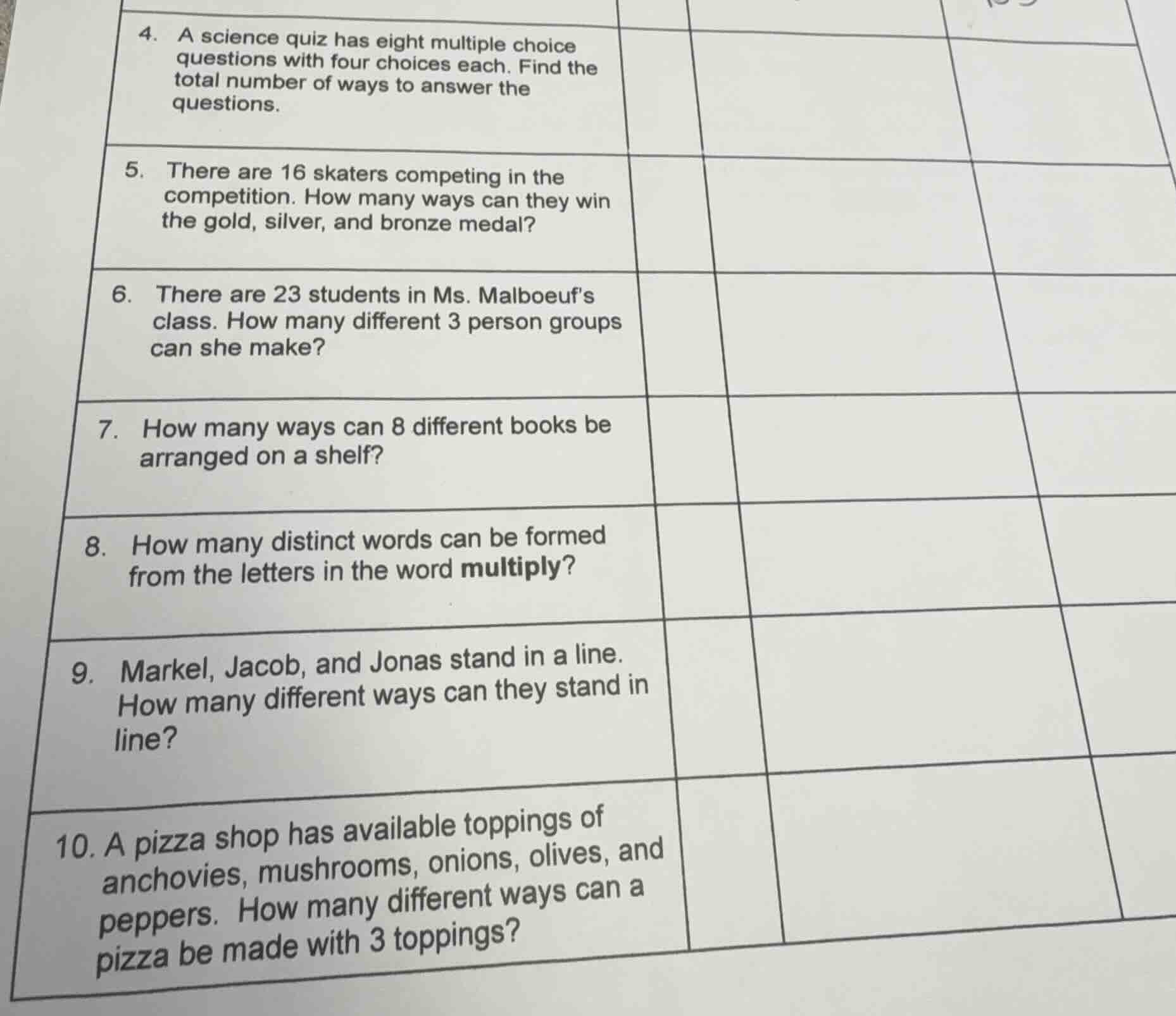
- a science quiz has eight multiple choice questions with four choices each. find the total number of ways to answer the questions.
- there are 16 skaters competing in the competition. how many ways can they win the gold, silver, and bronze medal?
- there are 23 students in ms. malboeuf’s class. how many different 3 person groups can she make?
- how many ways can 8 different books be arranged on a shelf?
- how many distinct words can be formed from the letters in the word multiply?
- markel, jacob, and jonas stand in a line. how many different ways can they stand in line?
- a pizza shop has available toppings of anchovies, mushrooms, onions, olives, and peppers. how many different ways can a pizza be made with 3 toppings?
Question 4
Step1: Identify the problem type
Each of the 8 multiple - choice questions has 4 choices. This is a problem of counting the number of ways to make independent choices. For each question, the number of choices is 4, and since the choices for each question are independent, we use the multiplication principle. The multiplication principle states that if there are \(n_1\) ways to do the first task, \(n_2\) ways to do the second task, \(\cdots\), \(n_k\) ways to do the \(k\) - th task, then the total number of ways to do all \(k\) tasks together is \(n_1\times n_2\times\cdots\times n_k\).
Step2: Apply the multiplication principle
Here, \(k = 8\) (number of questions) and \(n_i=4\) for each \(i\) (number of choices per question). So the total number of ways to answer the questions is \(4\times4\times\cdots\times4\) (8 times). In exponential form, this is \(4^8\).
Calculate \(4^8=(2^2)^8 = 2^{16}=65536\).
Step1: Identify the problem type
We need to find the number of ways to award 3 distinct medals (gold, silver, bronze) to 16 skaters. This is a permutation problem because the order of awarding (who gets gold, who gets silver, who gets bronze) matters. The formula for permutations of \(n\) objects taken \(r\) at a time is \(P(n,r)=\frac{n!}{(n - r)!}\), where \(n!=n\times(n - 1)\times\cdots\times1\). Here, \(n = 16\) (total number of skaters) and \(r = 3\) (number of medals).
Step2: Apply the permutation formula
\(P(16,3)=\frac{16!}{(16 - 3)!}=\frac{16!}{13!}\)
Since \(n!=n\times(n - 1)\times\cdots\times(n - r+1)\times(n - r)!\), we can simplify \(\frac{16!}{13!}=16\times15\times14\).
Calculate \(16\times15\times14 = 16\times210=3360\).
Step1: Identify the problem type
We need to find the number of ways to choose 3 - person groups from 23 students. The order of the people in the group does not matter (a group with person A, person B, person C is the same as a group with person B, person A, person C). This is a combination problem. The formula for combinations of \(n\) objects taken \(r\) at a time is \(C(n,r)=\frac{n!}{r!(n - r)!}\), where \(n = 23\) (total number of students) and \(r = 3\) (number of students in each group).
Step2: Apply the combination formula
\(C(23,3)=\frac{23!}{3!(23 - 3)!}=\frac{23!}{3!×20!}\)
Since \(n!=n\times(n - 1)\times\cdots\times(n - r + 1)\times(n - r)!\), we can simplify \(\frac{23!}{3!×20!}=\frac{23\times22\times21\times20!}{3\times2\times1\times20!}=\frac{23\times22\times21}{6}\)
Calculate \(23\times22\times21 = 23\times462 = 10626\), and \(\frac{10626}{6}=1771\).

Snap & solve any problem in the app
Get step-by-step solutions on Sovi AI
Photo-based solutions with guided steps
Explore more problems and detailed explanations
The total number of ways to answer the questions is \(\boldsymbol{65536}\).