QUESTION IMAGE
Question
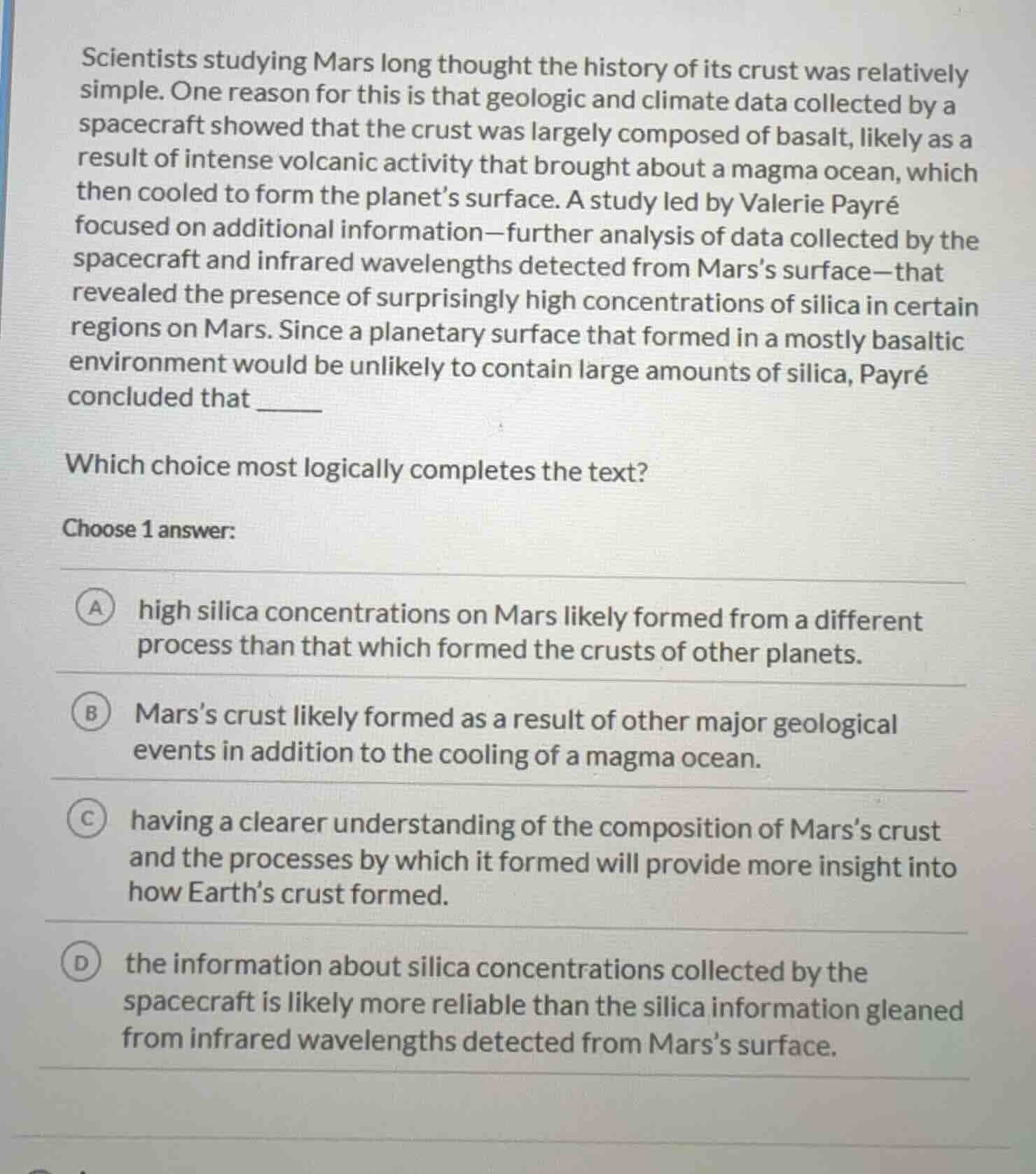
scientists studying mars long thought the history of its crust was relatively simple. one reason for this is that geologic and climate data collected by a spacecraft showed that the crust was largely composed of basalt, likely as a result of intense volcanic activity that brought about a magma ocean, which then cooled to form the planets surface. a study led by valerie payré focused on additional information—further analysis of data collected by the spacecraft and infrared wavelengths detected from marss surface—that revealed the presence of surprisingly high concentrations of silica in certain regions on mars. since a planetary surface that formed in a mostly basaltic environment would be unlikely to contain large amounts of silica, payré concluded that ______
which choice most logically completes the text?
choose 1 answer:
a high silica concentrations on mars likely formed from a different process than that which formed the crusts of other planets.
b marss crust likely formed as a result of other major geological events in addition to the cooling of a magma ocean.
c having a clearer understanding of the composition of marss crust and the processes by which it formed will provide more insight into how earths crust formed.
d the information about silica concentrations collected by the spacecraft is likely more reliable than the silica information gleaned from infrared wavelengths detected from marss surface.
The text states that scientists previously thought Mars' crust formed solely from a cooling magma ocean (creating basalt), but new data found high silica, which is unlikely in a basalt-only formation. The conclusion must address this contradiction by adding another formation process. Option A incorrectly compares to other planets (not the focus). Option C shifts to Earth, which is irrelevant. Option D questions data reliability, which is not supported. Option B logically adds other geological events to explain the silica, aligning with the evidence.

Snap & solve any problem in the app
Get step-by-step solutions on Sovi AI
Photo-based solutions with guided steps
Explore more problems and detailed explanations
B. Mars’s crust likely formed as a result of other major geological events in addition to the cooling of a magma ocean.