QUESTION IMAGE
Question
scientists think that human activities that add carbon dioxide (co₂) to the atmosphere may be affecting the oceans through a process known as ocean acidification. when atmospheric co₂ dissolves in the water of the ocean surface, carbonic acid could be produced.
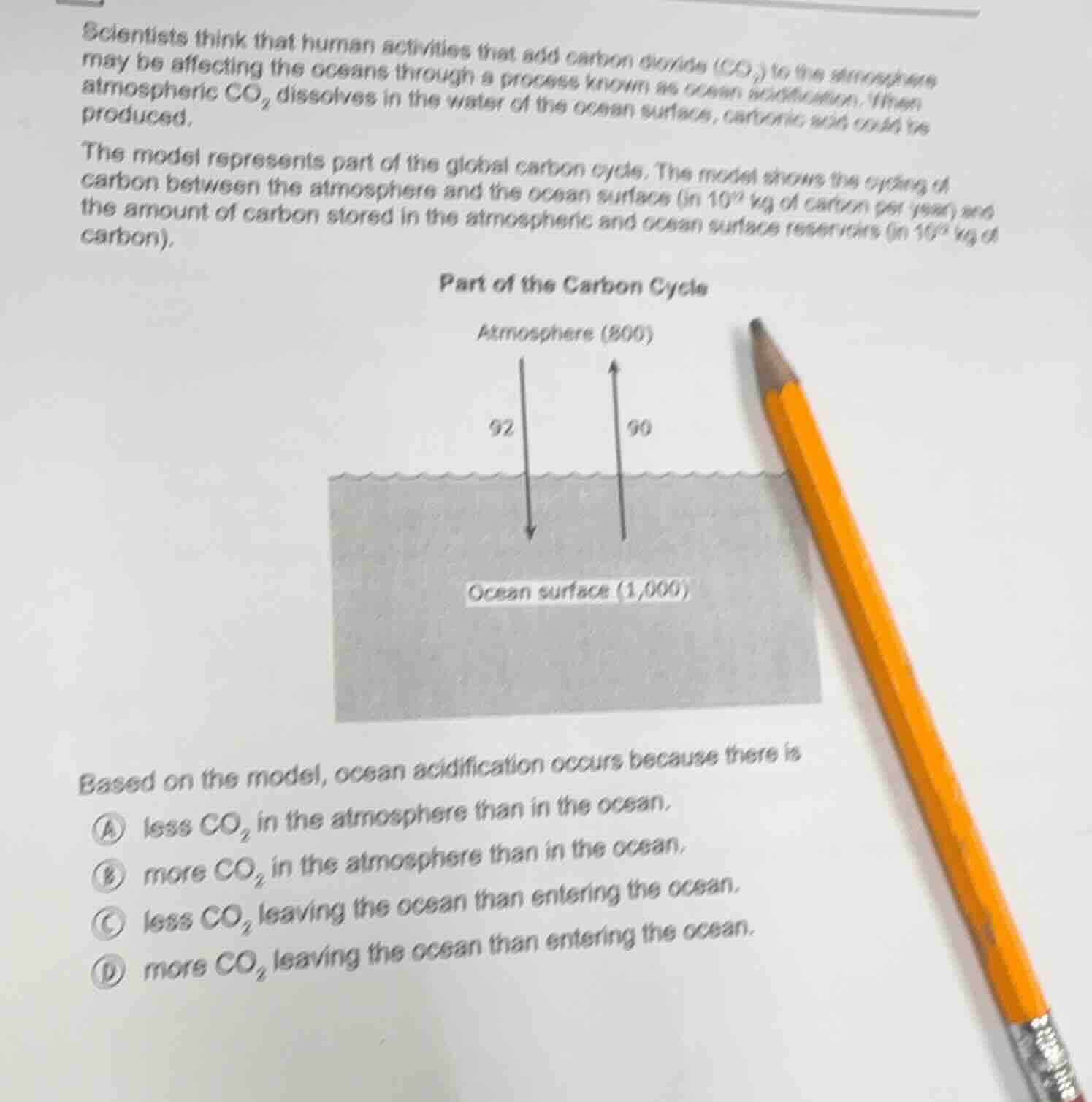
the model represents part of the global carbon cycle. the model shows the cycling of carbon between the atmosphere and the ocean surface (in 10¹² kg of carbon per year) and the amount of carbon stored in the atmospheric and ocean surface reservoirs (in 10¹² kg of carbon).
part of the carbon cycle
atmosphere (800)
92
90
ocean surface (1,000)
based on the model, ocean acidification occurs because there is
a less co₂ in the atmosphere than in the ocean.
b more co₂ in the atmosphere than in the ocean.
c less co₂ leaving the ocean than entering the ocean.
d more co₂ leaving the ocean than entering the ocean.
To solve this, we analyze the carbon cycle model:
- The amount of CO₂ entering the ocean (from atmosphere to ocean surface) is 92 (in \(10^{12}\) kg of carbon per year), and the amount leaving the ocean (from ocean surface to atmosphere) is 90 (in \(10^{12}\) kg of carbon per year).
- Option A and B compare the total CO₂ in atmosphere and ocean (800 vs 1000 in \(10^{12}\) kg of carbon), but ocean acidification is about the net flow into the ocean, not total storage.
- Option C: 90 (leaving) < 92 (entering), so less CO₂ leaves than enters. This means net CO₂ is entering the ocean, leading to ocean acidification as more CO₂ dissolves.
- Option D is incorrect as 90 < 92, so less leaves than enters.

Snap & solve any problem in the app
Get step-by-step solutions on Sovi AI
Photo-based solutions with guided steps
Explore more problems and detailed explanations
C. less CO₂ leaving the ocean than entering the ocean.