QUESTION IMAGE
Question
score on last try: 0.5 of 2 pts. see details for more.
next question get a similar question you can retry this question below
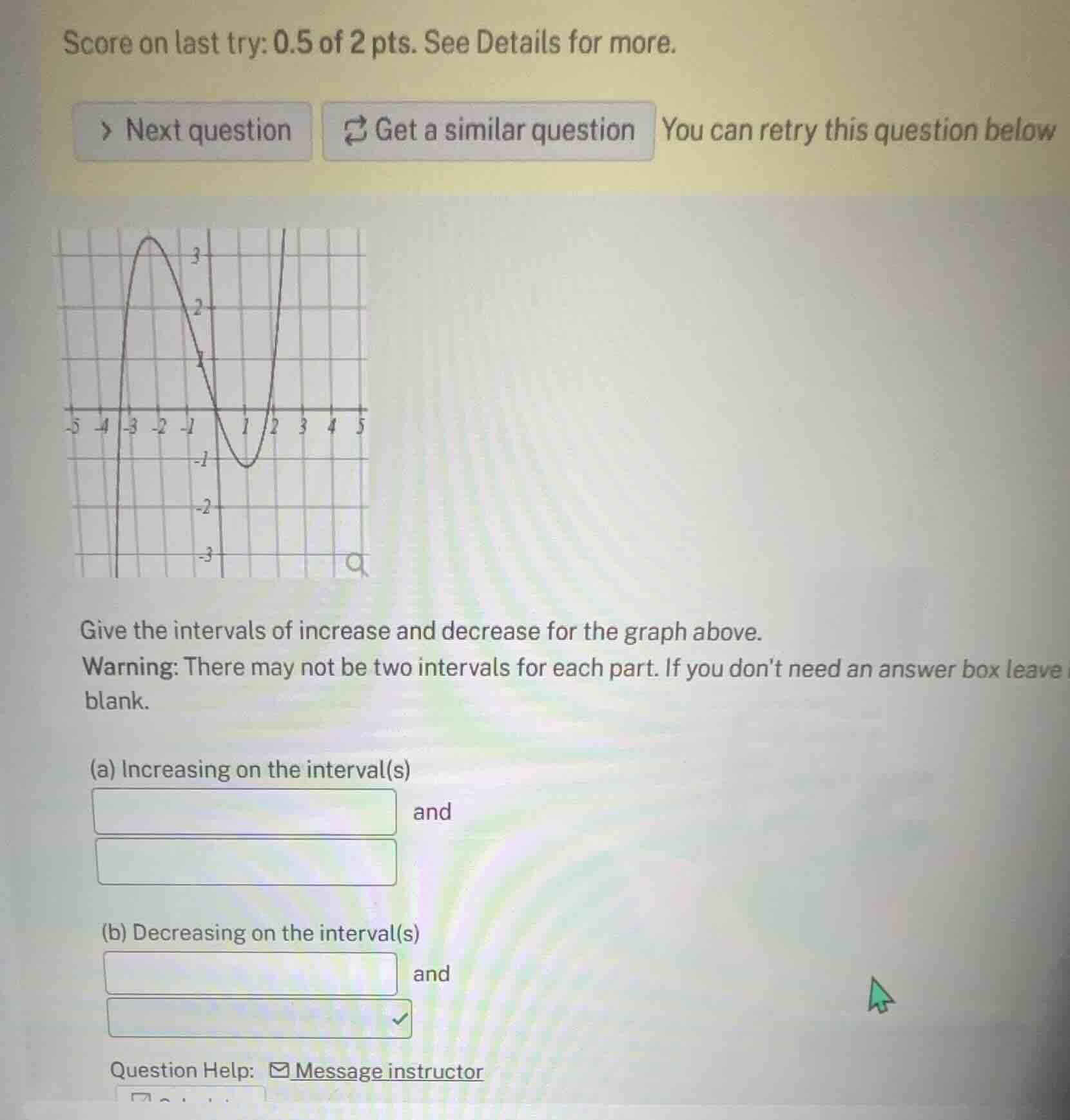
give the intervals of increase and decrease for the graph above.
warning: there may not be two intervals for each part. if you dont need an answer box leave blank.
(a) increasing on the interval(s)
and
(b) decreasing on the interval(s)
and
question help: message instructor
Step1: Analyze the graph's increasing intervals
A function is increasing when as \( x \) increases, \( y \) also increases. Looking at the graph, we observe the following:
- From \( x = -2 \) to \( x = 1 \)? Wait, no, let's re - examine. Wait, the left - most part: from \( x=-3 \) (the peak? Wait, no, the graph has a peak at \( x = - 2 \), then a valley at \( x = 1 \), and then increases again. Wait, actually, let's find the critical points. The graph has a local maximum at \( x=-2 \), a local minimum at \( x = 1 \). So, for increasing:
- To the left of \( x=-2 \), as \( x \) increases towards \( x=-2 \), the function increases? Wait, no. Wait, when \( x \) goes from \( - \infty \) (but in the graph, the domain shown is from - 5 to 5). Wait, looking at the graph, from \( x=-2 \) to \( x = 1 \), the function is decreasing? No, wait, let's look at the slope. When \( x \) increases from \( - 3 \) to \( - 2 \), the function goes up (increasing). Then from \( x=-2 \) to \( x = 1 \), the function goes down (decreasing). Then from \( x = 1 \) to \( x=\infty \) (in the graph, up to \( x = 5 \)), the function goes up (increasing). Wait, but in the graph, the left - hand side: the graph comes from below, rises to a peak at \( x=-2 \), then falls to a valley at \( x = 1 \), then rises again. So the increasing intervals are \( (-2,1) \)? No, wait, no. Wait, when \( x \) increases, if the function's \( y \) - value increases, it's increasing. So:
- From \( x=-3 \) to \( x=-2 \): as \( x \) increases from - 3 to - 2, \( y \) increases (so interval \( (-3,-2) \)? No, wait, the peak is at \( x=-2 \). Wait, maybe I made a mistake. Let's look at the x - axis. The graph has a root at \( x=-3 \), then rises to a maximum at \( x=-2 \), then falls, crosses the x - axis at \( x = 0 \), then falls to a minimum at \( x = 1 \), then rises, crossing the x - axis at \( x = 2 \), then rising. So:
- Increasing intervals: when the function's slope is positive. So from \( x=-2 \) to \( x = 1 \)? No, slope is negative there. Wait, no:
- From \( x=-\infty \) (in the graph, from \( x=-5 \) to \( x=-2 \)): as \( x \) increases from - 5 to - 2, the function is increasing (since it goes from a low point to the peak at \( x=-2 \)). Then from \( x = 1 \) to \( x = 5 \) (in the graph), the function is increasing (from the valley at \( x = 1 \) to the right - hand side). Wait, no, the valley is at \( x = 1 \), so after \( x = 1 \), as \( x \) increases, \( y \) increases. And before \( x=-2 \), as \( x \) increases towards \( x=-2 \), \( y \) increases. So the increasing intervals are \( (-2,1) \)? No, that's decreasing. Wait, I'm confused. Let's use the definition: a function \( f(x) \) is increasing on an interval \( (a,b) \) if for any \( x_1,x_2\in(a,b) \) with \( x_1
- Looking at the graph:
- From \( x=-2 \) to \( x = 1 \): if \( x_1=-2 \) and \( x_2 = 1 \), \( f(-2)>f(1) \), so it's decreasing.
- From \( x = 1 \) to \( x = 5 \): as \( x \) increases from 1 to 5, \( f(x) \) increases (so interval \( (1,+\infty) \), but in the graph, up to \( x = 5 \), so \( (1,5) \) or \( (1,\infty) \) in the domain shown).
- From \( x=-5 \) to \( x=-2 \): as \( x \) increases from - 5 to - 2, \( f(x) \) increases (since it goes from a lower value to the peak at \( x=-2 \)), so interval \( (-5,-2) \)? Wait, but the graph starts from below at \( x=-5 \), rises to \( x=-2 \). So the increasing intervals are \( (-2,1) \)? No, that's decreasing. Wait, I think I messed up the critical points. Let's re -…

Snap & solve any problem in the app
Get step-by-step solutions on Sovi AI
Photo-based solutions with guided steps
Explore more problems and detailed explanations
(a) Increasing on the interval(s) \((-\infty, - 2)\) and \((1,\infty)\) (or in the graph's visible domain, \((-5,-2)\) and \((1,5)\))
(b) Decreasing on the interval(s) \((-2,1)\)