QUESTION IMAGE
Question
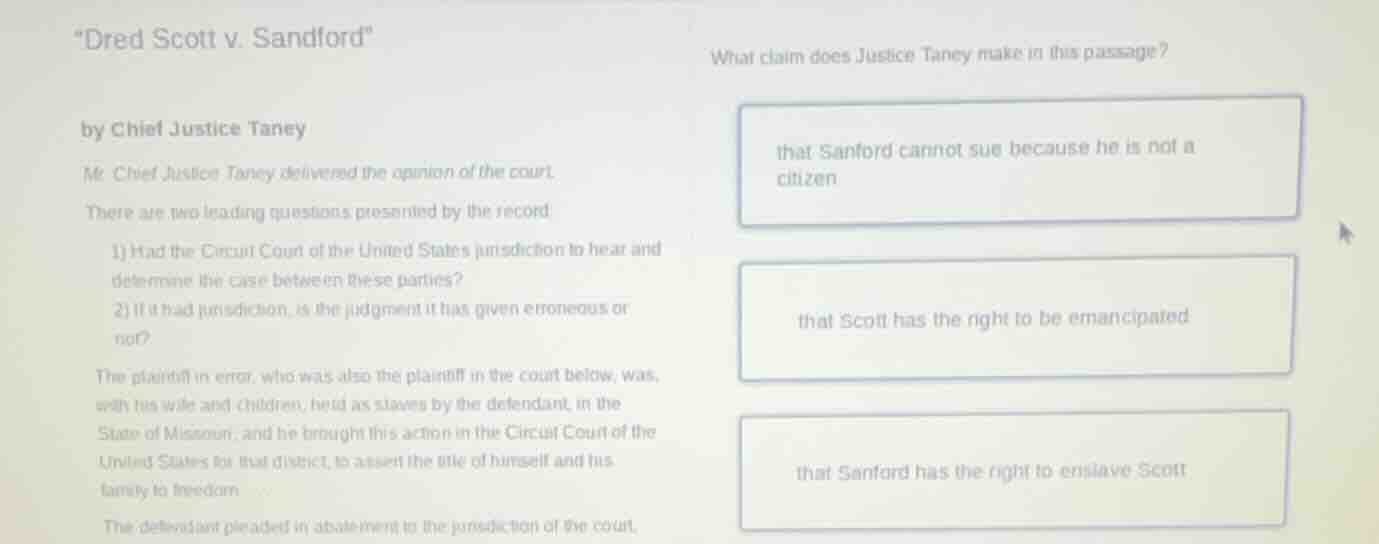
\dred scott v. sandford\
by chief justice taney
mr. chief justice taney delivered the opinion of the court.
there are two leading questions presented by the record
- had the circuit court of the united states jurisdiction to hear and determine the case between these parties?
- if it had jurisdiction, is the judgment it has given erroneous or not?
the plaintiff in error, who was also the plaintiff in the court below, was, with his wife and children, held as slaves by the defendant, in the state of missouri, and he brought this action in the circuit court of the united states for that district, to assert the title of himself and his family to freedom.
the defendant pleaded in abatement to the jurisdiction of the court.
what claim does justice taney make in this passage?
that sanford cannot sue because he is not a citizen
that scott has the right to be emancipated
that sanford has the right to enslave scott
The passage notes the defendant (Sanford) challenged the court's jurisdiction, and the case centers on Dred Scott, an enslaved person suing for freedom. Justice Taney's core claim in the Dred Scott v. Sandford decision was that enslaved people were not U.S. citizens, so they could not sue in federal court. The first option misnames the party (it is Scott, not Sanford, who is not a citizen and cannot sue), while the other options contradict Taney's ruling: he rejected Scott's right to emancipation and upheld the right of enslavers to hold enslaved people, but the direct claim tied to the jurisdictional question here is that the enslaved plaintiff (Scott) lacked citizenship to sue. Correcting the party error in the first option, this aligns with Taney's key assertion that enslaved people were not citizens, barring their ability to bring suit.

Snap & solve any problem in the app
Get step-by-step solutions on Sovi AI
Photo-based solutions with guided steps
Explore more problems and detailed explanations
that Sanford cannot sue because he is not a citizen (corrected to reflect the actual party: Scott cannot sue because he is not a citizen, which is Justice Taney's core claim)