QUESTION IMAGE
Question
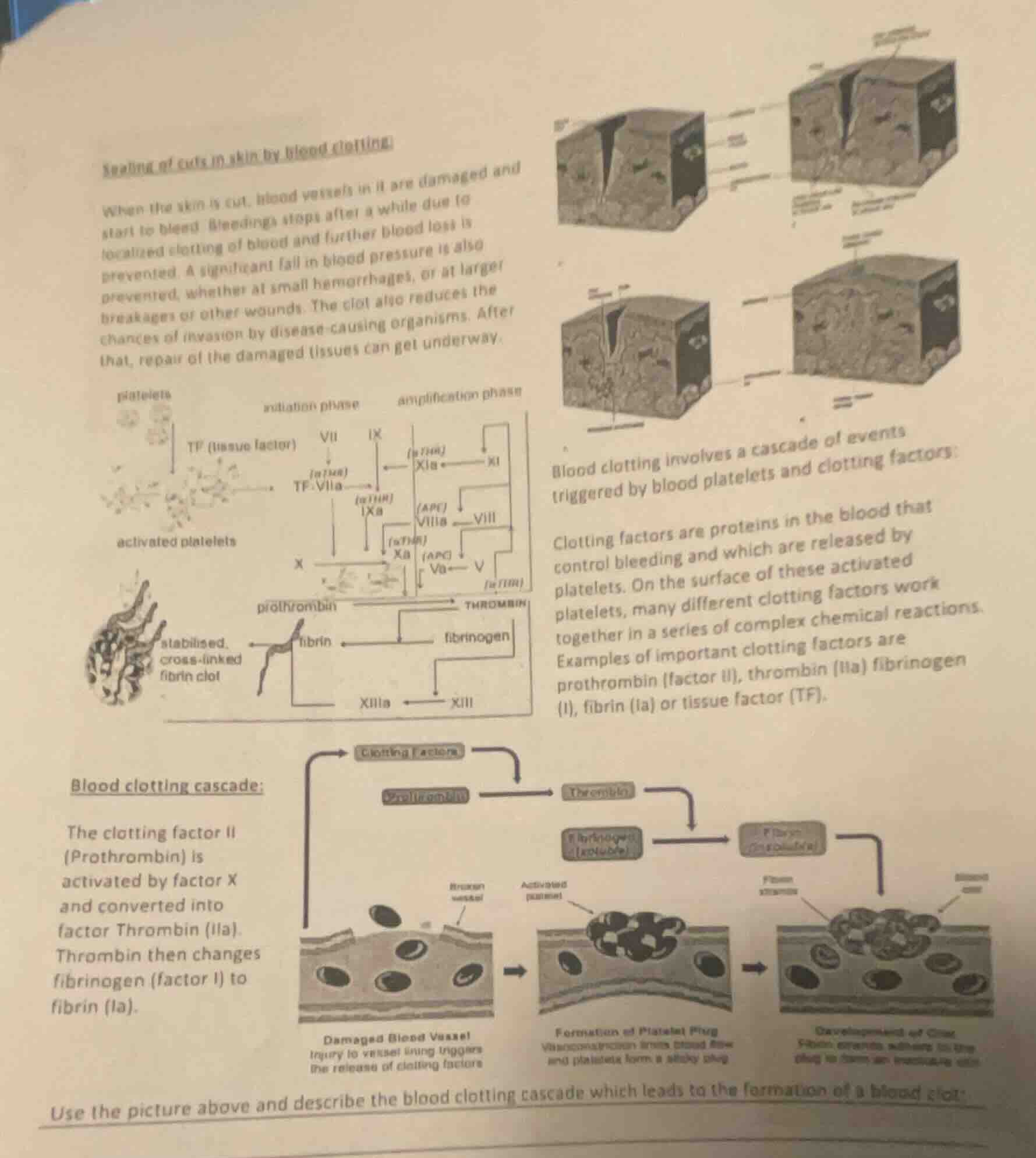
sealing of cuts in skin by blood clotting:when the skin is cut, blood vessels in it are damaged and start to bleed. bleeding stops after a while due to localized clotting of blood and further blood loss is prevented. a significant fall in blood pressure is also prevented, whether at small hemorrhages, or at larger breakages or other wounds. the clot also reduces the chances of invasion by disease-causing organisms. after that, repair of the damaged tissues can get underway.blood clotting involves a cascade of events triggered by blood platelets and clotting factors:clotting factors are proteins in the blood that control bleeding and which are released by platelets. on the surface of these activated platelets, many different clotting factors work together in a series of complex chemical reactions. examples of important clotting factors are prothrombin (factor ii), thrombin (iia) fibrinogen (i), fibrin (ia) or tissue factor (tf).blood clotting cascade:the clotting factor ii (prothrombin) is activated by factor x and converted into factor thrombin (iia). thrombin then changes fibrinogen (factor i) to fibrin (ia).use the picture above and describe the blood clotting cascade which leads to the formation of a blood clot:
- Initiation: Skin/blood vessel damage activates platelets and releases tissue factor (TF). TF combines with factor VII to form TF:VIIa, starting the clotting cascade.
- Amplification & Activation: TF:VIIa activates factors IX and X. Activated factor IX (IXa) further activates factor X, while activated factor X (Xa) combines with factor Va to form a complex.
- Prothrombin Conversion: The Xa-Va complex converts prothrombin (factor II) into thrombin (IIa).
- Fibrin Formation: Thrombin converts soluble fibrinogen (factor I) into insoluble fibrin strands.
- Clot Stabilization: Thrombin activates factor XIII to XIIIa, which cross-links fibrin strands into a stable mesh. This mesh traps platelets and blood cells to form a solid clot, stopping bleeding and enabling tissue repair.

Snap & solve any problem in the app
Get step-by-step solutions on Sovi AI
Photo-based solutions with guided steps
Explore more problems and detailed explanations
The blood clotting cascade proceeds as follows:
- Vessel/skin damage activates platelets and releases tissue factor (TF), which binds to factor VII to form TF:VIIa.
- TF:VIIa activates factors IX and X; IXa then amplifies activation of factor X, forming factor Xa.
- Factor Xa (with cofactor Va) converts prothrombin (factor II) into thrombin (IIa).
- Thrombin turns soluble fibrinogen (factor I) into insoluble fibrin strands.
- Thrombin activates factor XIII to XIIIa, which cross-links fibrin strands into a stable mesh. This mesh traps platelets and blood cells to form a solid, stable blood clot that stops bleeding and protects against infection, allowing tissue repair to begin.