QUESTION IMAGE
Question
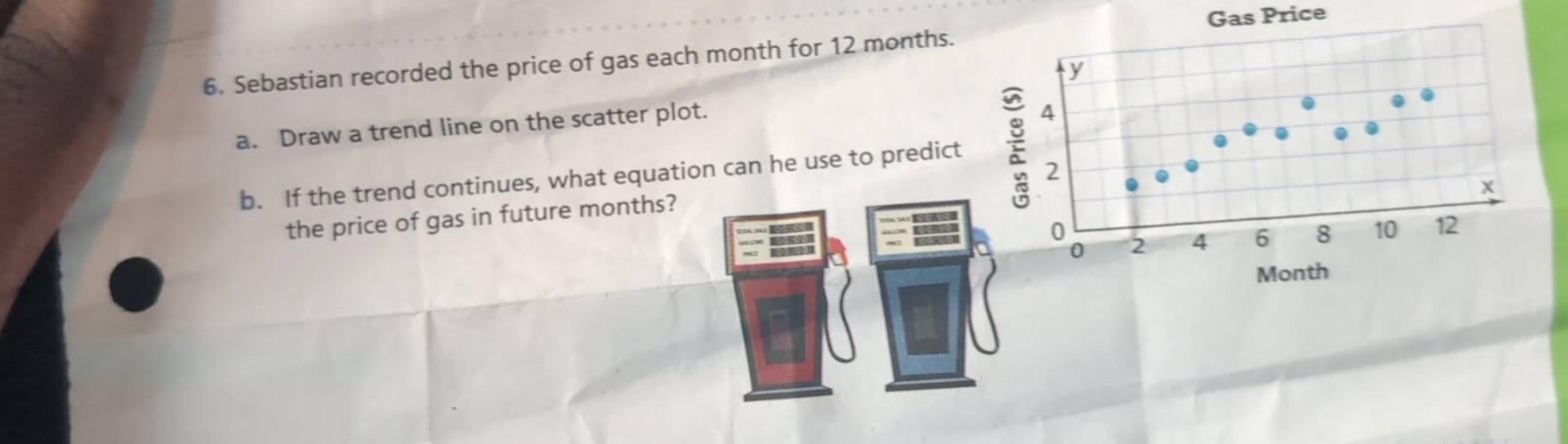
- sebastian recorded the price of gas each month for 12 months.
a. draw a trend line on the scatter plot.
b. if the trend continues, what equation can he use to predict the price of gas in future months?
Part (a)
To draw the trend line, we want to draw a line that best represents the general direction of the data points. We can visually estimate a line that passes through or near the middle of the cluster of points. For example, we can pick two points that seem to lie close to the trend. Let's assume we pick the points (2, 1.5) and (10, 4) (these are approximate from the scatter plot). Then we draw a straight line connecting these (and other similar) points.
Part (b)
Step 1: Find the slope ($m$)
The slope formula is $m=\frac{y_2 - y_1}{x_2 - x_1}$. Let's take two points on the trend line. Let's say $(x_1,y_1)=(2,1.5)$ and $(x_2,y_2)=(10,4)$.
So, $m=\frac{4 - 1.5}{10 - 2}=\frac{2.5}{8}= 0.3125\approx0.3$ (we can also use more accurate points or a better estimation). Alternatively, if we take $(2,1)$ and $(12,4)$: $m=\frac{4 - 1}{12 - 2}=\frac{3}{10} = 0.3$.
Step 2: Find the y - intercept ($b$)
We use the slope - intercept form of a line $y=mx + b$. Let's use the point $(2,1)$ (approximate from the plot) and $m = 0.3$.
Substitute $x = 2$, $y = 1$ and $m=0.3$ into $y=mx + b$:
$1=0.3\times2 + b$
$1 = 0.6 + b$
Subtract $0.6$ from both sides: $b=1 - 0.6=0.4$.
So the equation of the line (trend line) is $y = 0.3x+0.4$ (this is an approximation). If we use more accurate points, for example, if we take the first point as $(2,1.5)$ and the last point as $(12,4.5)$:
Slope $m=\frac{4.5 - 1.5}{12 - 2}=\frac{3}{10}=0.3$
Using $y=mx + b$ with $(2,1.5)$:
$1.5=0.3\times2 + b$
$1.5 = 0.6 + b$
$b=1.5 - 0.6 = 0.9$
Then the equation is $y=0.3x + 0.9$.
A more precise way: Let's list the approximate coordinates of the points. Let's assume the points are:
Month ($x$): 2, 3, 4, 5, 6, 7, 8, 9, 10, 11, 12
Gas Price ($y$): 1.5, 2, 2.5, 3, 3.5, 4, 3.5, 4, 4.5, 4.5, 5
We can use the method of least squares, but for a simple approximation, we can take two points. Let's take $(x_1,y_1)=(2,1.5)$ and $(x_2,y_2)=(12,5)$.
Slope $m=\frac{5 - 1.5}{12 - 2}=\frac{3.5}{10}=0.35$
Using $y=mx + b$ with $(2,1.5)$:
$1.5=0.35\times2 + b$
$1.5 = 0.7 + b$
$b=1.5 - 0.7 = 0.8$
So $y = 0.35x+0.8$
In general, the equation of the trend line will be in the form $y=mx + b$, where $m$ is the slope (rate of change of gas price per month) and $b$ is the y - intercept (initial price approximation). A reasonable approximation from the scatter plot is $y = 0.3x+0.5$ (or a similar linear equation based on the visual trend of the data points).
Final Answer (for part b)
An example of the equation is $\boldsymbol{y = 0.3x + 0.5}$ (the answer may vary slightly depending on the approximation of the trend line, but it should be a linear equation in the form $y=mx + b$ representing the trend of the gas price over months).

Snap & solve any problem in the app
Get step-by-step solutions on Sovi AI
Photo-based solutions with guided steps
Explore more problems and detailed explanations
Part (a)
To draw the trend line, we want to draw a line that best represents the general direction of the data points. We can visually estimate a line that passes through or near the middle of the cluster of points. For example, we can pick two points that seem to lie close to the trend. Let's assume we pick the points (2, 1.5) and (10, 4) (these are approximate from the scatter plot). Then we draw a straight line connecting these (and other similar) points.
Part (b)
Step 1: Find the slope ($m$)
The slope formula is $m=\frac{y_2 - y_1}{x_2 - x_1}$. Let's take two points on the trend line. Let's say $(x_1,y_1)=(2,1.5)$ and $(x_2,y_2)=(10,4)$.
So, $m=\frac{4 - 1.5}{10 - 2}=\frac{2.5}{8}= 0.3125\approx0.3$ (we can also use more accurate points or a better estimation). Alternatively, if we take $(2,1)$ and $(12,4)$: $m=\frac{4 - 1}{12 - 2}=\frac{3}{10} = 0.3$.
Step 2: Find the y - intercept ($b$)
We use the slope - intercept form of a line $y=mx + b$. Let's use the point $(2,1)$ (approximate from the plot) and $m = 0.3$.
Substitute $x = 2$, $y = 1$ and $m=0.3$ into $y=mx + b$:
$1=0.3\times2 + b$
$1 = 0.6 + b$
Subtract $0.6$ from both sides: $b=1 - 0.6=0.4$.
So the equation of the line (trend line) is $y = 0.3x+0.4$ (this is an approximation). If we use more accurate points, for example, if we take the first point as $(2,1.5)$ and the last point as $(12,4.5)$:
Slope $m=\frac{4.5 - 1.5}{12 - 2}=\frac{3}{10}=0.3$
Using $y=mx + b$ with $(2,1.5)$:
$1.5=0.3\times2 + b$
$1.5 = 0.6 + b$
$b=1.5 - 0.6 = 0.9$
Then the equation is $y=0.3x + 0.9$.
A more precise way: Let's list the approximate coordinates of the points. Let's assume the points are:
Month ($x$): 2, 3, 4, 5, 6, 7, 8, 9, 10, 11, 12
Gas Price ($y$): 1.5, 2, 2.5, 3, 3.5, 4, 3.5, 4, 4.5, 4.5, 5
We can use the method of least squares, but for a simple approximation, we can take two points. Let's take $(x_1,y_1)=(2,1.5)$ and $(x_2,y_2)=(12,5)$.
Slope $m=\frac{5 - 1.5}{12 - 2}=\frac{3.5}{10}=0.35$
Using $y=mx + b$ with $(2,1.5)$:
$1.5=0.35\times2 + b$
$1.5 = 0.7 + b$
$b=1.5 - 0.7 = 0.8$
So $y = 0.35x+0.8$
In general, the equation of the trend line will be in the form $y=mx + b$, where $m$ is the slope (rate of change of gas price per month) and $b$ is the y - intercept (initial price approximation). A reasonable approximation from the scatter plot is $y = 0.3x+0.5$ (or a similar linear equation based on the visual trend of the data points).
Final Answer (for part b)
An example of the equation is $\boldsymbol{y = 0.3x + 0.5}$ (the answer may vary slightly depending on the approximation of the trend line, but it should be a linear equation in the form $y=mx + b$ representing the trend of the gas price over months).