QUESTION IMAGE
Question
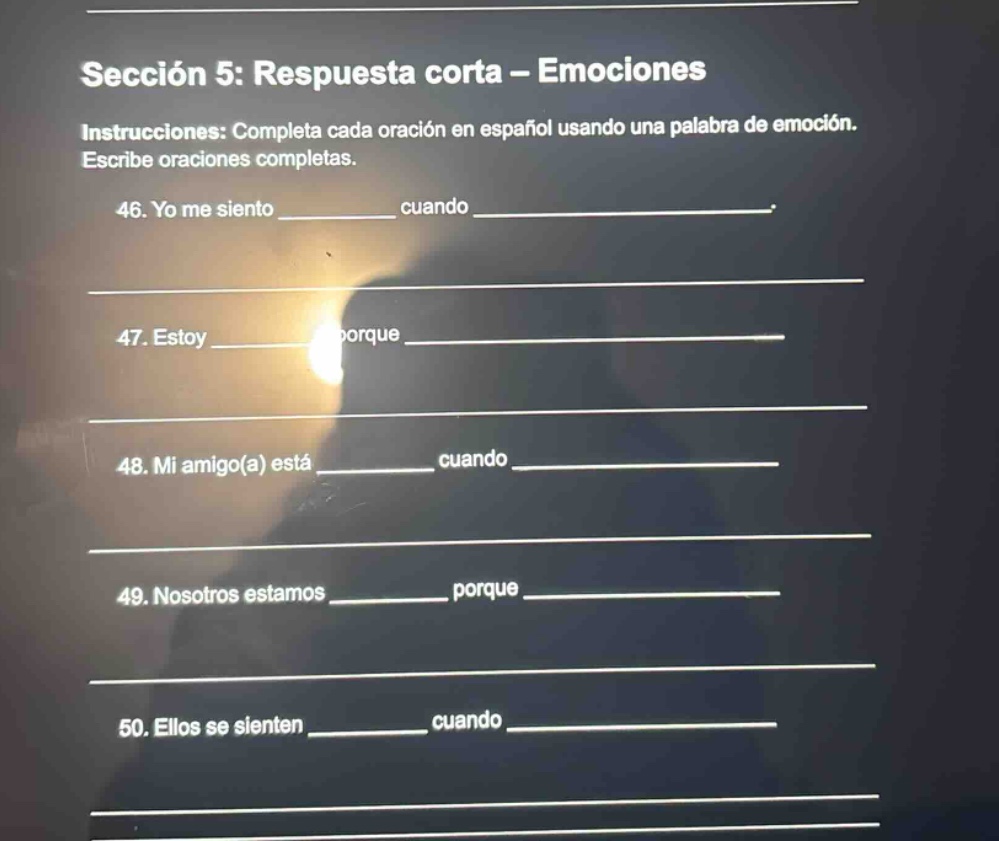
sección 5: respuesta corta – emociones
instrucciones: completa cada oración en español usando una palabra de emoción.
escribe oraciones completas.
- yo me siento ____ cuando ____.
- estoy ____ porque ____
- mi amigo(a) está ____ cuando ____
- nosotros estamos ____ porque ____
- ellos se sienten ____ cuando ____
To solve these short - answer questions about emotions in Spanish, we need to choose appropriate emotion words and context - related clauses. Here are some examples of how to complete each sentence:
Question 46
Step 1: Choose an emotion word
We can choose the emotion word "feliz" (happy).
Step 2: Provide a context clause
We can use "voy al parque" (I go to the park) as the context. So the completed sentence is: "Yo me siento feliz cuando voy al parque."
Question 47
Step 1: Choose an emotion word
Let's choose "triste" (sad).
Step 2: Provide a context clause
We can use "perdí mi juguete" (I lost my toy) as the context. So the completed sentence is: "Estoy triste porque perdí mi juguete."
Question 48
Step 1: Choose an emotion word
We choose "enojado(a)" (angry). For a female friend, we can use "enojada".
Step 2: Provide a context clause
We can use "su gato se escapó" (her cat ran away) as the context. So the completed sentence is: "Mi amiga está enojada cuando su gato se escapó."
Question 49
Step 1: Choose an emotion word
Let's choose "contentos" (happy, plural for "we").
Step 2: Provide a context clause
We can use "tenemos un día libre" (we have a free day) as the context. So the completed sentence is: "Nosotros estamos contentos porque tenemos un día libre."
Question 50
Step 1: Choose an emotion word
We choose "nerviosos" (nervous, plural for "they").
Step 2: Provide a context clause
We can use "tienen un examen" (they have an exam) as the context. So the completed sentence is: "Ellos se sienten nerviosos cuando tienen un examen."
These are just examples, and you can use other emotion words like "asustado(a)" (scared), "sorprendido(a)" (surprised), etc., and different context - related clauses according to your own ideas.
Final Answers (Examples)
- Yo me siento feliz cuando voy al parque.
- Estoy triste porque perdí mi juguete.
- Mi amiga está enojada cuando su gato se escapó.
- Nosotros estamos contentos porque tenemos un día libre.
- Ellos se sienten nerviosos cuando tienen un examen.

Snap & solve any problem in the app
Get step-by-step solutions on Sovi AI
Photo-based solutions with guided steps
Explore more problems and detailed explanations
To solve these short - answer questions about emotions in Spanish, we need to choose appropriate emotion words and context - related clauses. Here are some examples of how to complete each sentence:
Question 46
Step 1: Choose an emotion word
We can choose the emotion word "feliz" (happy).
Step 2: Provide a context clause
We can use "voy al parque" (I go to the park) as the context. So the completed sentence is: "Yo me siento feliz cuando voy al parque."
Question 47
Step 1: Choose an emotion word
Let's choose "triste" (sad).
Step 2: Provide a context clause
We can use "perdí mi juguete" (I lost my toy) as the context. So the completed sentence is: "Estoy triste porque perdí mi juguete."
Question 48
Step 1: Choose an emotion word
We choose "enojado(a)" (angry). For a female friend, we can use "enojada".
Step 2: Provide a context clause
We can use "su gato se escapó" (her cat ran away) as the context. So the completed sentence is: "Mi amiga está enojada cuando su gato se escapó."
Question 49
Step 1: Choose an emotion word
Let's choose "contentos" (happy, plural for "we").
Step 2: Provide a context clause
We can use "tenemos un día libre" (we have a free day) as the context. So the completed sentence is: "Nosotros estamos contentos porque tenemos un día libre."
Question 50
Step 1: Choose an emotion word
We choose "nerviosos" (nervous, plural for "they").
Step 2: Provide a context clause
We can use "tienen un examen" (they have an exam) as the context. So the completed sentence is: "Ellos se sienten nerviosos cuando tienen un examen."
These are just examples, and you can use other emotion words like "asustado(a)" (scared), "sorprendido(a)" (surprised), etc., and different context - related clauses according to your own ideas.
Final Answers (Examples)
- Yo me siento feliz cuando voy al parque.
- Estoy triste porque perdí mi juguete.
- Mi amiga está enojada cuando su gato se escapó.
- Nosotros estamos contentos porque tenemos un día libre.
- Ellos se sienten nerviosos cuando tienen un examen.