QUESTION IMAGE
Question
section 1 measuring motion (continued)
reading check
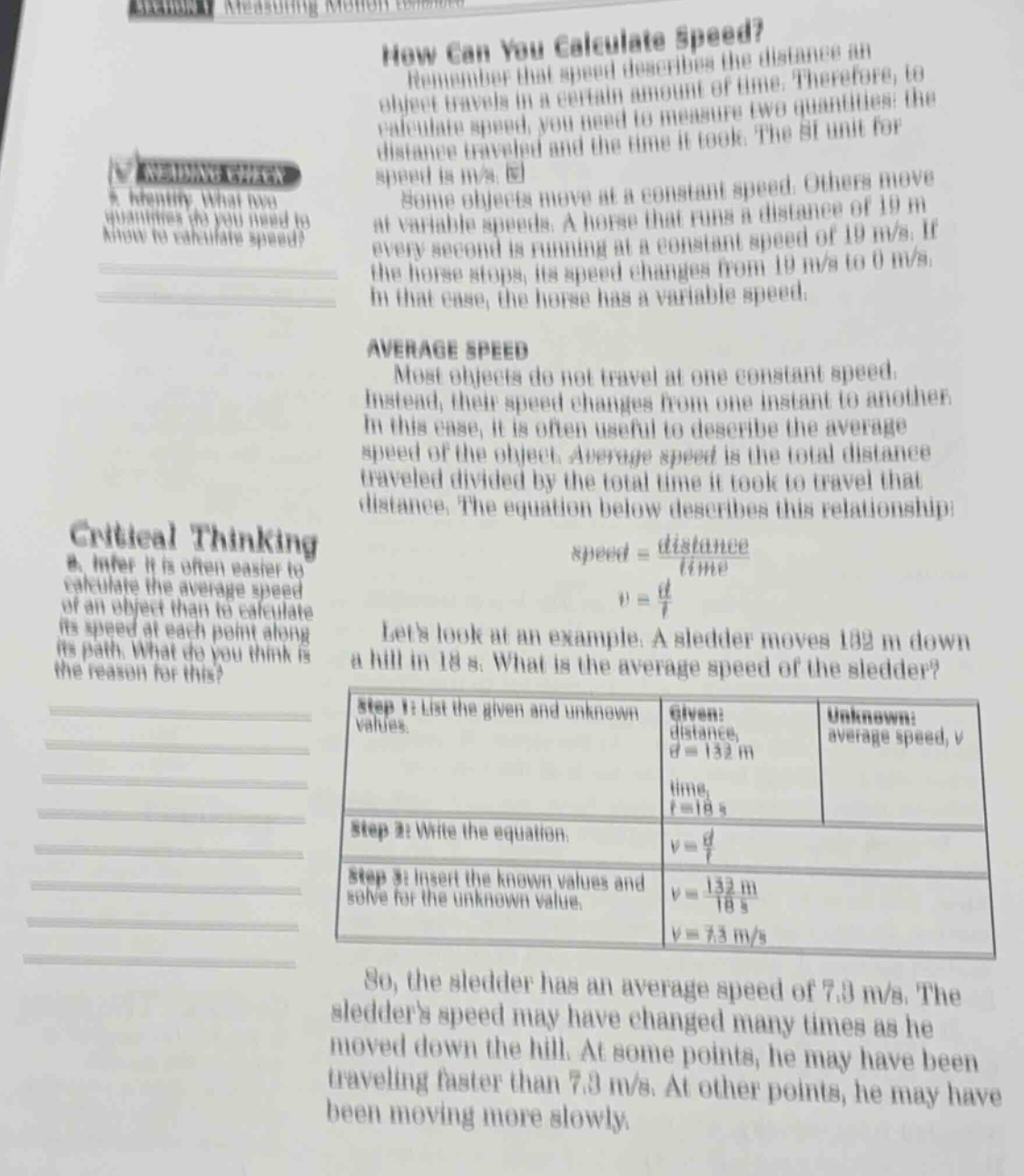
- identify what two quantities do you need to know to calculate speed?
critical thinking
- infer it is often easier to calculate the average speed of an object than to calculate its speed at each point along its path. what do you think is the reason for this?
how can you calculate speed?
remember that speed describes the distance an object travels in a certain amount of time. therefore, to calculate speed, you need to measure two quantities: the distance traveled and the time it took. the si unit for speed is m/s.
some objects move at a constant speed. others move at variable speeds. a horse that runs a distance of 19 m every second is running at a constant speed of 19 m/s. if the horse stops, its speed changes from 19 m/s to 0 m/s. in that case, the horse has a variable speed.
average speed
most objects do not travel at one constant speed. instead, their speed changes from one instant to another. in this case, it is often useful to describe the average speed of the object. average speed is the total distance traveled divided by the total time it took to travel that distance. the equation below describes this relationship:
\\( \text{speed} = \frac{\text{distance}}{\text{time}} \\)
\\( v = \frac{d}{t} \\)
let’s look at an example. a sledder moves 132 m down a hill in 18 s. what is the average speed of the sledder?
step 1: list the given and unknown values.
given:
distance, ( d = 132 \\, \text{m} )
time, ( t = 18 \\, \text{s} )
unknown:
average speed, ( v )
step 2: write the equation.
( v = \frac{d}{t} )
step 3: insert the known values and solve for the unknown value.
( v = \frac{132 \\, \text{m}}{18 \\, \text{s}} )
( v = 7.3 \\, \text{m/s} )
so, the sledder has an average speed of 7.3 m/s. the sledder’s speed may have changed many times as he moved down the hill. at some points, he may have been traveling faster than 7.3 m/s. at other points, he may have been moving more slowly.
Question 5:
To calculate speed, the formula is \( \text{speed} = \frac{\text{distance}}{\text{time}} \). From this formula, we can see that the two quantities needed are the distance an object travels and the time it takes to travel that distance. The text also explicitly states "to calculate speed, you need to measure two quantities: the distance traveled and the time it took".
Calculating speed at each point (instantaneous speed) requires knowing the exact distance covered and time taken at every single moment, which would involve measuring very small intervals of time and distance, making it highly precise and difficult. Average speed uses the total distance and total time, which are easier to measure (e.g., measuring the total length of a path and the total time from start to end) as they don't require tracking every moment's speed changes. Most objects don't move at a constant speed, so their speed varies continuously, making instantaneous speed measurement complex, while average speed simplifies by using overall distance and time.

Snap & solve any problem in the app
Get step-by-step solutions on Sovi AI
Photo-based solutions with guided steps
Explore more problems and detailed explanations
To calculate speed, you need to know the distance the object travels and the time it takes to travel that distance.