QUESTION IMAGE
Question
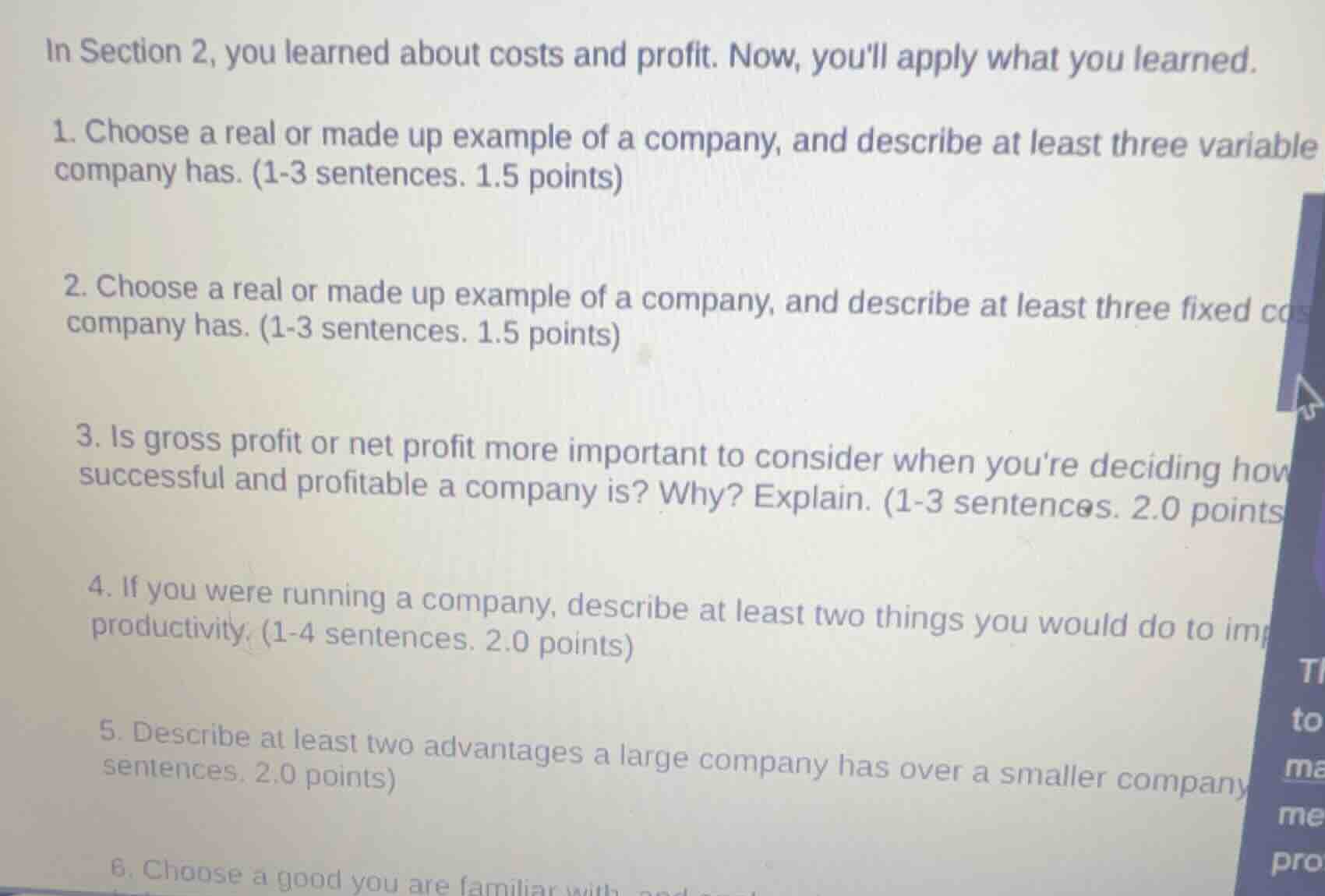
in section 2, you learned about costs and profit. now, youll apply what you learned.
- choose a real or made up example of a company, and describe at least three variable company has. (1-3 sentences. 1.5 points)
- choose a real or made up example of a company, and describe at least three fixed cos company has. (1-3 sentences. 1.5 points)
- is gross profit or net profit more important to consider when youre deciding how successful and profitable a company is? why? explain. (1-3 sentences. 2.0 points)
- if you were running a company, describe at least two things you would do to imp productivity. (1-4 sentences. 2.0 points)
- describe at least two advantages a large company has over a smaller company sentences. 2.0 points)
- choose a good you are familiar with
Brief Explanations
- For variable costs example: Uses a local bakery, lists costs tied to production volume.
- For fixed costs example: Uses the same bakery, lists costs unchanged by production.
- Explains net profit's role in measuring overall success.
- Lists two actionable productivity improvements for a company.
- Highlights key competitive advantages of large companies over small ones.

Snap & solve any problem in the app
Get step-by-step solutions on Sovi AI
Photo-based solutions with guided steps
Explore more problems and detailed explanations
- Let’s use a small local artisanal bakery as an example. Three variable costs for this business are: the cost of flour, sugar, and other raw baking ingredients (which rise with the number of pastries loaves made), hourly wages for part-time bakers brought in during busy periods, and the cost of disposable packaging for each sold item, which increases with sales volume.
- Using the same small local artisanal bakery, three fixed costs are: the monthly rent for the bakery storefront, which stays the same no matter how many items are baked, the annual insurance premium for the shop and equipment, and the monthly payment for the commercial oven lease, which does not fluctuate with production levels.
- Net profit is more important for judging a company’s overall success and profitability. Gross profit only accounts for revenue minus direct production costs, but net profit subtracts all expenses (including overhead, taxes, and interest) to show the actual amount of money the company keeps after all obligations, giving a full picture of financial health.
- If running a company, I would first implement a task management software to streamline workflow, assign clear deadlines, and reduce time wasted on miscommunication. I would also offer targeted training programs for employees to improve their skills, which would help them complete tasks more efficiently and reduce errors.
- Large companies have greater purchasing power, allowing them to negotiate lower prices for raw materials or inventory in bulk, which reduces their per-unit costs compared to small businesses. They also have easier access to capital through loans, stock offerings, or retained earnings, which lets them invest in research, expansion, or new technology that small companies often cannot afford.