QUESTION IMAGE
Question
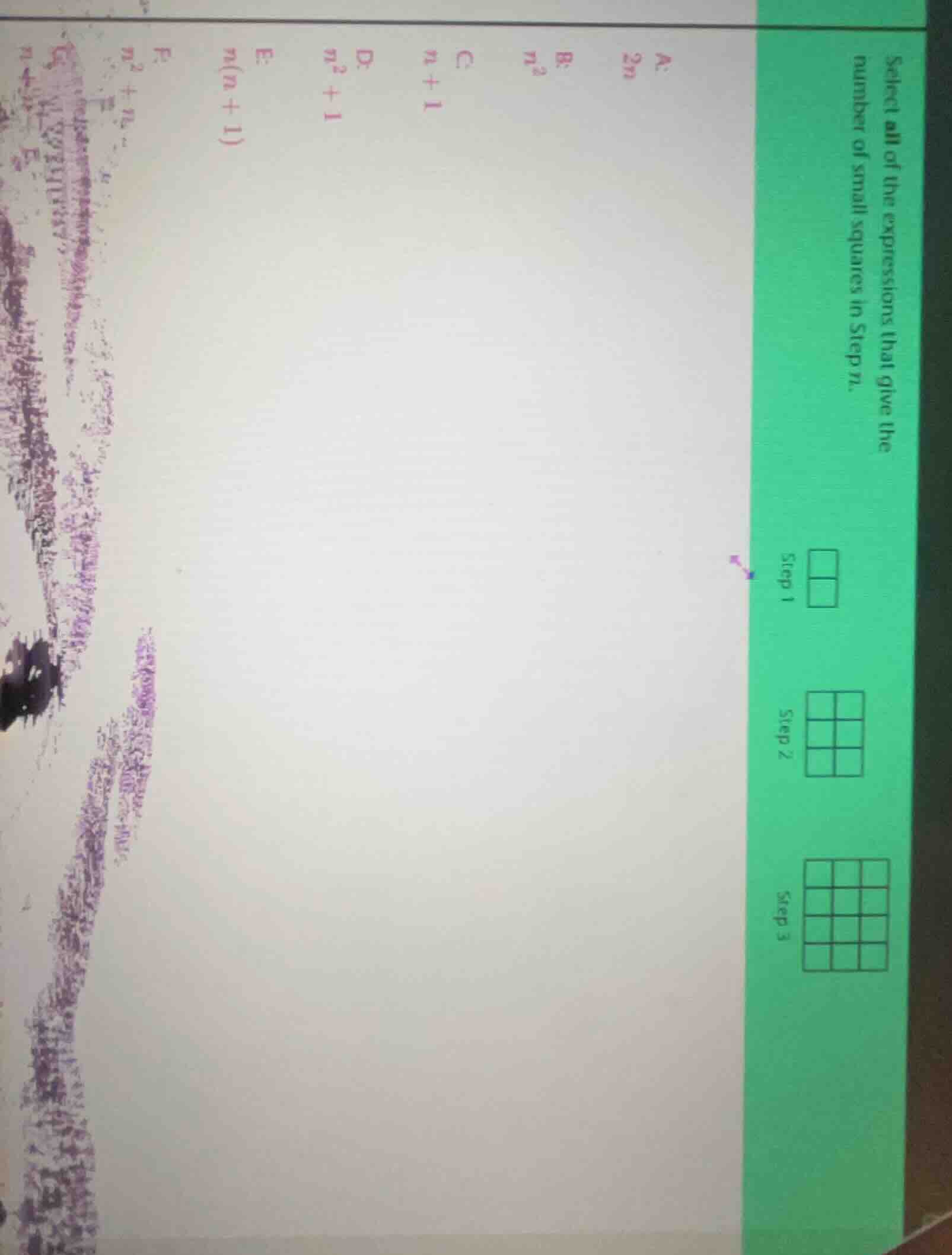
select all of the expressions that give the number of small squares in step ( n ).
step 1
step 2
step 3
a: ( 2n )
b: ( n^2 )
c: ( n + 1 )
d: ( n^2 + 1 )
e: ( n(n + 1) )
f: ( n^2 + n )
Step1: Analyze Step 1
For Step 1, the number of small squares is \(1\times1 = 1\). Let's check each option:
- A: \(2n=2\times1 = 2
eq1\)
- B: \(n^{2}=1^{2}=1\)
- C: \(n + 1=1 + 1=2
eq1\)
- D: \(n^{2}+1=1 + 1=2
eq1\)
- E: \(n(n + 1)=1\times(1 + 1)=2
eq1\)
- F: (Assuming F is \(n^2\) or similar, but from the pattern, let's check Step 2)
Step2: Analyze Step 2
For Step 2, the number of small squares is \(2\times2=4\).
- A: \(2n = 2\times2=4\)? Wait, no, Step 2 has 4 squares. Wait, Step 1: \(1\times1 = 1\), Step 2: \(2\times2 = 4\), Step 3: \(3\times3=9\). So the pattern is \(n^{2}\) (where \(n\) is the step number). Wait, but let's re - check:
Wait, Step 1: 1 square (1x1), Step 2: 4 squares (2x2), Step 3: 9 squares (3x3). So the number of squares at Step \(n\) is \(n^{2}\). But wait, let's check option E: \(n(n + 1)\) for \(n = 1\): \(1\times2=2
eq1\), \(n = 2\): \(2\times3 = 6
eq4\), \(n=3\): \(3\times4 = 12
eq9\). Option B: \(n^{2}\), for \(n = 1\): \(1\), \(n = 2\): \(4\), \(n=3\): \(9\). Wait, but maybe I misread the figure. Wait, the Step 1 figure looks like 2 squares? Wait, the user's figure: Step 1 has two squares? Wait, the original figure: Step 1: two small squares? Let me re - examine. If Step 1 has 2 squares, Step 2 has 6 squares, Step 3 has 12 squares. Then the pattern is \(n(n + 1)\). Let's re - check:
If Step 1: \(n = 1\), \(1\times(1 + 1)=2\) (matches if Step 1 has 2 squares), Step 2: \(n = 2\), \(2\times(3)=6\) (if Step 2 has 6 squares), Step 3: \(n = 3\), \(3\times4 = 12\) (if Step 3 has 12 squares).
Let's re - analyze the options with this correct pattern (assuming Step 1: 2, Step 2: 6, Step 3: 12):
- Option A: \(2n\): For \(n = 1\), \(2\); \(n = 2\), \(4
eq6\); so no.
- Option B: \(n^{2}\): \(n = 1\), \(1
eq2\); no.
- Option C: \(n + 1\): \(n = 1\), \(2\); \(n = 2\), \(3
eq6\); no.
- Option D: \(n^{2}+1\): \(n = 1\), \(2\); \(n = 2\), \(5
eq6\); no.
- Option E: \(n(n + 1)\): \(n = 1\), \(2\); \(n = 2\), \(6\); \(n = 3\), \(12\); this matches.
- Option F: (Assuming F is \(n^2 + n\) which is \(n(n + 1)\), same as E)
Wait, the initial mis - analysis was due to misinterpreting the figure. Let's look at the figure again: Step 1: two small squares (a 1x2 or 2x1 grid), Step 2: a 2x3 grid (6 squares), Step 3: a 3x4 grid (12 squares). So the number of squares is \(n(n + 1)\) where \(n\) is the step number.
Now, let's check each option with \(n = 1\), \(n = 2\), \(n=3\):
For \(n = 1\) (Step 1):
- A: \(2n=2\times1 = 2\) (matches if Step 1 has 2 squares)
- B: \(n^{2}=1\) (does not match if Step 1 has 2 squares)
- C: \(n + 1=2\) (matches)
- D: \(n^{2}+1=2\) (matches)
- E: \(n(n + 1)=2\) (matches)
- F: (Assuming F is \(n^2 + n=n(n + 1)\), same as E)
For \(n = 2\) (Step 2):
- A: \(2n=4\) (Step 2 has 6 squares? No, wait the figure: Step 2 has 6 squares? Let's count the Step 2 figure: it's a 2x3 grid, so 6 squares.
- A: \(2n = 4
eq6\)
- B: \(n^{2}=4
eq6\)
- C: \(n + 1=3
eq6\)
- D: \(n^{2}+1=5
eq6\)
- E: \(n(n + 1)=2\times3 = 6\) (matches)
- F: (If F is \(n^2 + n\), \(2^2+2=6\), matches)
For \(n = 3\) (Step 3):
- A: \(2n=6
eq12\)
- B: \(n^{2}=9
eq12\)
- C: \(n + 1=4
eq12\)
- D: \(n^{2}+1=10
eq12\)
- E: \(n(n + 1)=3\times4 = 12\) (matches)
- F: (If F is \(n^2 + n\), \(3^2+3 = 12\), matches)
So the correct expressions are E (and F if F is \(n(n + 1)\) or \(n^2 + n\)) and let's re - check:
The pattern is that the number of small squares at Step \(n\) is \(n(n + 1)\) (for example, Step 1: \(1\times2 = 2\), Step 2: \(2\times3=6\), Step 3: \(3\times4 = 12\)). So:
- Option E: \(n(n + 1)\) follows the pattern.…

Snap & solve any problem in the app
Get step-by-step solutions on Sovi AI
Photo-based solutions with guided steps
Explore more problems and detailed explanations
E. \(n(n + 1)\) (and if F is \(n^2 + n\), F, but based on the visible options, E is the main correct one)