QUESTION IMAGE
Question
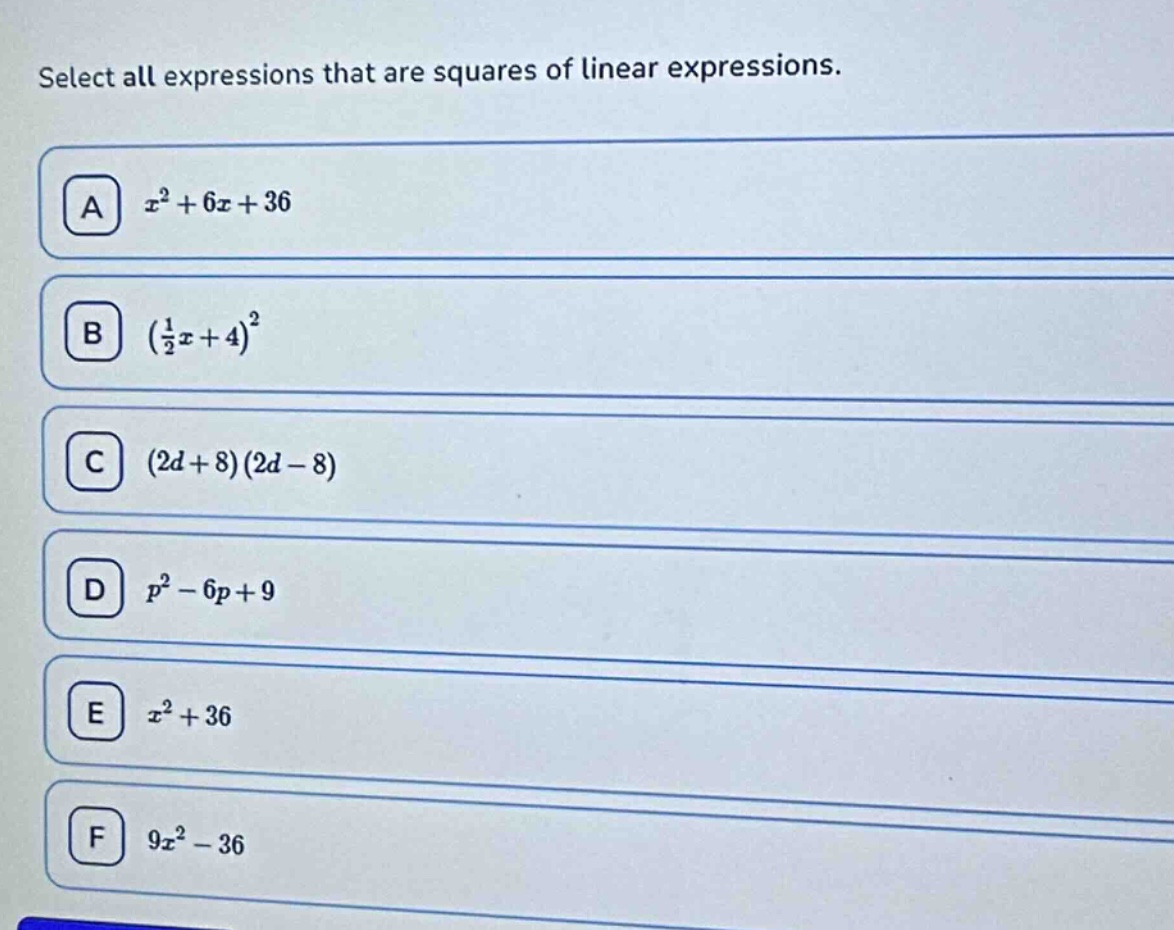
select all expressions that are squares of linear expressions. a $x^2 + 6x + 36$ b $left(\frac{1}{2}x + 4\
ight)^2$ c $(2d + 8)(2d - 8)$ d $p^2 - 6p + 9$ e $x^2 + 36$ f $9x^2 - 36$
Step1: Recall square of linear form
A square of a linear expression follows the perfect square trinomial pattern: $(ax+b)^2 = a^2x^2 + 2abx + b^2$, or $(ax-b)^2 = a^2x^2 - 2abx + b^2$. It can also be written directly as a squared linear term.
Step2: Analyze Option A
Check if $x^2+6x+36$ fits the pattern. For $x^2+6x+b^2$, $2ab=6$ (here $a=1$), so $b=3$, $b^2=9
eq36$. Not a perfect square.
Step3: Analyze Option B
$(\frac{1}{2}x+4)^2$ is explicitly written as the square of the linear expression $\frac{1}{2}x+4$. This qualifies.
Step4: Analyze Option C
Expand $(2d+8)(2d-8) = 4d^2 - 64$, which is a difference of squares, not a perfect square trinomial. Not a square of a linear expression.
Step5: Analyze Option D
Check $p^2-6p+9$. Here $a=1$, $2ab=6\Rightarrow b=3$, $b^2=9$. This matches $(p-3)^2$, the square of linear expression $p-3$. Qualifies.
Step6: Analyze Option E
$x^2+36$ is a sum of squares, it cannot be written as $(ax+b)^2$ (since that would require a middle linear term). Not a square of a linear expression.
Step7: Analyze Option F
$9x^2-36=9(x^2-4)$, which is a difference of squares, not a perfect square trinomial. Not a square of a linear expression.

Snap & solve any problem in the app
Get step-by-step solutions on Sovi AI
Photo-based solutions with guided steps
Explore more problems and detailed explanations
B. $(\frac{1}{2}x + 4)^2$
D. $p^2 - 6p + 9$