QUESTION IMAGE
Question
a.
b.
c.
d.
e.
f.
g.
h.
i.
j.
k.
l.
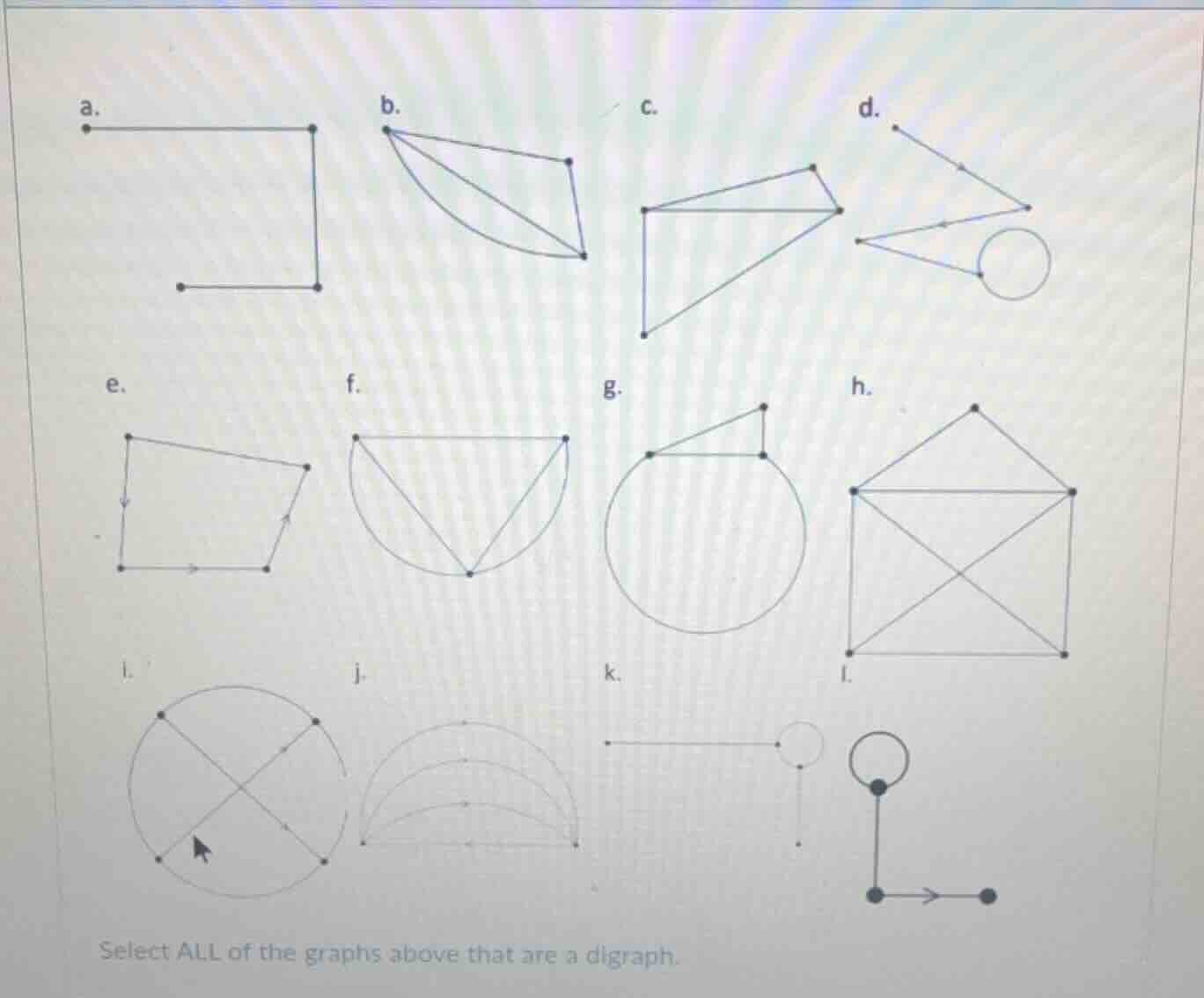
select all of the graphs above that are a digraph.
To determine which graphs are digraphs, we recall that a digraph (directed graph) is a graph where edges have a direction (represented by arrows). We analyze each graph:
Step 1: Analyze Graph a
Graph a has undirected edges (no arrows), so it is not a digraph.
Step 2: Analyze Graph b
Graph b has a curved edge and undirected straight edges, no arrows, so not a digraph.
Step 3: Analyze Graph c
Graph c has undirected edges, no arrows, so not a digraph.
Step 4: Analyze Graph d
Graph d has directed edges (arrows on the edges), so it is a digraph.
Step 5: Analyze Graph e
Graph e has directed edges (arrows on the edges), so it is a digraph.
Step 6: Analyze Graph f
Graph f has undirected edges (no arrows), so not a digraph.
Step 7: Analyze Graph g
Graph g has undirected edges, no arrows, so not a digraph.
Step 8: Analyze Graph h
Graph h has undirected edges, no arrows, so not a digraph.
Step 9: Analyze Graph i
Graph i has undirected edges (the cross is undirected), no arrows, so not a digraph.
Step 10: Analyze Graph j
Graph j has undirected edges (curved, no arrows), so not a digraph.
Step 11: Analyze Graph k
Graph k has a directed edge (arrow on the horizontal edge) and a directed edge (arrow on the vertical edge), so it is a digraph.
Step 12: Analyze Graph l
Graph l has a directed edge (arrow on the bottom edge) and other edges with direction implied by the arrow and the loop, so it is a digraph.

Snap & solve any problem in the app
Get step-by-step solutions on Sovi AI
Photo-based solutions with guided steps
Explore more problems and detailed explanations
d. (directed edges), e. (directed edges), k. (directed edges), l. (directed edges)
So the digraphs are d, e, k, l.