QUESTION IMAGE
Question
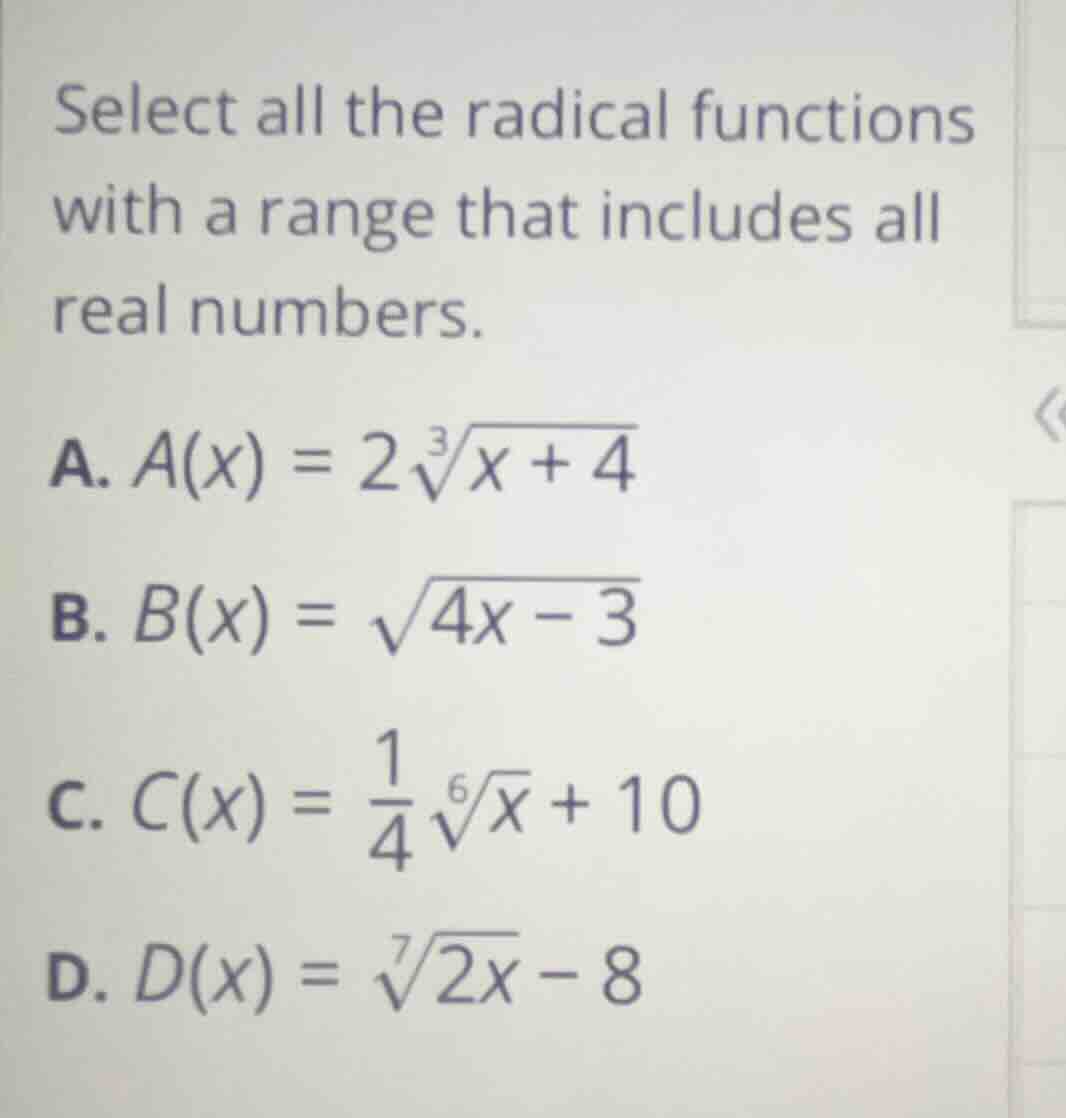
select all the radical functions with a range that includes all real numbers. a. $a(x) = 2sqrt3{x + 4}$ b. $b(x) = sqrt{4x - 3}$ c. $c(x) = \frac{1}{4}sqrt6{x} + 10$ d. $d(x) = sqrt7{2x} - 8$
Step1: Recall the range of radical functions
For an \(n\)-th root function \(\sqrt[n]{u}\), if \(n\) is odd, the range is all real numbers because we can take the odd root of any real number (positive, negative, or zero). If \(n\) is even, the range is \(y\geq0\) (or restricted by transformations) because the even root of a negative number is not a real number, so the radicand must be non - negative and the result of the even root is non - negative.
Step2: Analyze option A
The function \(A(x)=2\sqrt[3]{x + 4}\) has a cube root (\(n = 3\), which is odd). The cube root of any real number \(x+4\) (since \(x\) can be any real number, \(x + 4\) can be any real number) is a real number. Then we multiply it by 2, which is a vertical stretch. The range of \(\sqrt[3]{u}\) (where \(u=x + 4\)) is all real numbers, and multiplying by 2 and adding 0 (there is no vertical shift other than the transformation of the cube root) still gives a range of all real numbers. So the range of \(A(x)\) is all real numbers.
Step3: Analyze option B
The function \(B(x)=\sqrt{4x-3}\) has a square root (\(n = 2\), which is even). The radicand \(4x-3\) must be non - negative (\(4x-3\geq0\)), and the square root of a non - negative number is non - negative. So the range of \(B(x)\) is \(y\geq0\), which does not include all real numbers (for example, \(y=- 1\) is not in the range).
Step4: Analyze option C
The function \(C(x)=\frac{1}{4}\sqrt[6]{x}+10\) has a sixth root (\(n = 6\), which is even). The radicand \(x\) must be non - negative (\(x\geq0\)) because we can't take the sixth root of a negative number in the real number system. The sixth root of a non - negative number is non - negative, so \(\sqrt[6]{x}\geq0\). Then \(\frac{1}{4}\sqrt[6]{x}\geq0\), and \(\frac{1}{4}\sqrt[6]{x}+10\geq10\). So the range is \(y\geq10\), which does not include all real numbers.
Step5: Analyze option D
The function \(D(x)=\sqrt[7]{2x}-8\) has a seventh root (\(n = 7\), which is odd). The radicand \(2x\) can be any real number (since \(x\) can be any real number, \(2x\) can be any real number). The seventh root of any real number \(2x\) is a real number. Then we subtract 8, which is a vertical shift. The range of \(\sqrt[7]{u}\) (where \(u = 2x\)) is all real numbers, and subtracting 8 (a vertical shift) still gives a range of all real numbers. So the range of \(D(x)\) is all real numbers.

Snap & solve any problem in the app
Get step-by-step solutions on Sovi AI
Photo-based solutions with guided steps
Explore more problems and detailed explanations
A. \(A(x)=2\sqrt[3]{x + 4}\), D. \(D(x)=\sqrt[7]{2x}-8\)