QUESTION IMAGE
Question
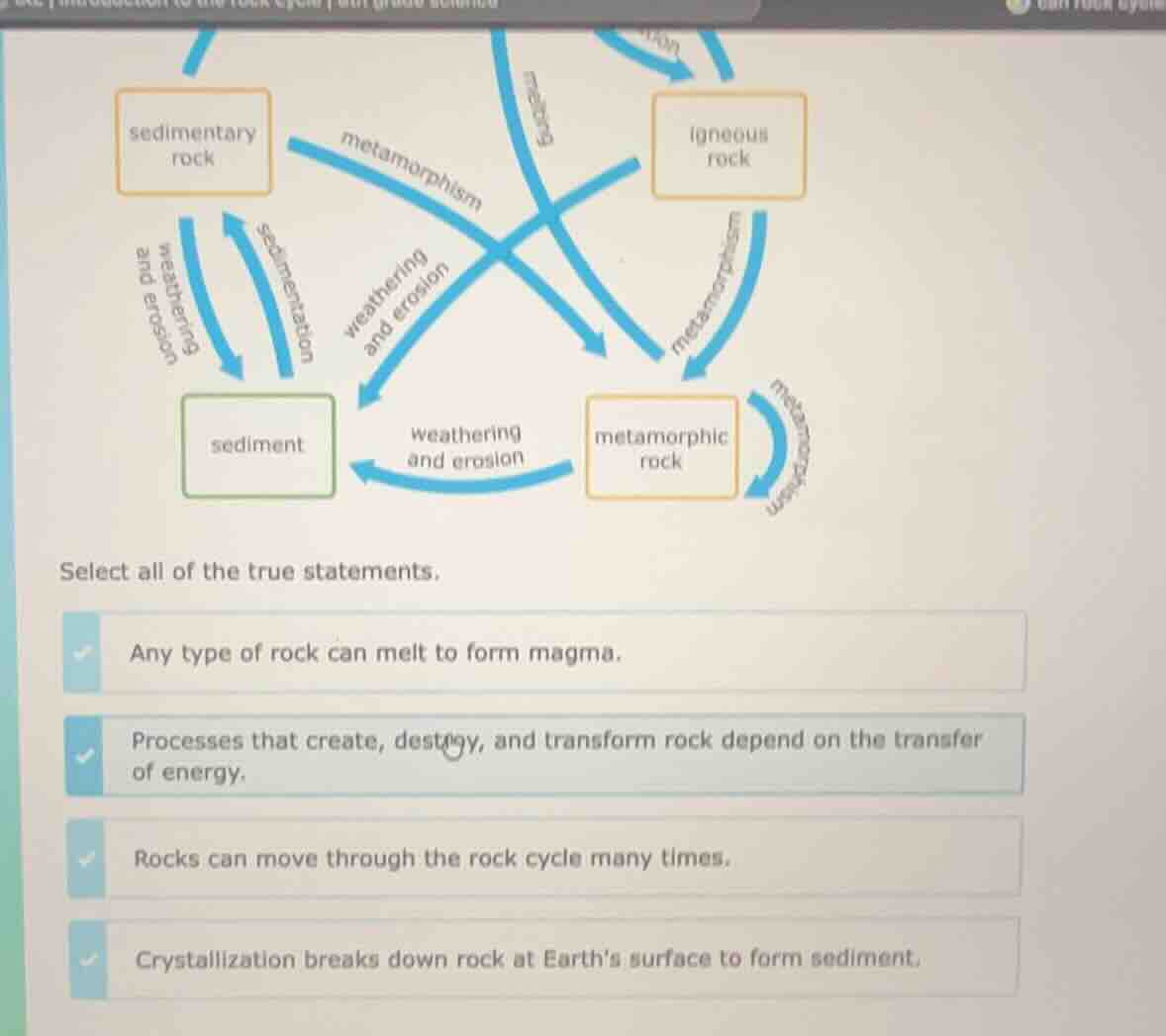
select all of the true statements. any type of rock can melt to form magma. processes that create, destroy, and transform rock depend on the transfer of energy. rocks can move through the rock cycle many times. crystallization breaks down rock at earth’s surface to form sediment.
To determine the true statements, we analyze each one using rock cycle concepts:
- "Any type of rock can melt to form magma."
In the rock cycle, igneous, sedimentary, and metamorphic rocks can all be subjected to high heat (e.g., in Earth’s mantle) and melt into magma. This is consistent with the rock cycle’s processes.
- "Processes that create, destroy, and transform rock depend on the transfer of energy."
Rock cycle processes (e.g., weathering, metamorphism, melting, crystallization) rely on energy transfers (e.g., heat from Earth’s interior, kinetic energy from erosion, solar energy for weathering). Energy drives these changes.
- "Rocks can move through the rock cycle many times."
The rock cycle is a continuous, cyclic process. A sedimentary rock can become metamorphic, then melt into magma, crystallize into igneous, and repeat—there’s no fixed "end" to the cycle.
- "Crystallization breaks down rock at Earth’s surface to form sediment."
Crystallization is the process of magma cooling to form igneous rock (e.g., lava cooling into basalt). Weathering and erosion (not crystallization) break down rock at the surface to form sediment. Thus, this statement is false.

Snap & solve any problem in the app
Get step-by-step solutions on Sovi AI
Photo-based solutions with guided steps
Explore more problems and detailed explanations
A. Any type of rock can melt to form magma
B. Processes that create, destroy, and transform rock depend on the transfer of energy
C. Rocks can move through the rock cycle many times