QUESTION IMAGE
Question
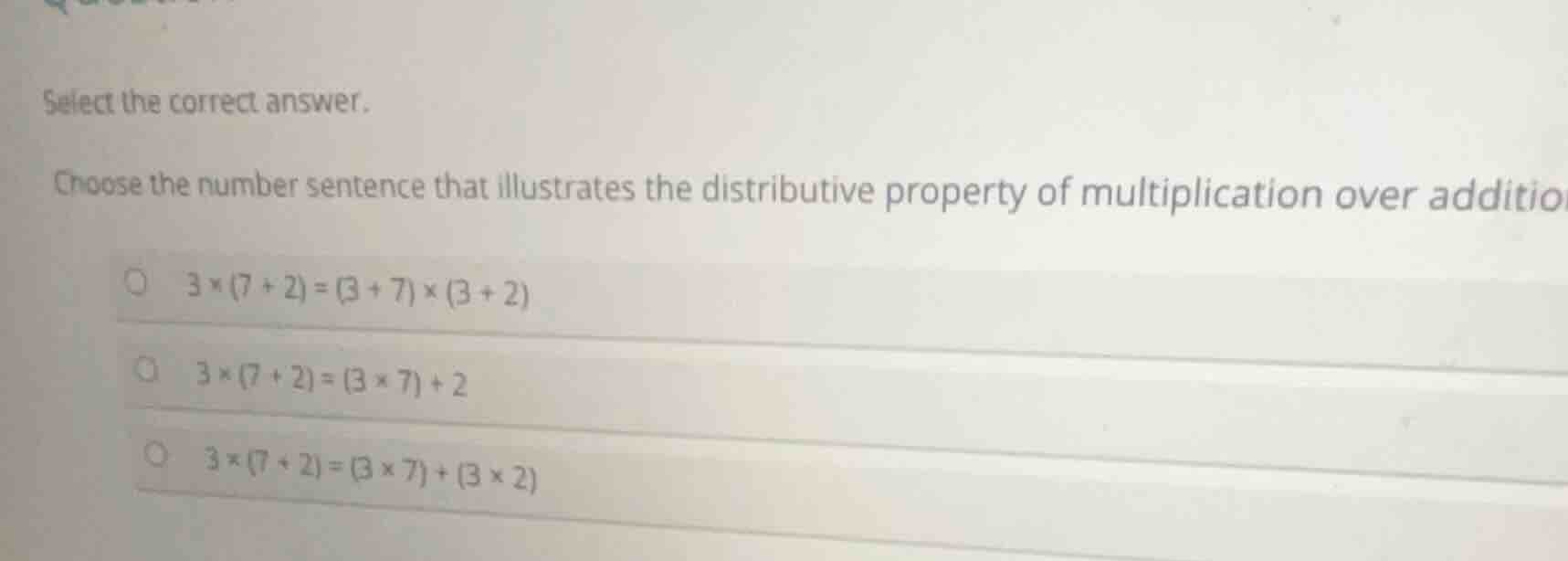
select the correct answer. choose the number sentence that illustrates the distributive property of multiplication over addition. \\(\bigcirc\\ 3 \times (7 + 2) = (3 + 7) \times (3 + 2)\\) \\(\bigcirc\\ 3 \times (7 + 2) = (3 \times 7) + 2\\) \\(\bigcirc\\ 3 \times (7 + 2) = (3 \times 7) + (3 \times 2)\\)
Step1: Recall Distributive Property
The distributive property of multiplication over addition states that \( a \times (b + c) = (a \times b) + (a \times c) \) for any real numbers \( a \), \( b \), and \( c \).
Step2: Analyze Each Option
- First Option: \( 3 \times (7 + 2) = (3 + 7) \times (3 + 2) \)
This does not follow the distributive property. The right - hand side is expanding in a non - distributive way (it's using a wrong expansion for the product of a number and a sum).
- Second Option: \( 3 \times (7 + 2)=(3\times7)+2 \)
Here, the 2 is not multiplied by 3 as required by the distributive property. The correct expansion should multiply 3 with both 7 and 2 and then add the results.
- Third Option: \( 3 \times (7 + 2)=(3\times7)+(3\times2) \)
This follows the distributive property \( a\times(b + c)=(a\times b)+(a\times c) \) where \( a = 3 \), \( b = 7 \) and \( c = 2 \).

Snap & solve any problem in the app
Get step-by-step solutions on Sovi AI
Photo-based solutions with guided steps
Explore more problems and detailed explanations
\( 3 \times (7 + 2)=(3\times7)+(3\times2) \) (the third option)