QUESTION IMAGE
Question
select the correct answer from each drop - down menu.
complete the passage about orbital eccentricity.
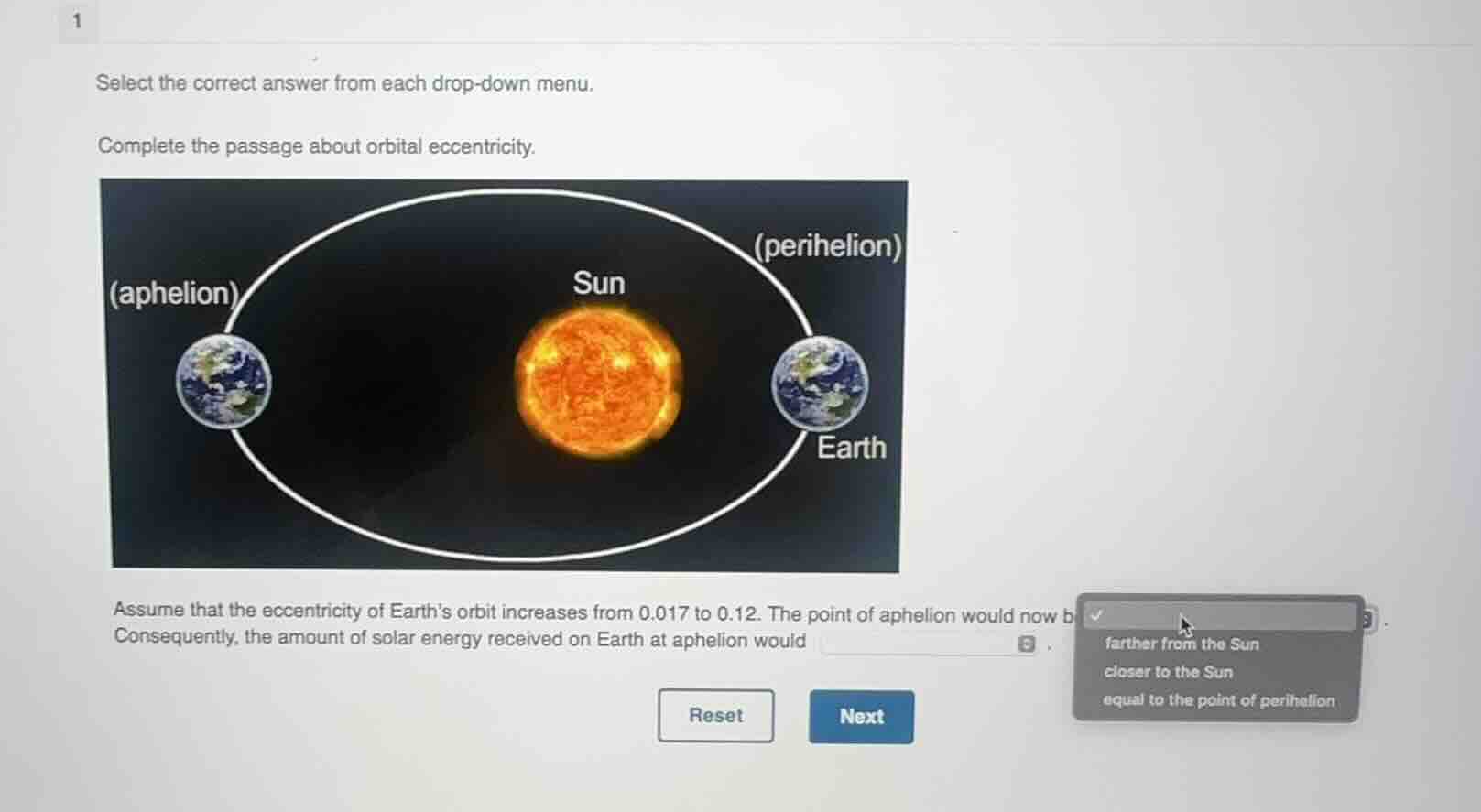
(image of earths orbit around the sun, labeled with aphelion, perihelion, and the sun)
assume that the eccentricity of earths orbit increases from 0.017 to 0.12. the point of aphelion would now be drop - down menu. consequently, the amount of solar energy received on earth at aphelion would drop - down menu.
(options for the first drop - down: farther from the sun, closer to the sun, equal to the point of perihelion; reset and next buttons)
First Drop - Down (Aphelion Position)
Orbital eccentricity (\(e\)) is related to the shape of the orbit. The formula for the distance of aphelion (\(r_{a}\)) from the Sun (for a planet orbiting the Sun) is \(r_{a}=a(1 + e)\), where \(a\) is the semi - major axis and \(e\) is the eccentricity. When the eccentricity \(e\) increases (from 0.017 to 0.12 in this case), and \(a\) remains constant (since the semi - major axis of Earth's orbit is approximately constant over short timescales), the value of \(r_{a}=a(1 + e)\) will increase. So, the point of aphelion will be farther from the Sun.
The intensity of solar energy received (irradiance) follows the inverse - square law, \(I\propto\frac{1}{d^{2}}\), where \(d\) is the distance from the Sun. If the aphelion is farther from the Sun (as we determined in the first part), the distance \(d\) at aphelion increases. Since \(I\) is inversely proportional to the square of the distance, an increase in distance will lead to a decrease in the amount of solar energy received at aphelion.

Snap & solve any problem in the app
Get step-by-step solutions on Sovi AI
Photo-based solutions with guided steps
Explore more problems and detailed explanations
farther from the Sun