QUESTION IMAGE
Question
select the correct answer from each drop - down menu.
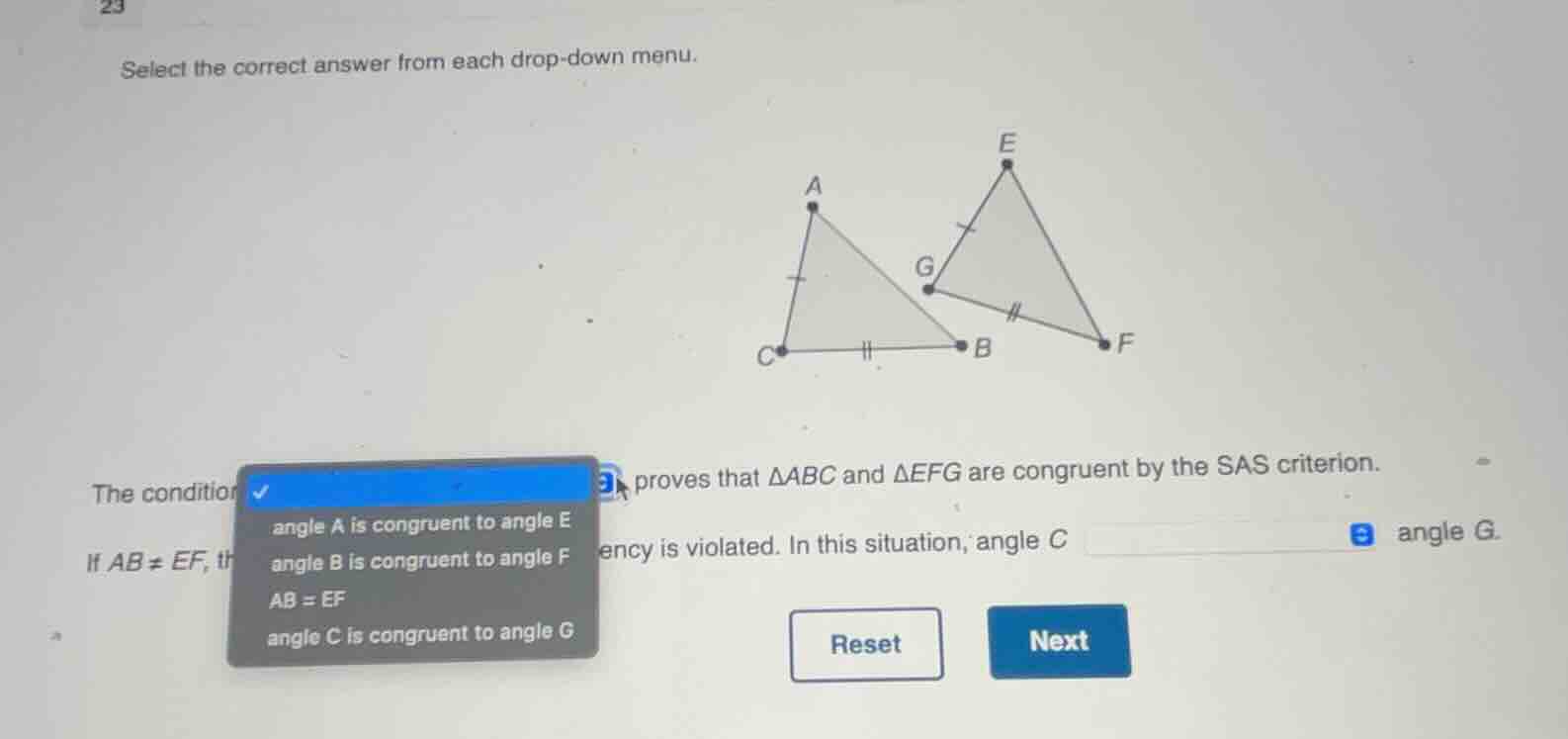
the condition drop - down menu proves that $\triangle abc$ and $\triangle efg$ are congruent by the sas criterion.
if $ab\
eq ef$, thdrop - down menuency is violated. in this situation, angle $c$ drop - down menu angle $g$.
drop - down menu options for the first blank: angle $a$ is congruent to angle $e$, angle $b$ is congruent to angle $f$, $ab = ef$, angle $c$ is congruent to angle $g$
buttons: reset, next
Step1: Recall SAS congruence rule
SAS (Side-Angle-Side) requires two pairs of congruent sides, with the included angle congruent between them. From the diagram: $AC \cong EG$, $BC \cong FG$. The included angle for $\triangle ABC$ is $\angle C$, for $\triangle EFG$ is $\angle G$. Wait, no—correction: for sides $AC, BC$ the included angle is $\angle C$; for $EG, FG$ included angle is $\angle G$. But wait, the first blank needs the condition for SAS. Wait, recheck: the marked sides: $AC$ (one tick) $\cong EG$ (one tick), $BC$ (two ticks) $\cong FG$ (two ticks). So the included angles are $\angle C$ and $\angle G$? No, wait no: SAS is side-included angle-side. So if we have $AC \cong EG$, $BC \cong FG$, the included angle is $\angle C$ (between $AC$ and $BC$) and $\angle G$ (between $EG$ and $FG$). But wait the first dropdown: the options are angle A≅E, angle B≅F, AB=EF, angle C≅G. Wait no, wait I misread: the sides: $AB$ is unmarked, $EF$ unmarked; $AC$ and $EG$ have one tick, $BC$ and $FG$ have two ticks. So for SAS, we need the angle between the two marked sides to be congruent. The angle between $AC$ and $BC$ is $\angle C$, between $EG$ and $FG$ is $\angle G$. But wait, the second part: if $AB
eq EF$, then congruency is violated, so angle C is **not congruent** to angle G? No, wait no: first, the first blank: which condition proves SAS? Wait no, wait maybe I mixed up the sides. Wait, maybe the sides are $AB$ and $EF$? No, the marked sides are $AC \cong EG$, $BC \cong FG$. So SAS requires $\angle C \cong \angle G$. But wait the first dropdown: option 4 is angle C≅G. But wait, no, wait the question says "the condition ____ proves that $\triangle ABC$ and $\triangle EFG$ are congruent by SAS".
Wait, let's re-express SAS properly: For $\triangle ABC \cong \triangle EFG$ by SAS, we need:
- One pair of sides congruent: $AC \cong EG$ (given by tick marks)
- The included angle congruent: $\angle C \cong \angle G$
- The other adjacent side congruent: $BC \cong FG$ (given by tick marks)
So the missing condition for SAS is $\angle C \cong \angle G$.
Now the second part: If $AB
eq EF$, then the triangles are not congruent, so $\angle C
cong \angle G$ (angle C is not congruent to angle G).
Wait but let's confirm the first dropdown: the options are:
- angle A is congruent to angle E
- angle B is congruent to angle F
- AB = EF
- angle C is congruent to angle G
Yes, the SAS condition requires the included angle between the two marked sides, which is $\angle C \cong \angle G$.
Then, if $AB
eq EF$, the triangles can't be congruent, so the congruence of $\angle C$ and $\angle G$ is violated, meaning $\angle C$ is **not congruent to** $\angle G$.
Step2: Match to dropdown options
First blank: select "angle C is congruent to angle G"
Second blank: "is not congruent to"

Snap & solve any problem in the app
Get step-by-step solutions on Sovi AI
Photo-based solutions with guided steps
Explore more problems and detailed explanations
- The condition: angle C is congruent to angle G proves that $\triangle ABC$ and $\triangle EFG$ are congruent by the SAS criterion.
- If $AB
eq EF$, the congruency is violated. In this situation, angle C is not congruent to angle G.