QUESTION IMAGE
Question
2
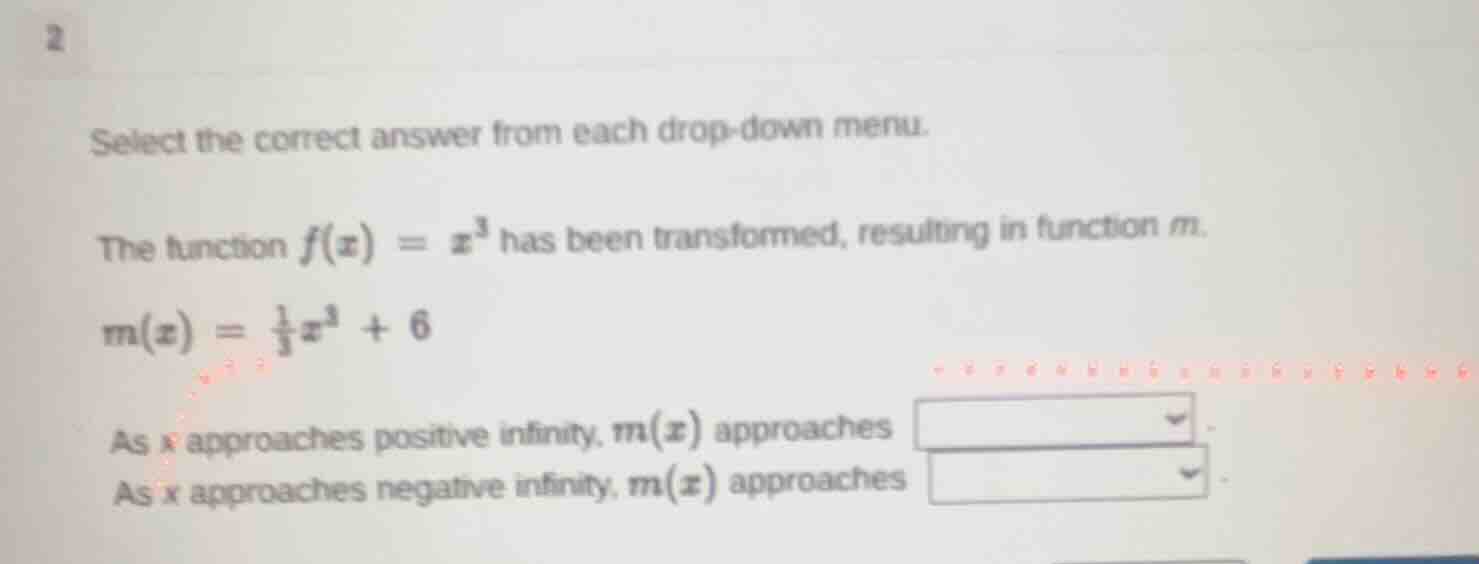
select the correct answer from each drop-down menu.
the function $f(x) = x^3$ has been transformed, resulting in function $m$.
$m(x) = \frac{1}{3}x^3 + 6$
as $x$ approaches positive infinity, $m(x)$ approaches drop-down menu.
as $x$ approaches negative infinity, $m(x)$ approaches drop-down menu.
Step1: Analyze the leading term
The function \( m(x)=\frac{1}{3}x^{3}+6 \). The leading term is \( \frac{1}{3}x^{3} \), and the degree of the polynomial is 3 (odd) and the leading coefficient \( \frac{1}{3} \) is positive.
Step2: Behavior as \( x \to +\infty \)
For a polynomial with odd degree and positive leading coefficient, as \( x \) approaches positive infinity, \( x^{3} \) will approach positive infinity, and multiplying by \( \frac{1}{3} \) (a positive constant) and adding 6 will still make \( m(x) \) approach positive infinity. So as \( x \to +\infty \), \( m(x) \to +\infty \).
Step3: Behavior as \( x \to -\infty \)
For a polynomial with odd degree and positive leading coefficient, as \( x \) approaches negative infinity, \( x^{3} \) will approach negative infinity (since \( (-a)^{3}=-a^{3} \) for \( a>0 \)), multiplying by \( \frac{1}{3} \) (positive) will still give a negative value, and adding 6 will not change the fact that it approaches negative infinity. So as \( x \to -\infty \), \( m(x) \to -\infty \).

Snap & solve any problem in the app
Get step-by-step solutions on Sovi AI
Photo-based solutions with guided steps
Explore more problems and detailed explanations
As \( x \) approaches positive infinity, \( m(x) \) approaches positive infinity.
As \( x \) approaches negative infinity, \( m(x) \) approaches negative infinity.