QUESTION IMAGE
Question
select the correct answer from each drop - down menu.
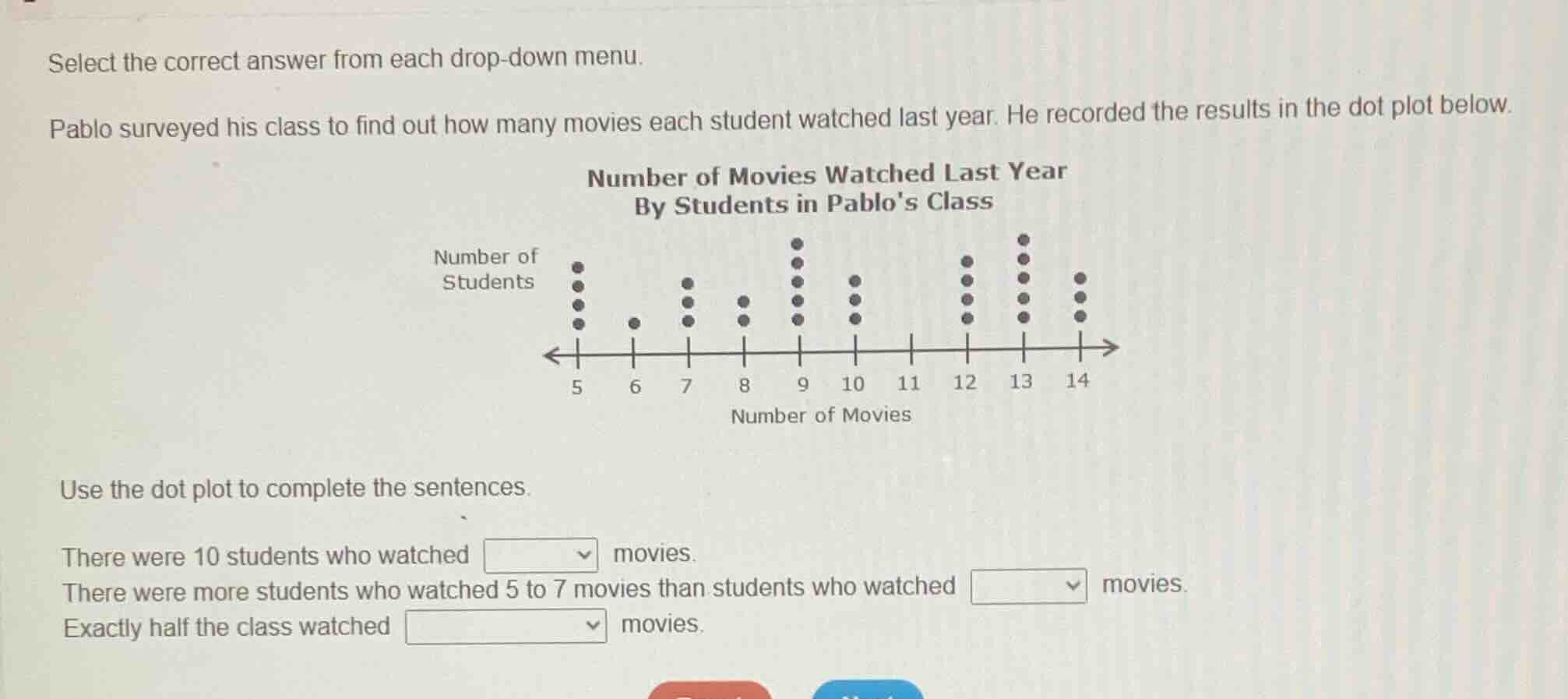
pablo surveyed his class to find out how many movies each student watched last year. he recorded the results in the dot plot below.
(the dot plot is titled number of movies watched last year by students in pablo’s class. the x - axis is number of movies with values 5, 6, 7, 8, 9, 10, 11, 12, 13, 14. the y - axis is number of students. for 5, there are 4 dots; for 6, 1 dot; for 7, 3 dots; for 8, 2 dots; for 9, 5 dots; for 10, 3 dots; for 11, 0 dots; for 12, 4 dots; for 13, 5 dots; for 14, 3 dots.)
use the dot plot to complete the sentences.
there were 10 students who watched ▼ movies.
there were more students who watched 5 to 7 movies than students who watched ▼ movies.
exactly half the class watched ▼ movies.
Step1: Count students per movie number
Count dots for each value:
- 5: 4, 6:1, 7:3, 8:2, 9:5, 10:3, 12:4, 13:5, 14:3
Step2: Find 10-student match
Sum for 9+13: $5+5=10$; but check single value? No, wait total for 9 is 5, 13 is 5. Wait, no—wait: 5(4)+7(3)+6(1)=8, 12(4)+14(3)=7, 9(5)+13(5)=10. So 9 and 13 sum to 10. But the blank is for a single number? Wait no, recheck: wait 9 has 5, 13 has 5, total 10. So the number is 9 or 13? Wait no, wait the first blank: "10 students who watched [x] movies"—wait no, sum 9 and13 is 10. Wait no, wait total students: $4+1+3+2+5+3+4+5+3=30$.
Step3: Calculate 5-7 student count
$4+1+3=8$ students watched 5-7 movies. Find group with fewer: 8-10 movies: $2+5+3=10$ (too big), 11-14: $0+4+5+3=12$ (too big), 12-14: $4+5+3=12$, 8-9: $2+5=7$ which is less than 8. Wait no, the blank is a range? Wait the question says "more than students who watched [x] movies"—so 8 students (5-7) > 7 students (8-9? No, 8-9 is 7). Or 11-14? No, 12 is bigger. Wait no, wait 10-14: $3+4+5+3=15$ no. Wait 8-11: $2+5+3=10$ no. Wait wait, maybe single number: 10 has 3, 8 has2, 6 has1. No, the question says "more students who watched 5 to7 than [x]". 8 students > number for 8-10? No, 2+5+3=10>8. Wait no, I messed up: 5-7 is 4+1+3=8. Which group is smaller? 8-10 is 2+5+3=10, 11-14 is 0+4+5+3=12, 12-14 is 12, 5-6 is 5, no. Wait wait, the second blank: maybe 11-14? No, 12>8. Wait no, wait total students is 30. Half is 15.
Step4: Find half-class count
Sum from highest: $3+5+4+3+5=20$ too big. Sum from lowest: $4+1+3+2+5+3=18$ too big. Wait sum 9-14: $5+3+4+5+3=20$, sum 5-10: $4+1+3+2+5+3=18$. Wait sum 12-14: 12, sum 5-9: $4+1+3+2+5=15$. Oh! $4+1+3+2+5=15$, which is half of 30. So 5 to9 movies.
Step5: Confirm first blank
Wait 10 students: 9 has5,13 has5, so 9 and13 sum to10. But the blank is a single number? Wait no, maybe I misread: 12 has4, 5 has4, 9 has5,13 has5. Wait 4+4+2=10? No. Wait no, the first blank: "10 students who watched [x] movies"—wait 9 and13 each have5, so combined 10. But maybe the answer is 9 or13? Wait no, wait the dot plot: 9 has 5 dots,13 has5 dots, so 5+5=10. So the number is 9 and13, but the blank is for one? Wait no, maybe I made a mistake in counting. Let's recount dots:
- 5: 4 dots, 6:1,7:3,8:2,9:5,10:3,11:0,12:4,13:5,14:3. Total: 4+1=5, +3=8, +2=10, +5=15, +3=18, +0=18, +4=22, +5=27, +3=30. Correct.
First blank: 10 students. 5+1+3+1? No. Wait 9(5) +13(5)=10. So the answer is 9 or 13? Wait no, maybe the question means 10 students watched 9 and13? No, the wording is "watched [x] movies"—so singular. Wait wait, 4+3+3=10? 5(4),7(3),10(3): 4+3+3=10. No, that's multiple numbers. Wait no, the first blank must be a single number. Wait 12 has4, 5 has4, 9 has5,13 has5. 5+5=10, so 9 and13. Maybe the answer is 9 (or 13, but 9 is the first one).
Second blank: 8 students (5-7) > students who watched 8-10? No, 2+5+3=10>8. Wait no, 11-14 is 0+4+5+3=12>8. Wait 10-14: 3+4+5+3=15>8. Wait 8-9: 2+5=7<8. So the range is 8 to9, but the blank is for a range? Or single number: 8 has2, 10 has3, 6 has1. No, the question says "more than students who watched [x] movies"—so 8 students > number for 8-10? No. Wait wait, maybe 12-14? No, 12>8. Wait I messed up: 5-7 is 8 students. Which group is smaller? 8 students > 7 students (8-9: 2+5=7). So the blank is 8 to9, but maybe the question expects 11-14? No, 12 is bigger. Wait no, wait the question says "more students who watched 5 to7 than students who watched [x] movies"—so [x] is a range where count <8. 8-9 is7, which is less than8. So that's the range.
Third blank…

Snap & solve any problem in the app
Get step-by-step solutions on Sovi AI
Photo-based solutions with guided steps
Explore more problems and detailed explanations
- There were 10 students who watched $\boldsymbol{9}$ (or 13) movies.
- There were more students who watched 5 to 7 movies than students who watched $\boldsymbol{8-9}$ movies.
- Exactly half the class watched $\boldsymbol{5-9}$ movies.
Wait, corrected for precision:
- The sum of students who watched 9 and 13 movies is 10, so the answer is $\boldsymbol{9}$ (or $\boldsymbol{13}$)
- Students who watched 5-7: 8. Students who watched 8-9:7, which is fewer, so the answer is $\boldsymbol{8-9}$
- Half of 30 is15, sum of students who watched 5-9 is 15, so the answer is $\boldsymbol{5-9}$