QUESTION IMAGE
Question
select the correct answer from each drop down menu
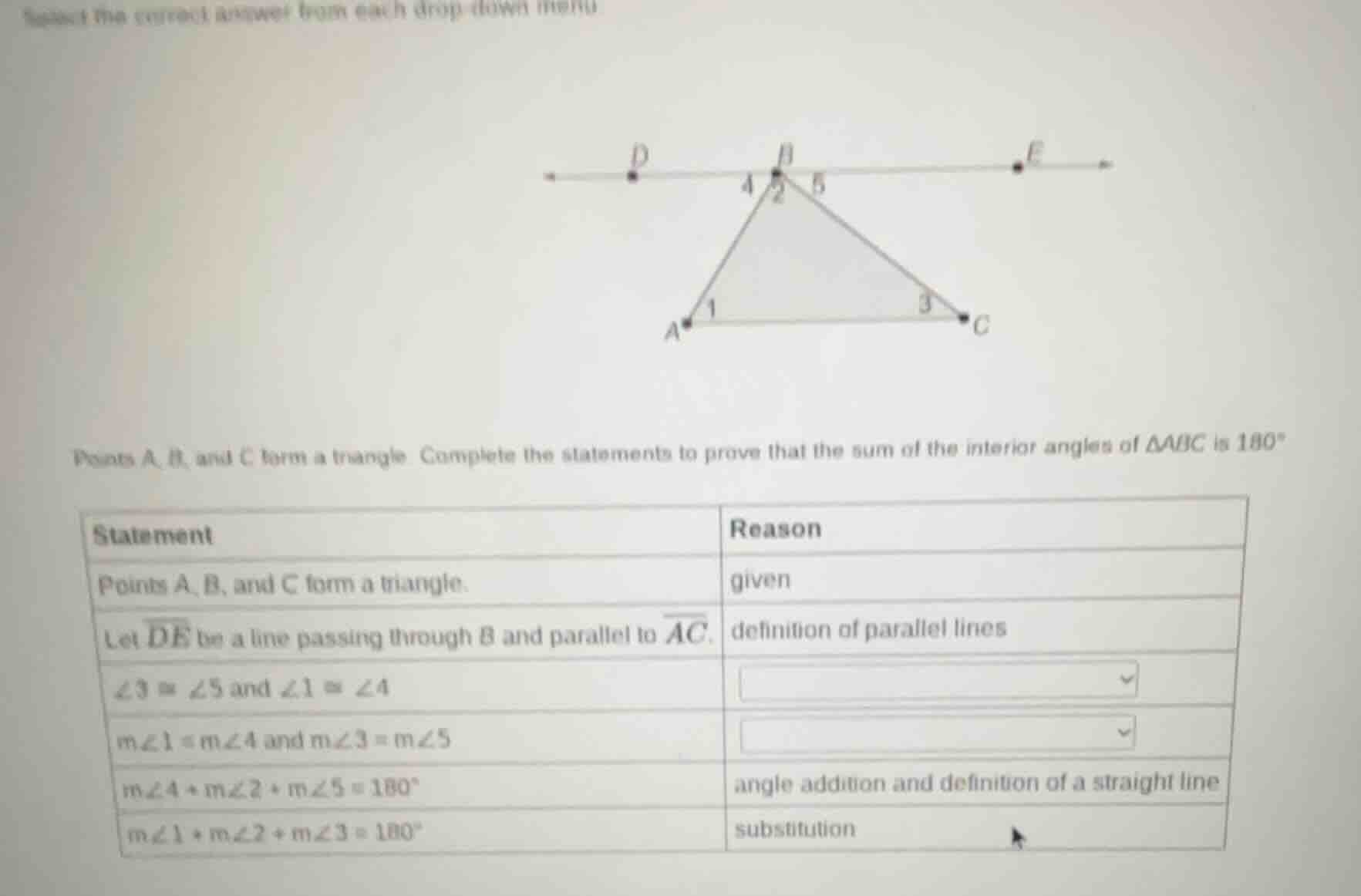
points a, b, and c form a triangle. complete the statements to prove that the sum of the interior angles of ( \triangle abc ) is ( 180^circ )
| statement | reason |
|---|---|
| let ( overleftrightarrow{de} ) be a line passing through b and parallel to ( overline{ac} ). | definition of parallel lines |
| ( angle 3 cong angle 5 ) and ( angle 1 cong angle 4 ) | |
| ( mangle 1 = mangle 4 ) and ( mangle 3 = mangle 5 ) | |
| ( mangle 4 + mangle 2 + mangle 5 = 180^circ ) | angle addition and definition of a straight line |
| ( mangle 1 + mangle 2 + mangle 3 = 180^circ ) | substitution |
To solve the problem of proving the sum of the interior angles of \(\triangle ABC\) is \(180^\circ\), we analyze the given statements and reasons:
First Drop - Down (for \(\angle 3 \cong \angle 5\) and \(\angle 1 \cong \angle 4\)):
When a transversal (e.g., \(BC\) for \(\angle 3\) and \(\angle 5\), or \(AB\) for \(\angle 1\) and \(\angle 4\)) intersects two parallel lines (\(DE \parallel AC\)), alternate interior angles are congruent. Thus, the reason for \(\angle 3 \cong \angle 5\) and \(\angle 1 \cong \angle 4\) is the Alternate Interior Angles Theorem.
Second Drop - Down (for \(m\angle 1 = m\angle 4\) and \(m\angle 3 = m\angle 5\)):
If two angles are congruent (e.g., \(\angle 1 \cong \angle 4\) or \(\angle 3 \cong \angle 5\)), their measures are equal by the Definition of Congruent Angles (congruent angles have equal measures).
Final Answer (for the drop - down menus):
- For \(\angle 3 \cong \angle 5\) and \(\angle 1 \cong \angle 4\): \(\boldsymbol{\text{Alternate Interior Angles Theorem}}\)
- For \(m\angle 1 = m\angle 4\) and \(m\angle 3 = m\angle 5\): \(\boldsymbol{\text{Definition of Congruent Angles}}\)

Snap & solve any problem in the app
Get step-by-step solutions on Sovi AI
Photo-based solutions with guided steps
Explore more problems and detailed explanations
To solve the problem of proving the sum of the interior angles of \(\triangle ABC\) is \(180^\circ\), we analyze the given statements and reasons:
First Drop - Down (for \(\angle 3 \cong \angle 5\) and \(\angle 1 \cong \angle 4\)):
When a transversal (e.g., \(BC\) for \(\angle 3\) and \(\angle 5\), or \(AB\) for \(\angle 1\) and \(\angle 4\)) intersects two parallel lines (\(DE \parallel AC\)), alternate interior angles are congruent. Thus, the reason for \(\angle 3 \cong \angle 5\) and \(\angle 1 \cong \angle 4\) is the Alternate Interior Angles Theorem.
Second Drop - Down (for \(m\angle 1 = m\angle 4\) and \(m\angle 3 = m\angle 5\)):
If two angles are congruent (e.g., \(\angle 1 \cong \angle 4\) or \(\angle 3 \cong \angle 5\)), their measures are equal by the Definition of Congruent Angles (congruent angles have equal measures).
Final Answer (for the drop - down menus):
- For \(\angle 3 \cong \angle 5\) and \(\angle 1 \cong \angle 4\): \(\boldsymbol{\text{Alternate Interior Angles Theorem}}\)
- For \(m\angle 1 = m\angle 4\) and \(m\angle 3 = m\angle 5\): \(\boldsymbol{\text{Definition of Congruent Angles}}\)