QUESTION IMAGE
Question
select the correct answer from each drop - down menu.
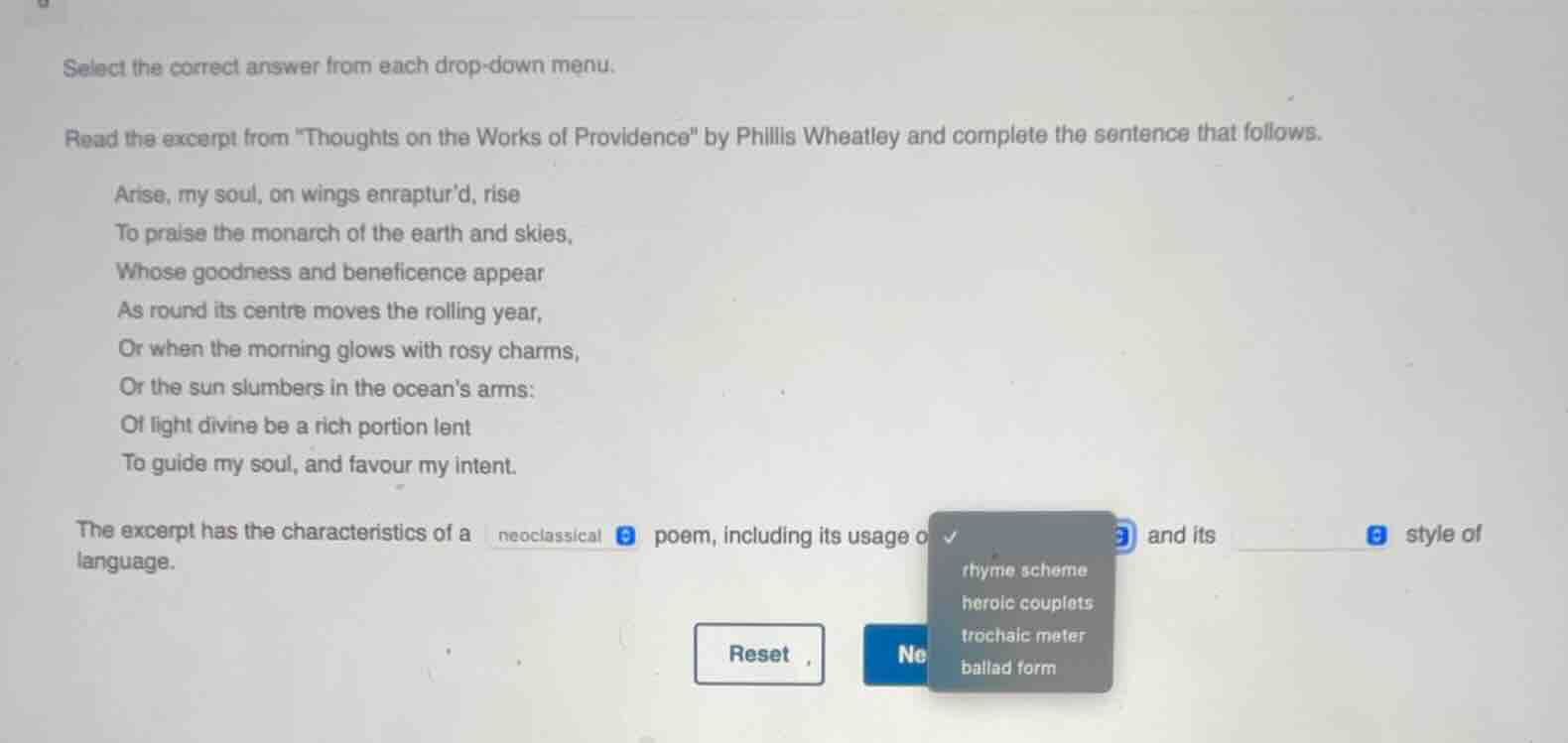
read the excerpt from \thoughts on the works of providence\ by phillis wheatley and complete the sentence that follows.
arise, my soul, on wings enrapturd, rise
to praise the monarch of the earth and skies,
whose goodness and beneficence appear
as round its centre moves the rolling year,
or when the morning glows with rosy charms,
or the sun slumbers in the oceans arms:
of light divine be a rich portion lent
to guide my soul, and favour my intent.
the excerpt has the characteristics of a neoclassical poem, including its usage o and its style of language.
options for the first blank (partially shown): rhyme scheme, heroic couplets, trochaic meter, ballad form
- First dropdown (already selected correctly): Phillis Wheatley's work aligns with neoclassical poetry, which often uses formal structure, elevated language, and focuses on moral/philosophical themes like divine providence.
- Second dropdown: Analyzing the poem's rhyme pattern:
- Lines 1-2: rise/skies (A)
- Lines 3-4: appear/year (B)
- Lines 5-6: charms/arms (C)
- Lines 7-8: lent/intent (D)
This paired rhyming structure of two consecutive lines with the same rhyme is defined as heroic couplets.
- Third dropdown: Neoclassical poetry like this uses formal, elevated, eloquent/elevated language, but more specifically, the poem uses a formal, reverent, didactic (moral-teaching) style, but the key characteristic tied to neoclassical poetic language here is its elevated, formal tone, often described as grand or ornate. The most precise fit for the final blank, matching neoclassical poetic traits, is elevated (or more specifically, formal, reverent; but the standard term here is elevated formal language).

Snap & solve any problem in the app
Get step-by-step solutions on Sovi AI
Photo-based solutions with guided steps
Explore more problems and detailed explanations
- First dropdown: neoclassical
- Second dropdown: heroic couplets
- Third dropdown: elevated formal