QUESTION IMAGE
Question
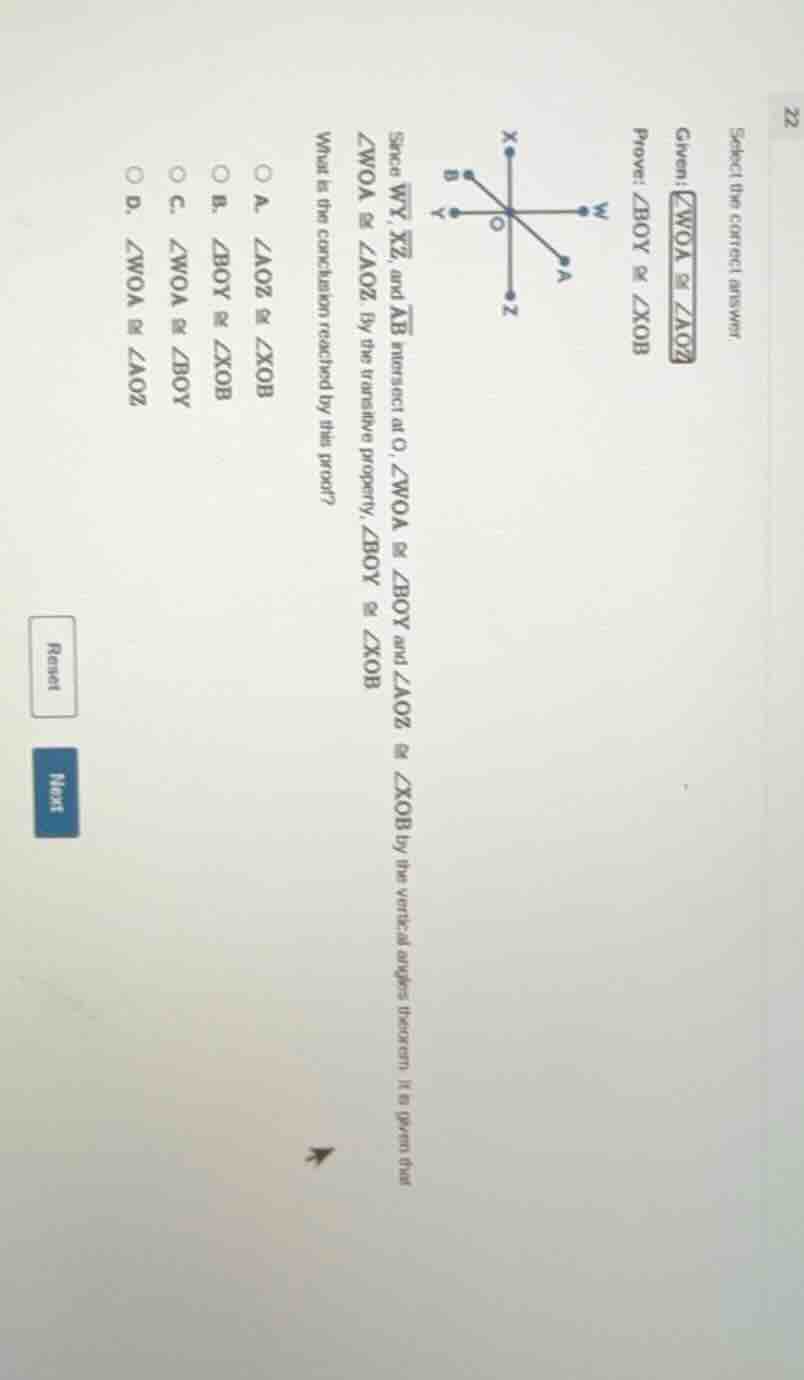
select the correct answer given: ∠woa ≅ ∠aoz prove: ∠boy ≅ ∠xob since ( overleftrightarrow{wy} ), ( overleftrightarrow{xz} ), and ( overleftrightarrow{ab} ) intersect at o, ( angle woa cong angle boy ) and ( angle aoz cong angle xob ) by the vertical angles theorem. it is given that ( angle woa cong angle aoz ). by the transitive property, ( angle boy cong angle xob ). what is the conclusion reached by this proof? a. ( angle aoz cong angle xob ) b. ( angle boy cong angle xob ) c. ( angle woa cong angle boy ) d. ( angle woa cong angle aoz )
We know that \(\angle WOA \cong \angle BOY\) (given or from vertical angles/other) and \(\angle WOA \cong \angle AOZ\) (given). Then, by the transitive property of congruence (if \(a\cong b\) and \(b\cong c\), then \(a\cong c\)), we can substitute. Here, if \(\angle WOA \cong \angle BOY\) and \(\angle WOA \cong \angle AOZ\) is not directly the transitive for the final conclusion, wait, no—wait, the proof is about \(\angle BOY \cong \angle XOB\) using transitive? Wait, no, the given is \(\angle WOA \cong \angle AOZ\), and we have \(\angle WOA \cong \angle BOY\) (maybe vertical angles) and \(\angle AOZ \cong \angle XOB\) (vertical angles). Then by transitive, \(\angle BOY \cong \angle XOB\) (since \(\angle WOA \cong \angle BOY\), \(\angle WOA \cong \angle AOZ\), \(\angle AOZ \cong \angle XOB\), so \(\angle BOY \cong \angle XOB\) via transitive). Wait, but the options: the conclusion of the proof (to prove \(\angle BOY \cong \angle XOB\)) using transitive with \(\angle WOA \cong \angle BOY\) and \(\angle WOA \cong \angle AOZ\), and \(\angle AOZ \cong \angle XOB\). Wait, the question is "What is the conclusion reached by this proof?" The proof is to prove \(\angle BOY \cong \angle XOB\), and the steps use transitive with \(\angle WOA \cong \angle BOY\) and \(\angle WOA \cong \angle AOZ\) (wait, no, the initial given is \(\angle WOA \cong \angle AOZ\), and then \(\angle WOA \cong \angle BOY\) (maybe vertical angles) and \(\angle AOZ \cong \angle XOB\) (vertical angles). Then by transitive, \(\angle BOY \cong \angle XOB\) (since \(\angle BOY \cong \angle WOA\) and \(\angle WOA \cong \angle AOZ\) and \(\angle AOZ \cong \angle XOB\), so transitive gives \(\angle BOY \cong \angle XOB\)). So the conclusion is \(\angle BOY \cong \angle XOB\), which is option B.

Snap & solve any problem in the app
Get step-by-step solutions on Sovi AI
Photo-based solutions with guided steps
Explore more problems and detailed explanations
B. \(\angle BOY \cong \angle XOB\)