QUESTION IMAGE
Question
select the correct answer.
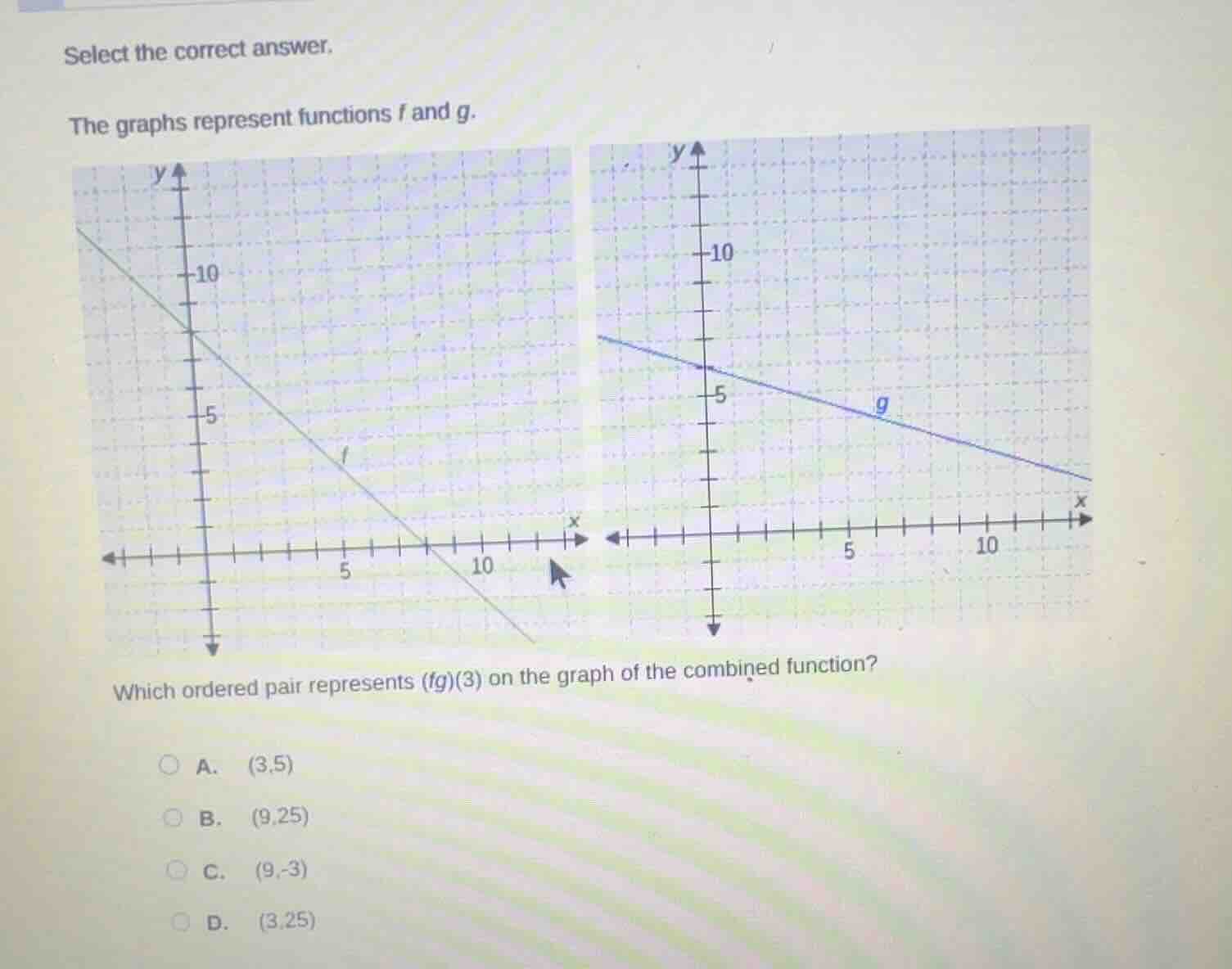
the graphs represent functions f and g.
which ordered pair represents (fg)(3) on the graph of the combined function?
a. (3,5)
b. (9,25)
c. (9,-3)
d. (3,25)
Step1: Find \( g(3) \)
From the graph of \( g \), when \( x = 3 \), we determine the \( y \)-value. Looking at the grid, for function \( g \), at \( x = 3 \), \( g(3)=5 \) (since the line passes through appropriate grid points, we can see the \( y \)-coordinate is 5 when \( x = 3 \)).
Step2: Find \( f(g(3))=f(5) \)
Now, we look at the graph of \( f \). We need to find the \( y \)-value of \( f \) when \( x = 5 \). From the graph of \( f \), when \( x = 5 \), we can see the \( y \)-coordinate (by analyzing the line's equation or grid points). The line for \( f \) has a slope, but from the grid, when \( x = 5 \), the \( y \)-value is 3? Wait, no, wait. Wait, actually, let's re - check. Wait, the combined function is \( (fg)(3) \)? Wait, no, the problem says \( (fg)(3) \), which is \( f(g(3)) \). Wait, first, \( g(3) \): looking at the second graph (function \( g \)), when \( x = 3 \), the \( y \)-value is 5 (since the line of \( g \) at \( x = 3 \) is at \( y = 5 \)). Then, we need to find \( f(5) \) from the first graph (function \( f \)). Looking at the first graph, when \( x = 5 \), what is \( f(5) \)? Wait, the first graph: let's find the equation of \( f \). The first graph (function \( f \)): when \( x = 0 \), \( y = 8 \) (intercept), and when \( x = 8 \), \( y = 0 \) (since it crosses the x - axis at \( x = 8 \)). So the slope \( m=\frac{0 - 8}{8-0}=- 1 \). So the equation of \( f(x) \) is \( y=-x + 8 \). So when \( x = 5 \), \( f(5)=-5 + 8 = 3 \)? Wait, that can't be. Wait, maybe I misread the problem. Wait, the problem says "Which ordered pair represents \( (fg)(3) \) on the graph of the combined function?". Wait, maybe \( (fg)(3) \) is the product \( f(3)\times g(3) \)? No, the notation \( (fg)(x)=f(x)g(x) \), so \( (fg)(3)=f(3)\times g(3) \)? Wait, that's a different interpretation. Oh! Maybe I made a mistake in the operation. If \( (fg)(x)=f(x)\times g(x) \), then \( (fg)(3)=f(3)\times g(3) \). Let's re - evaluate.
Let's start over.
First, find \( f(3) \) from the first graph (function \( f \)):
For function \( f \): The line passes through, let's find two points. When \( x = 0 \), \( y = 8 \); when \( x = 8 \), \( y = 0 \). So the equation is \( y=-x + 8 \). So \( f(3)=-3 + 8 = 5 \).
For function \( g \): Let's find its equation. The line for \( g \): when \( x = 0 \), \( y = 6 \) (intercept), and when \( x = 10 \), \( y = 1 \) (approx, but let's take two points. Let's take \( x = 0 \), \( y = 6 \) and \( x = 5 \), \( y = 4.5 \)? No, wait the second graph: when \( x = 5 \), \( g(5)=4 \)? Wait, no, the second graph (function \( g \)): looking at the grid, each square is 1 unit. The line of \( g \) goes from, say, \( (0,6) \) to \( (10,1) \)? No, the problem's second graph: the \( y \)-axis has 10, and the line of \( g \) at \( x = 5 \) is at \( y = 4 \)? Wait, I think I messed up the operation. The problem says \( (fg)(3) \), which is the product function \( (fg)(x)=f(x)\times g(x) \), so \( (fg)(3)=f(3)\times g(3) \).
Let's recalculate:
First, find \( f(3) \): from the first graph (function \( f \)), using the equation \( y=-x + 8 \) (since when \( x = 0 \), \( y = 8 \); when \( x = 8 \), \( y = 0 \), slope \( m=-1 \)), so \( f(3)=-3 + 8 = 5 \).
Then, find \( g(3) \): from the second graph (function \( g \)). Let's find the equation of \( g \). Let's take two points on \( g \): when \( x = 0 \), \( y = 6 \); when \( x = 10 \), \( y = 1 \)? No, looking at the grid, when \( x = 5 \), the \( y \)-value of \( g \) is 4? Wait, no, the second graph: the line of \( g \) passes through \( (0,6) \) and \( (10,1) \)? No…

Snap & solve any problem in the app
Get step-by-step solutions on Sovi AI
Photo-based solutions with guided steps
Explore more problems and detailed explanations
D. \( (3,25) \)