QUESTION IMAGE
Question
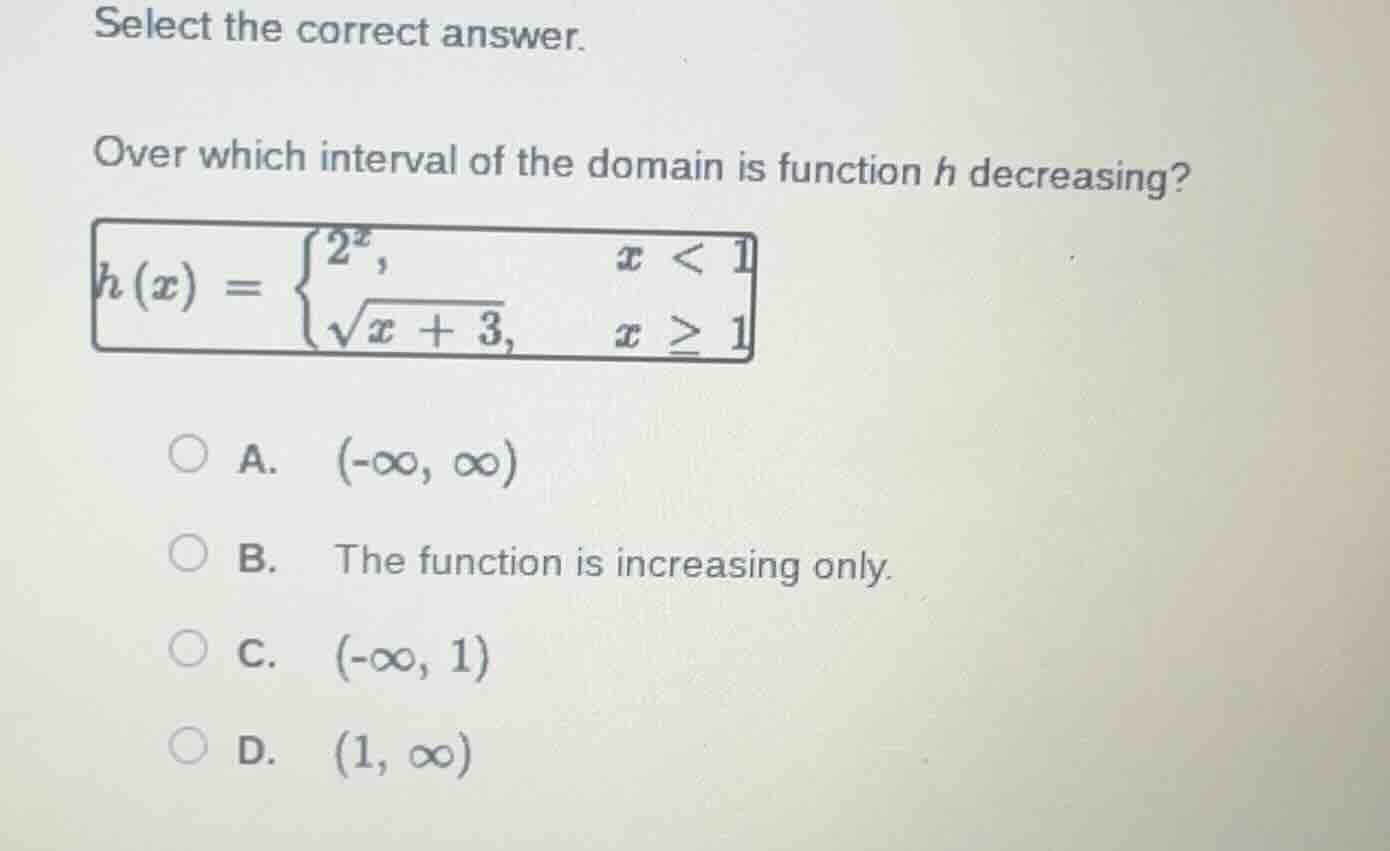
select the correct answer. over which interval of the domain is function h decreasing? $h(x)=\
$ a. $(-\infty, \infty)$ b. the function is increasing only. c. $(-\infty, 1)$ d. $(1, \infty)$
Step1: Analyze $2^x$ for $x<1$
Exponential function $2^x$ has base $2>1$, so it is strictly increasing for all $x$. For $x<1$, as $x$ increases, $2^x$ increases.
Step2: Analyze $\sqrt{x+3}$ for $x\geq1$
The square root function $\sqrt{u}$ is increasing when $u\geq0$. Here $u=x+3$, which increases as $x$ increases. So $\sqrt{x+3}$ is strictly increasing for $x\geq1$.
Step3: Check continuity at $x=1$
Calculate $h(1^-) = 2^1=2$, $h(1^+)=\sqrt{1+3}=2$. The function is continuous at $x=1$, and the value at the join point is consistent with the increasing trend of both pieces.
Step4: Conclusion on monotonicity
Both pieces of the piecewise function are increasing, and the function is continuous at the boundary. Thus the function is increasing over its entire domain, with no decreasing intervals.

Snap & solve any problem in the app
Get step-by-step solutions on Sovi AI
Photo-based solutions with guided steps
Explore more problems and detailed explanations
B. The function is increasing only.