QUESTION IMAGE
Question
select the correct answer.
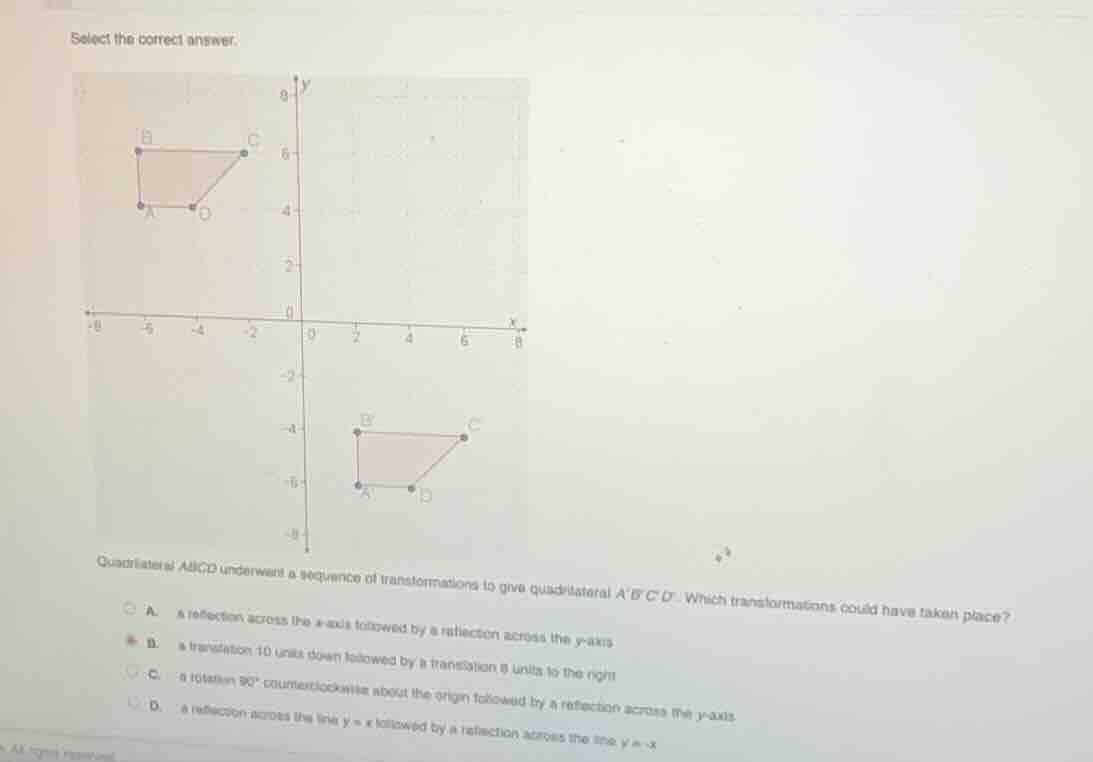
quadrilateral (abcd) underwent a sequence of transformations to give quadrilateral (abcd). which transformations could have taken place?
a. a reflection across the (x)-axis followed by a reflection across the (y)-axis
b. a translation 10 units down followed by a translation 8 units to the right
c. a rotation (90^circ) counterclockwise about the origin followed by a reflection across the (y)-axis
d. a reflection across the line (y = x) followed by a reflection across the line (y = -x)
Step1: Analyze Option A
A reflection across the x - axis would change the y - coordinate sign, and then a reflection across the y - axis would change the x - coordinate sign. Let's take a point from ABCD, say B(-6,6). After reflection over x - axis: (-6,-6), then reflection over y - axis: (6,-6). But in A'B'C'D', the x - coordinate of B' is 2 (from the graph, approximate). So this is not correct.
Step2: Analyze Option B
Let's take point B(-6,6). A translation 10 units down: y - coordinate becomes 6 - 10=-4. Then a translation 8 units to the right: x - coordinate becomes - 6+8 = 2. So B(-6,6) becomes (2,-4), which matches the position of B' (from the graph, B' seems to be (2,-4)). Let's check another point, A(-6,4). Translation 10 units down: 4 - 10=-6. Translation 8 units right: -6 + 8 = 2. So A(-6,4) becomes (2,-6), which matches A' (2,-6). Let's check D(-4,4). Translation 10 units down: 4-10 = - 6. Translation 8 units right: -4 + 8=4. So D(-4,4) becomes (4,-6), which matches D' (4,-6). And C(-2,6). Translation 10 units down: 6 - 10=-4. Translation 8 units right: -2+8 = 6. So C(-2,6) becomes (6,-4), which matches C' (6,-4).
Step3: Analyze Option C
A rotation 90° counterclockwise about the origin for a point (x,y) gives (-y,x). For B(-6,6), rotation 90° counterclockwise: (-6,-6). Then reflection across y - axis: (6,-6), which does not match B' (2,-4). So this is incorrect.
Step4: Analyze Option D
A reflection across y = x swaps x and y, and reflection across y=-x swaps and negates x and y. For B(-6,6), reflection across y = x: (6,-6), then reflection across y=-x: (6, - 6)→(6,6) (since (a,b)→(-b,-a) for y=-x, so (6,-6)→(6,6)), which is not equal to B' (2,-4). So this is incorrect.

Snap & solve any problem in the app
Get step-by-step solutions on Sovi AI
Photo-based solutions with guided steps
Explore more problems and detailed explanations
B. a translation 10 units down followed by a translation 8 units to the right