QUESTION IMAGE
Question
select the correct answer.
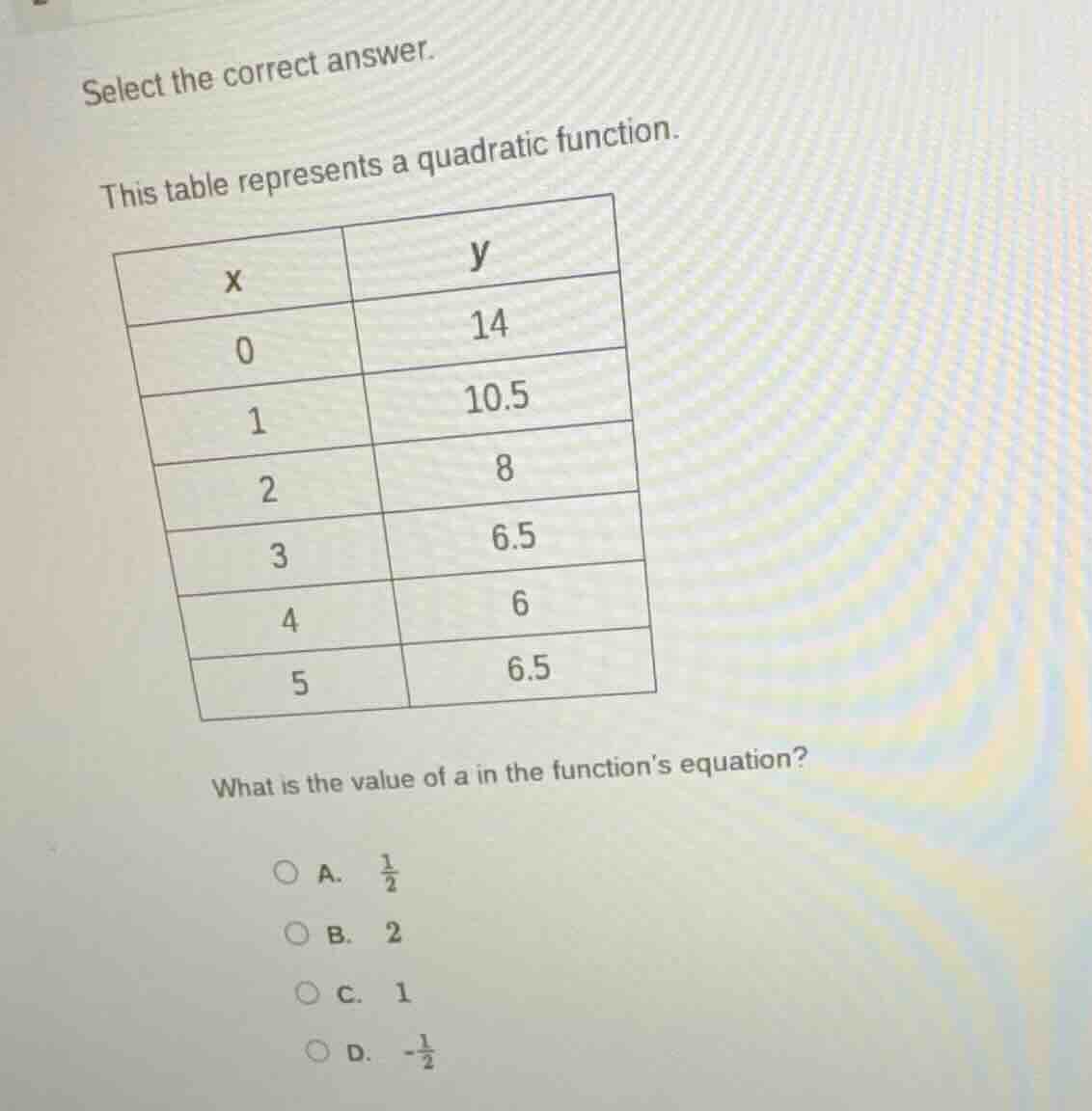
this table represents a quadratic function.
| x | y |
|---|---|
| 1 | 10.5 |
| 2 | 8 |
| 3 | 6.5 |
| 4 | 6 |
| 5 | 6.5 |
what is the value of a in the function’s equation?
a. $\frac{1}{2}$
b. 2
c. 1
d. $-\frac{1}{2}$
Step1: Recall quadratic function form
A quadratic function can be written in vertex form: \( y = a(x - h)^2 + k \), where \((h, k)\) is the vertex. First, find the vertex of the quadratic from the table. The parabola is symmetric, so the vertex is at \( x = 4 \) (since \( x = 3 \) and \( x = 5 \) have the same \( y \)-value, \( x = 4 \) is the axis of symmetry), and \( y = 6 \) at \( x = 4 \). So the vertex \((h, k) = (4, 6)\).
Step2: Substitute vertex into the formula
Substitute \( h = 4 \), \( k = 6 \) into the vertex form: \( y = a(x - 4)^2 + 6 \).
Step3: Use a point to solve for \( a \)
We can use the point \( (0, 14) \) (when \( x = 0 \), \( y = 14 \)). Substitute \( x = 0 \), \( y = 14 \) into the equation:
\( 14 = a(0 - 4)^2 + 6 \)
Simplify: \( 14 = a(16) + 6 \)
Step4: Solve for \( a \)
Subtract 6 from both sides: \( 14 - 6 = 16a \)
\( 8 = 16a \)
Divide both sides by 16: \( a = \frac{8}{16} = \frac{1}{2} \)? Wait, no, wait. Wait, let's check another point. Wait, maybe I made a mistake. Wait, let's check \( x = 2 \), \( y = 8 \). Wait, no, let's re-examine the symmetry. Wait, when \( x = 4 \), \( y = 6 \); \( x = 3 \) and \( x = 5 \) are 1 unit from 4, \( y = 6.5 \); \( x = 2 \) and \( x = 6 \) (but \( x = 6 \) isn't in the table) would be 2 units from 4, \( y = 8 \); \( x = 1 \) and \( x = 7 \) (not in table) 3 units, \( y = 10.5 \); \( x = 0 \) and \( x = 8 \) (not in table) 4 units, \( y = 14 \). Wait, actually, the vertex is at \( (4, 6) \), and as we move left or right from \( x = 4 \), the \( y \)-values increase. Wait, but when we move left by 1 (from \( x = 4 \) to \( x = 3 \)), \( y \) increases by 0.5; left by 2 (to \( x = 2 \)), \( y \) increases by 2 (from 6 to 8); left by 3 (to \( x = 1 \)), \( y \) increases by 4.5 (from 6 to 10.5); left by 4 (to \( x = 0 \)), \( y \) increases by 8 (from 6 to 14). Wait, the second differences: let's compute the first differences (change in \( y \) over change in \( x \)):
From \( x = 0 \) to \( x = 1 \): \( 10.5 - 14 = -3.5 \)
\( x = 1 \) to \( x = 2 \): \( 8 - 10.5 = -2.5 \)
\( x = 2 \) to \( x = 3 \): \( 6.5 - 8 = -1.5 \)
\( x = 3 \) to \( x = 4 \): \( 6 - 6.5 = -0.5 \)
\( x = 4 \) to \( x = 5 \): \( 6.5 - 6 = +0.5 \)
Ah, so the first differences are: -3.5, -2.5, -1.5, -0.5, +0.5. The second differences (difference of first differences) are: (-2.5) - (-3.5) = 1; (-1.5) - (-2.5) = 1; (-0.5) - (-1.5) = 1; (+0.5) - (-0.5) = 1. So the second difference is constant at 1. For a quadratic function, the second difference is \( 2a \) (since the general form of a quadratic is \( y = ax^2 + bx + c \), and the second difference is \( 2a \) when the \( x \)-values are spaced by 1). Wait, the second difference here is 1, so \( 2a = 1 \)? No, wait, no. Wait, when the \( x \)-values are consecutive (difference of 1), the second difference is \( 2a \). Wait, let's recall: for \( y = ax^2 + bx + c \), the first difference (between \( x \) and \( x + 1 \)) is \( a(2x + 1) + b \), and the second difference is \( 2a \). So here, the second difference is 1 (from -3.5 to -2.5: +1; -2.5 to -1.5: +1; etc.), so \( 2a = 1 \)? Wait, but that would mean \( a = 0.5 \), but wait, let's check with the vertex form again. Wait, maybe I messed up the vertex. Wait, when \( x = 4 \), \( y = 6 \); \( x = 3 \), \( y = 6.5 \); \( x = 2 \), \( y = 8 \); \( x = 1 \), \( y = 10.5 \); \( x = 0 \), \( y = 14 \). Let's model this as \( y = a(x - 4)^2 + 6 \). Let's plug in \( x = 3 \), \( y = 6.5 \):
\( 6.5 = a(3 - 4)^2 + 6 \)
\( 6.5 = a(1) + 6 \)
\( a = 0.5 \), which is \( \frac{1}{2} \). Wait, but that co…

Snap & solve any problem in the app
Get step-by-step solutions on Sovi AI
Photo-based solutions with guided steps
Explore more problems and detailed explanations
A. \(\frac{1}{2}\)