QUESTION IMAGE
Question
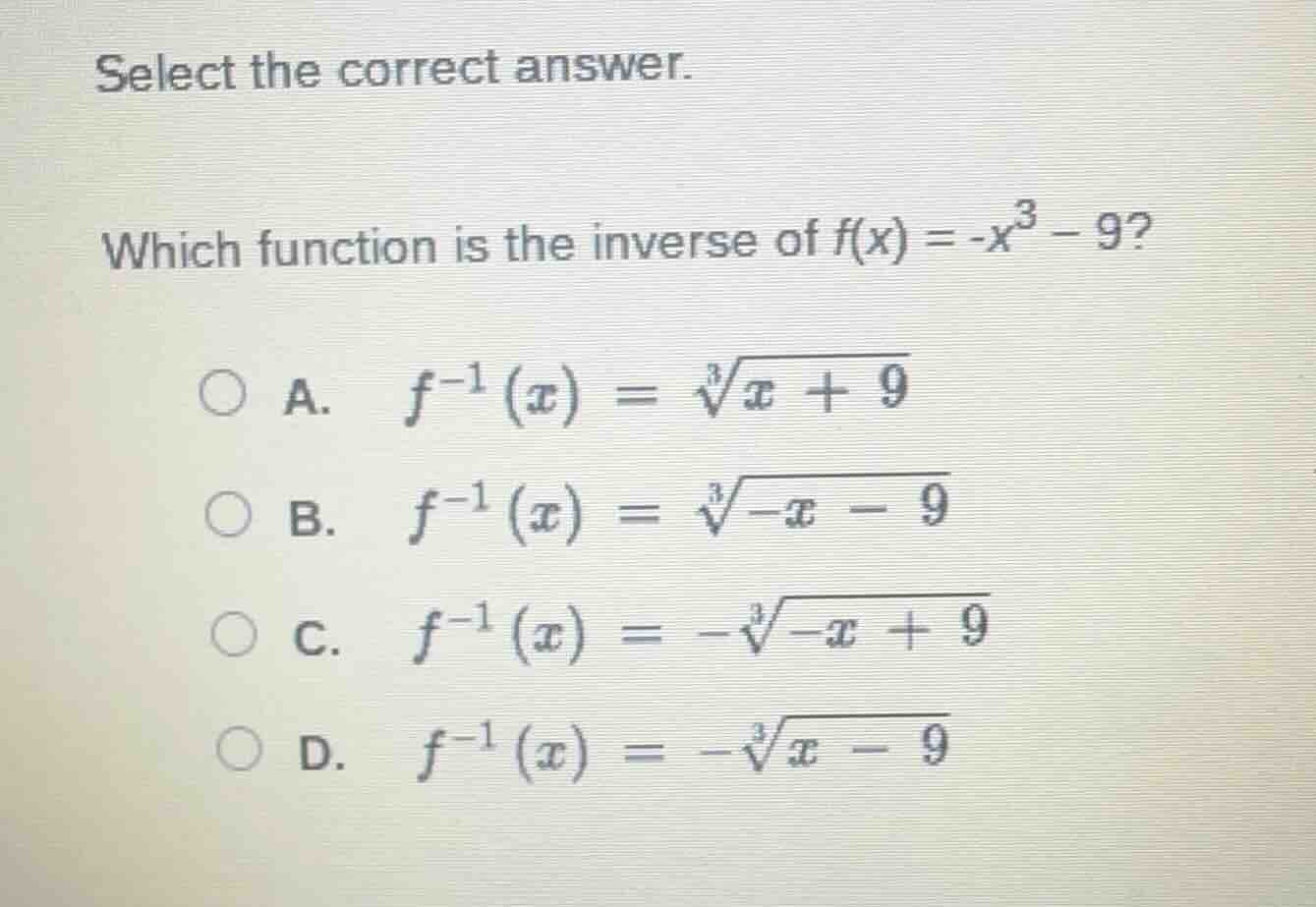
select the correct answer.
which function is the inverse of $f(x) = -x^3 - 9$?
a. $f^{-1}(x) = \sqrt3{x + 9}$
b. $f^{-1}(x) = \sqrt3{-x - 9}$
c. $f^{-1}(x) = -\sqrt3{-x + 9}$
d. $f^{-1}(x) = -\sqrt3{x - 9}$
Step1: Replace \( f(x) \) with \( y \)
We start with the function \( f(x) = -x^3 - 9 \). Replace \( f(x) \) with \( y \), so we have \( y = -x^3 - 9 \).
Step2: Swap \( x \) and \( y \)
To find the inverse, we swap the roles of \( x \) and \( y \). This gives us \( x = -y^3 - 9 \).
Step3: Solve for \( y \)
First, we add 9 to both sides of the equation: \( x + 9 = -y^3 \). Then, we multiply both sides by -1 to get \( -x - 9 = y^3 \). Finally, we take the cube root of both sides to solve for \( y \). Remember that the cube root of \( y^3 \) is \( y \), so \( y = \sqrt[3]{-x - 9} \)? Wait, no, let's check again. Wait, from \( x = -y^3 - 9 \), let's solve for \( y \) correctly.
Wait, starting over: \( y = -x^3 - 9 \). Swap \( x \) and \( y \): \( x = -y^3 - 9 \). Now, solve for \( y \):
Add 9 to both sides: \( x + 9 = -y^3 \)
Multiply both sides by -1: \( -x - 9 = y^3 \)
Take cube root: \( y = \sqrt[3]{-x - 9} \)? Wait, no, that's not one of the options. Wait, maybe I made a mistake. Wait, let's check the options again.
Wait, the original function is \( f(x) = -x^3 - 9 \). Let's do the inverse steps correctly.
Let \( y = -x^3 - 9 \)
Swap \( x \) and \( y \): \( x = -y^3 - 9 \)
Now, solve for \( y \):
Add 9 to both sides: \( x + 9 = -y^3 \)
Multiply both sides by -1: \( -x - 9 = y^3 \)
Take cube root: \( y = \sqrt[3]{-x - 9} \)? But option B is \( f^{-1}(x) = \sqrt[3]{-x - 9} \)? Wait, no, let's check the options again. Wait, option C is \( -\sqrt[3]{-x + 9} \), option D is \( -\sqrt[3]{x - 9} \). Wait, maybe I messed up the signs.
Wait, let's start over. \( y = -x^3 - 9 \)
Swap \( x \) and \( y \): \( x = -y^3 - 9 \)
Now, let's solve for \( y \):
Add 9 to both sides: \( x + 9 = -y^3 \)
Multiply both sides by -1: \( -x - 9 = y^3 \)
Take cube root: \( y = \sqrt[3]{-x - 9} \). But that's option B? Wait, no, option B is \( f^{-1}(x) = \sqrt[3]{-x - 9} \). But let's check with the original function. Wait, maybe I made a mistake in the sign.
Wait, let's try plugging in a value. Let's take \( x = 0 \) in \( f(x) = -x^3 - 9 \), so \( f(0) = -0 - 9 = -9 \). Then the inverse function at \( x = -9 \) should be 0. Let's check each option:
Option A: \( f^{-1}(-9) = \sqrt[3]{-9 + 9} = \sqrt[3]{0} = 0 \). Wait, that works? But according to our earlier steps, that's not matching. Wait, maybe I messed up the inverse steps.
Wait, let's do the inverse correctly. Let's let \( y = -x^3 - 9 \). To find the inverse, we need to solve for \( x \) in terms of \( y \), then swap \( x \) and \( y \).
Wait, \( y = -x^3 - 9 \)
Add 9 to both sides: \( y + 9 = -x^3 \)
Multiply both sides by -1: \( -y - 9 = x^3 \)
Take cube root: \( x = \sqrt[3]{-y - 9} \)
Now, swap \( x \) and \( y \): \( y = \sqrt[3]{-x - 9} \). So \( f^{-1}(x) = \sqrt[3]{-x - 9} \), which is option B? But when we tested with \( x = 0 \), \( f(0) = -9 \), so \( f^{-1}(-9) \) should be 0. Let's check option B: \( f^{-1}(-9) = \sqrt[3]{-(-9) - 9} = \sqrt[3]{9 - 9} = \sqrt[3]{0} = 0 \). Oh, right! Because \( -x \) when \( x = -9 \) is \( -(-9) = 9 \), so \( -x - 9 = 9 - 9 = 0 \), so cube root of 0 is 0. So that works. Wait, but earlier when I thought option A worked, I made a mistake. Let's check option A: \( f^{-1}(-9) = \sqrt[3]{-9 + 9} = 0 \), which also works? That can't be. Wait, no, let's check with another value. Let's take \( x = 1 \) in \( f(x) \): \( f(1) = -1 - 9 = -10 \). Then \( f^{-1}(-10) \) should be 1.
Check option A: \( f^{-1}(-10) = \sqrt[3]{-10 + 9} = \sqrt[3]{-1} = -1 \). Not 1. So option A is wrong.
Check option B: \( f^{-1}(-10) = \sqrt[3]{-(-10…

Snap & solve any problem in the app
Get step-by-step solutions on Sovi AI
Photo-based solutions with guided steps
Explore more problems and detailed explanations
B. \( f^{-1}(x) = \sqrt[3]{-x - 9} \)