QUESTION IMAGE
Question
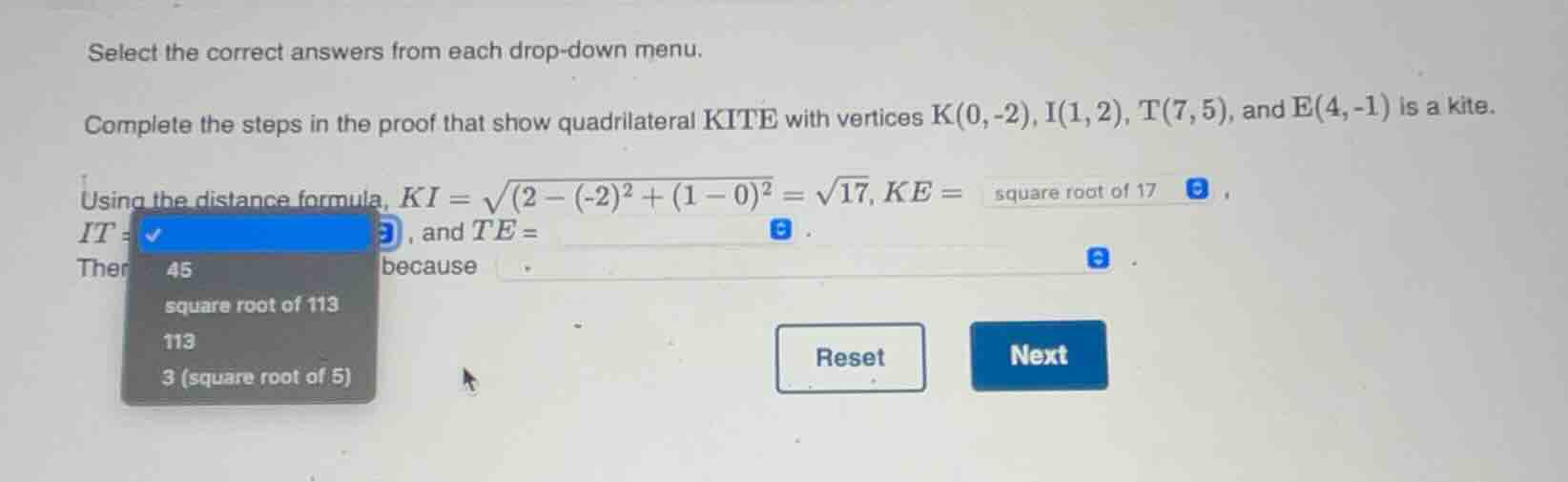
select the correct answers from each drop-down menu. complete the steps in the proof that show quadrilateral kite with vertices k(0,-2), i(1,2), t(7,5), and e(4,-1) is a kite. using the distance formula, $ki = \sqrt{(2 - (-2))^2 + (1 - 0)^2} = \sqrt{17}$, $ke = $ square root of 17, $it = $, and $te = $. then because
Step1: Calculate KE via distance formula
$KE = \sqrt{(-1 - (-2))^2 + (4 - 0)^2} = \sqrt{(1)^2 + (4)^2} = \sqrt{1 + 16} = \sqrt{17}$
Step2: Calculate IT via distance formula
$IT = \sqrt{(5 - 2)^2 + (7 - 1)^2} = \sqrt{(3)^2 + (6)^2} = \sqrt{9 + 36} = \sqrt{45} = 3\sqrt{5}$
Step3: Calculate TE via distance formula
$TE = \sqrt{(-1 - 5)^2 + (4 - 7)^2} = \sqrt{(-6)^2 + (-3)^2} = \sqrt{36 + 9} = \sqrt{45} = 3\sqrt{5}$
Step4: Verify kite definition
A kite has two distinct pairs of congruent adjacent sides. Here $KI=KE=\sqrt{17}$ and $IT=TE=3\sqrt{5}$.

Snap & solve any problem in the app
Get step-by-step solutions on Sovi AI
Photo-based solutions with guided steps
Explore more problems and detailed explanations
- $KE = \sqrt{17}$ (square root of 17)
- $IT = 3\sqrt{5}$ (3 (square root of 5))
- $TE = 3\sqrt{5}$ (3 (square root of 5))
- Final reasoning: quadrilateral KITE has two pairs of congruent adjacent sides, so it is a kite.