QUESTION IMAGE
Question
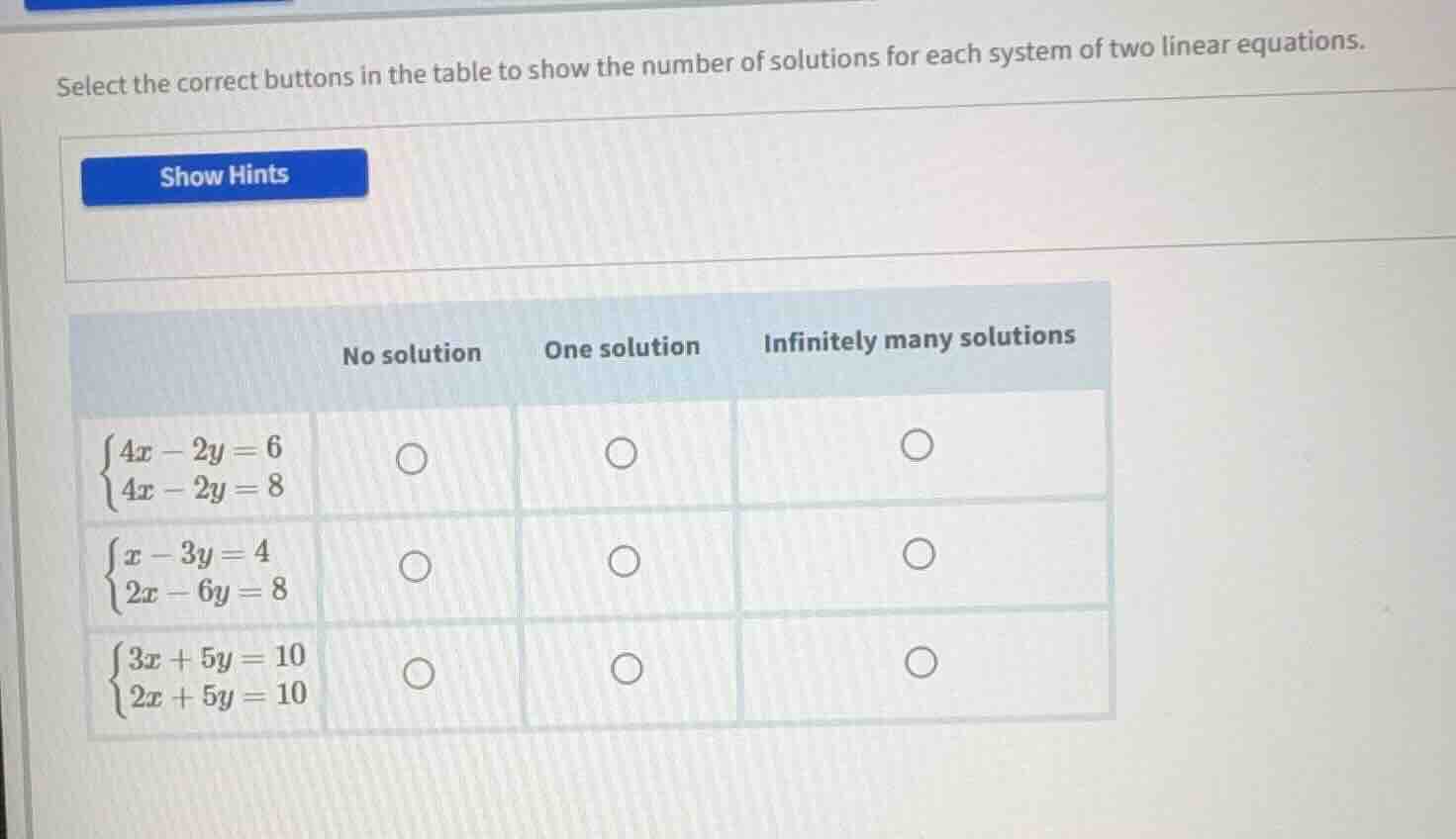
select the correct buttons in the table to show the number of solutions for each system of two linear equations.
show hints
no solution one solution infinitely many solutions
\\(\
\\) \\(\circ\\) \\(\circ\\) \\(\circ\\)
\\(\
\\) \\(\circ\\) \\(\circ\\) \\(\circ\\)
\\(\
\\) \\(\circ\\) \\(\circ\\) \\(\circ\\)
for First System:
Step1: Analyze the equations
The left - hand sides of both equations are the same ($4x - 2y$), but the right - hand sides are 6 and 8 respectively. If we subtract the first equation from the second equation: $(4x - 2y)-(4x - 2y)=8 - 6$, which simplifies to $0 = 2$, a contradiction.
Step2: Determine the number of solutions
A system of linear equations with a contradiction has no solution. So the first system has no solution.
for Second System:
Step1: Simplify the second equation
Divide the second equation $2x - 6y = 8$ by 2, we get $x - 3y = 4$, which is the same as the first equation.
Step2: Determine the number of solutions
Since the two equations are equivalent, they represent the same line. So there are infinitely many solutions.
for Third System:
Step1: Subtract the equations
Subtract the second equation from the first equation: $(3x + 5y)-(2x + 5y)=10 - 10$.
Simplify the left - hand side: $3x+5y - 2x - 5y=x$, and the right - hand side is 0. So $x = 0$.
Step2: Find the value of y
Substitute $x = 0$ into the second equation $2(0)+5y = 10$, then $5y = 10$, and $y = 2$.
Since we can find a unique pair of values $(x,y)=(0,2)$ that satisfies both equations, the system has one solution.

Snap & solve any problem in the app
Get step-by-step solutions on Sovi AI
Photo-based solutions with guided steps
Explore more problems and detailed explanations
- For the system
: Select "No solution".
- For the system
: Select "Infinitely many solutions".
- For the system
: Select "One solution".