QUESTION IMAGE
Question
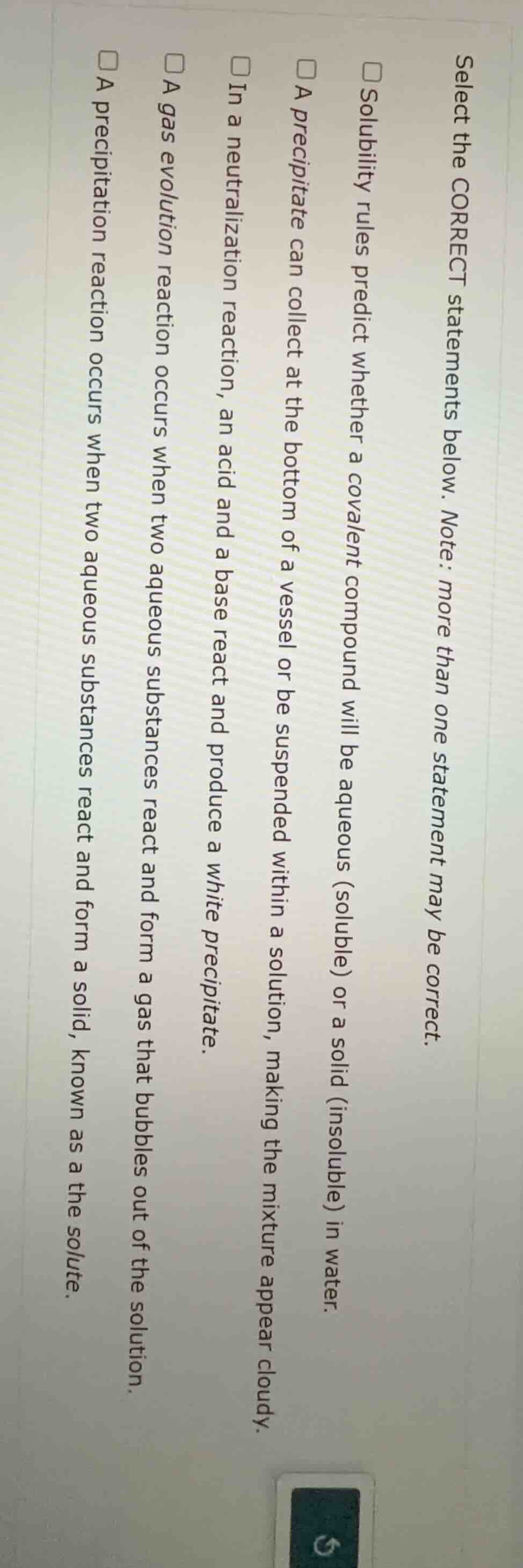
select the correct statements below. note: more than one statement may be correct. □ solubility rules predict whether a covalent compound will be aqueous (soluble) or a solid (insoluble) in water. □ a precipitate can collect at the bottom of a vessel or be suspended within a solution, making the mixture appear cloudy. □ in a neutralization reaction, an acid and a base react and produce a white precipitate. □ a gas evolution reaction occurs when two aqueous substances react and form a gas that bubbles out of the solution. □ a precipitation reaction occurs when two aqueous substances react and form a solid, known as the solute.
- Analyze the first statement: Solubility rules predict the solubility of ionic compounds (not covalent) in water. So this statement is incorrect.
- Analyze the second statement: A precipitate is an insoluble solid that can settle at the bottom or be suspended, making the mixture cloudy. This statement is correct.
- Analyze the third statement: Neutralization reactions (acid + base) typically produce a salt and water, not necessarily a white precipitate. So this statement is incorrect.
- Analyze the fourth statement: A gas evolution reaction occurs when two aqueous substances react and produce a gas (bubbling out). This statement is correct.
- Analyze the fifth statement: In a precipitation reaction, the solid formed is called a precipitate (not solute). So this statement is incorrect.

Snap & solve any problem in the app
Get step-by-step solutions on Sovi AI
Photo-based solutions with guided steps
Explore more problems and detailed explanations
B. A precipitate can collect at the bottom of a vessel or be suspended within a solution, making the mixture appear cloudy
D. A gas evolution reaction occurs when two aqueous substances react and form a gas that bubbles out of the solution