QUESTION IMAGE
Question
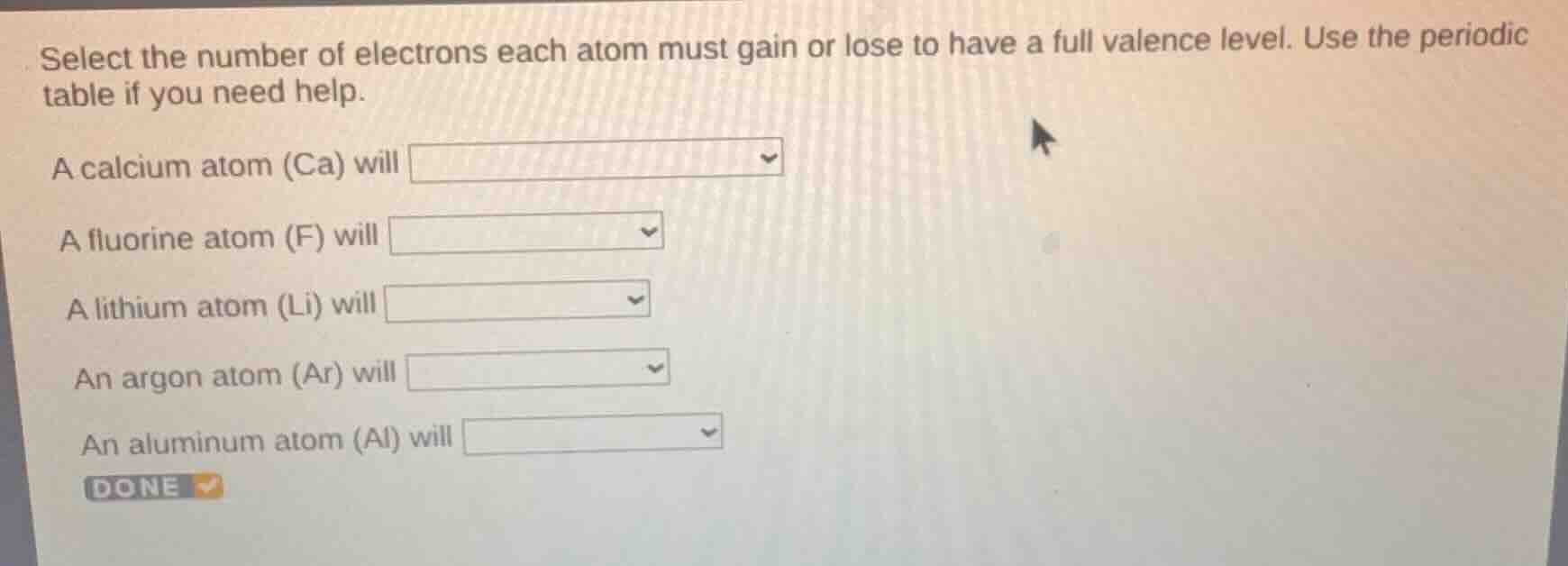
select the number of electrons each atom must gain or lose to have a full valence level. use the periodic table if you need help. a calcium atom (ca) will a fluorine atom (f) will a lithium atom (li) will an argon atom (ar) will an aluminum atom (al) will
For Calcium (Ca):
Step1: Determine valence electrons
Calcium is in group 2 of the periodic table. Group 2 elements have 2 valence electrons.
Step2: Decide gain/lose to fill valence
To achieve a full valence level (like the nearest noble gas, which has 8 valence electrons in the outer shell for main - group elements, or 2 for the first shell), calcium, with 2 valence electrons, will lose 2 electrons. Losing 2 electrons will give it the electron configuration of the previous noble gas (argon), with a full valence level.
Step1: Determine valence electrons
Fluorine is in group 17 of the periodic table. Group 17 elements have 7 valence electrons.
Step2: Decide gain/lose to fill valence
To achieve a full valence level (8 electrons in the outer shell), fluorine, with 7 valence electrons, will gain 1 electron. Gaining 1 electron will give it the electron configuration of the next noble gas (neon), with a full valence level.
Step1: Determine valence electrons
Lithium is in group 1 of the periodic table. Group 1 elements have 1 valence electron.
Step2: Decide gain/lose to fill valence
To achieve a full valence level (2 electrons in the first shell, which is a full valence level for lithium as it has only two electron shells and the first shell can hold 2 electrons), lithium, with 1 valence electron, will lose 1 electron. Losing 1 electron will give it the electron configuration of the previous noble gas (helium), with a full valence level.

Snap & solve any problem in the app
Get step-by-step solutions on Sovi AI
Photo-based solutions with guided steps
Explore more problems and detailed explanations
lose 2 electrons