QUESTION IMAGE
Question
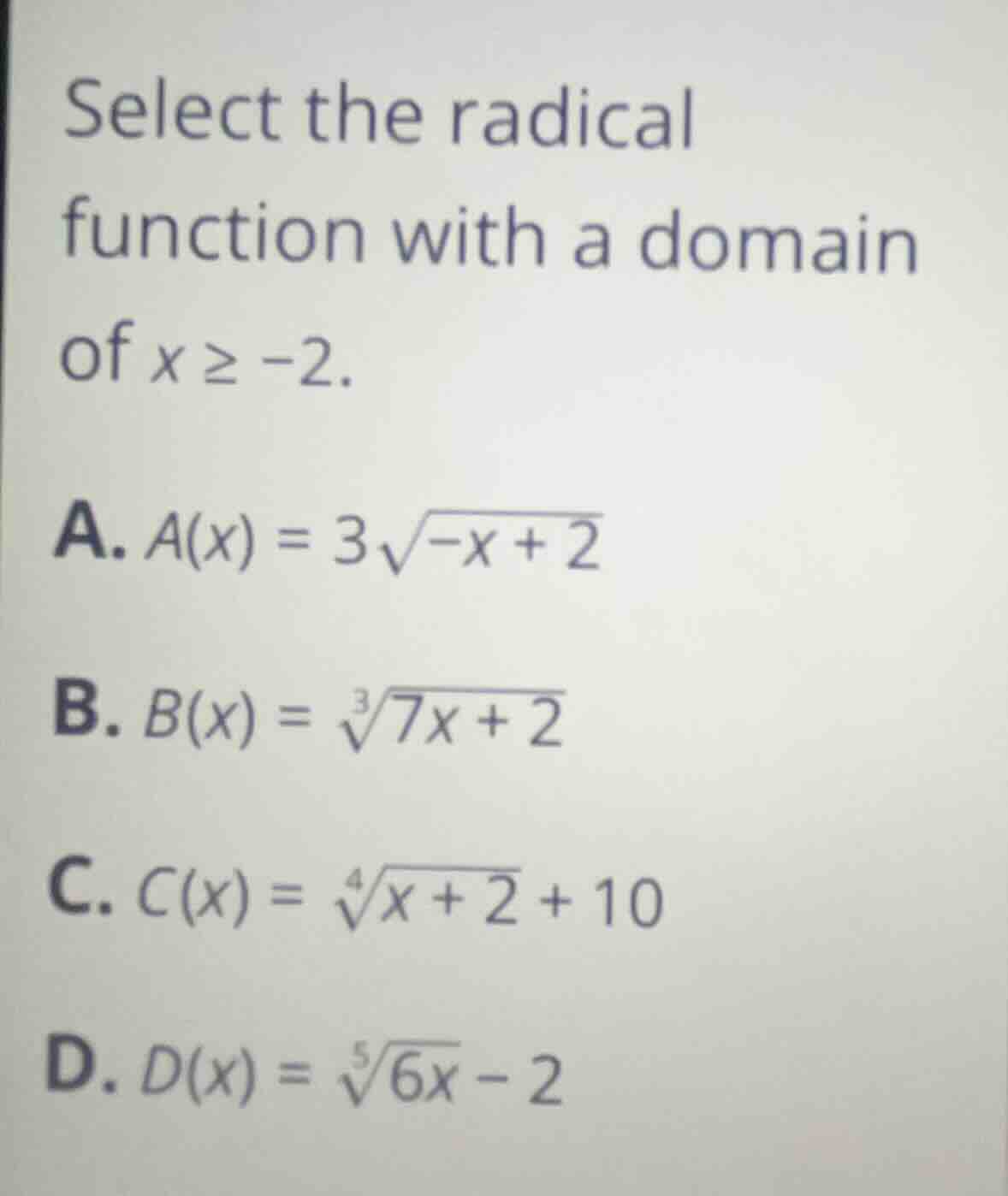
select the radical function with a domain of $x\geq -2$.
a. $a(x) = 3\sqrt{-x + 2}$
b. $b(x) = \sqrt3{7x + 2}$
c. $c(x) = \sqrt4{x + 2} + 10$
d. $d(x) = \sqrt5{6x} - 2$
Step1: Analyze the domain of even - root and odd - root functions
For an \(n\) - th root function \(y = \sqrt[n]{u}\):
- If \(n\) is even ( \(n = 2,4,6,\cdots\) ), the expression inside the root (the radicand) must satisfy \(u\geq0\) because the square root (and other even - root) of a negative number is not a real number.
- If \(n\) is odd ( \(n = 3,5,7,\cdots\) ), the radicand \(u\) can be any real number because the cube root (and other odd - root) of a negative number is a real number.
Step2: Analyze Option A
For the function \(A(x)=3\sqrt{-x + 2}\), since it is a square root function ( \(n = 2\), even), we set the radicand \(-x + 2\geq0\).
Solve the inequality \(-x+2\geq0\):
Subtract 2 from both sides: \(-x\geq - 2\).
Multiply both sides by - 1 (and reverse the inequality sign): \(x\leq2\). So the domain of \(A(x)\) is \(x\leq2\), not \(x\geq - 2\).
Step3: Analyze Option B
For the function \(B(x)=\sqrt[3]{7x + 2}\), since \(n = 3\) (odd), the radicand \(7x + 2\) can be any real number. So the domain of \(B(x)\) is all real numbers, not \(x\geq - 2\).
Step4: Analyze Option C
For the function \(C(x)=\sqrt[4]{x + 2}+10\), since \(n = 4\) (even), we set the radicand \(x + 2\geq0\).
Solve the inequality \(x + 2\geq0\):
Subtract 2 from both sides: \(x\geq - 2\). So the domain of \(C(x)\) is \(x\geq - 2\).
Step5: Analyze Option D
For the function \(D(x)=\sqrt[5]{6x}-2\), since \(n = 5\) (odd), the radicand \(6x\) can be any real number. So the domain of \(D(x)\) is all real numbers, not \(x\geq - 2\).

Snap & solve any problem in the app
Get step-by-step solutions on Sovi AI
Photo-based solutions with guided steps
Explore more problems and detailed explanations
C. \(C(x)=\sqrt[4]{x + 2}+10\)