QUESTION IMAGE
Question
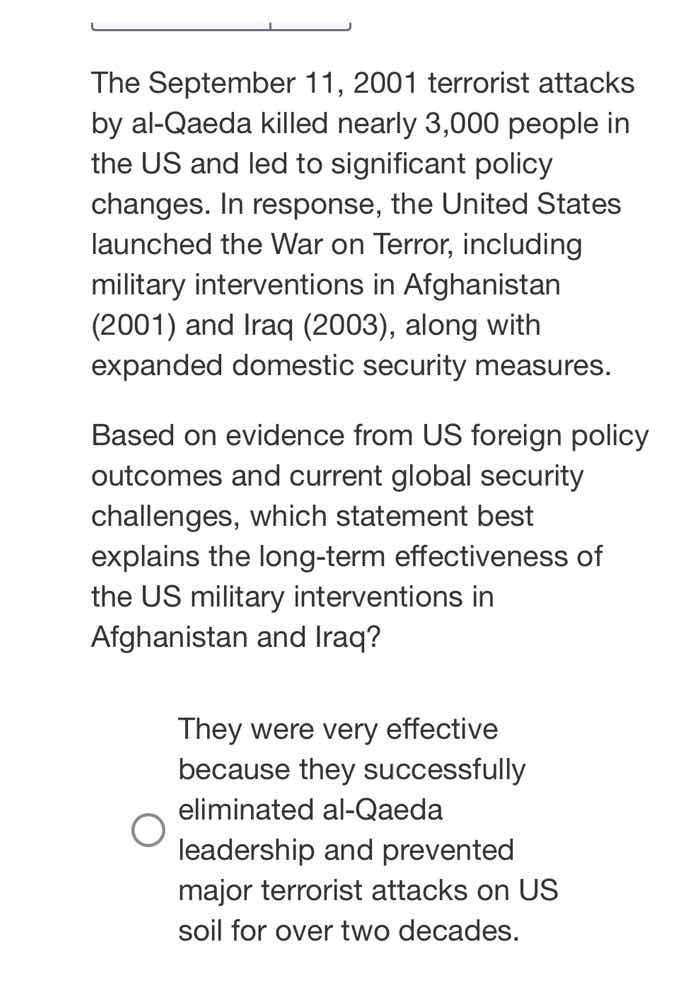
the september 11, 2001 terrorist attacks by al - qaeda killed nearly 3,000 people in the us and led to significant policy changes. in response, the united states launched the war on terror, including military interventions in afghanistan (2001) and iraq (2003), along with expanded domestic security measures. based on evidence from us foreign policy outcomes and current global security challenges, which statement best explains the long - term effectiveness of the us military interventions in afghanistan and iraq? they were very effective because they successfully eliminated al - qaeda leadership and prevented major terrorist attacks on us soil for over two decades.
To determine the long - term effectiveness of US military interventions in Afghanistan and Iraq, we analyze the claim. While the US military actions had some impacts, the statement that they “successfully eliminated al - Qaeda leadership and prevented major terrorist attacks on US soil for over two decades” is inaccurate. Al - Qaeda still exists, and the military interventions in Iraq and Afghanistan had complex and often destabilizing long - term effects, including contributing to the rise of other extremist groups and regional instability. So this statement does not best explain the long - term effectiveness. (Note: Since the question seems to be expecting an evaluation of the given option, and as the provided option is incorrect, we explain why. If there were other options, we would compare them based on the actual outcomes of the interventions, such as the destabilization of regions, the cost - benefit analysis in terms of security, and the persistence of terrorist threats in different forms.)

Snap & solve any problem in the app
Get step-by-step solutions on Sovi AI
Photo-based solutions with guided steps
Explore more problems and detailed explanations
The given statement ("They were very effective because they successfully eliminated al - Qaeda leadership and prevented major terrorist attacks on US soil for over two decades.") does not best explain the long - term effectiveness of the US military interventions in Afghanistan and Iraq. Al - Qaeda was not fully eliminated, and the interventions led to complex regional instabilities and the emergence of new security challenges, so this claim is inaccurate.