QUESTION IMAGE
Question
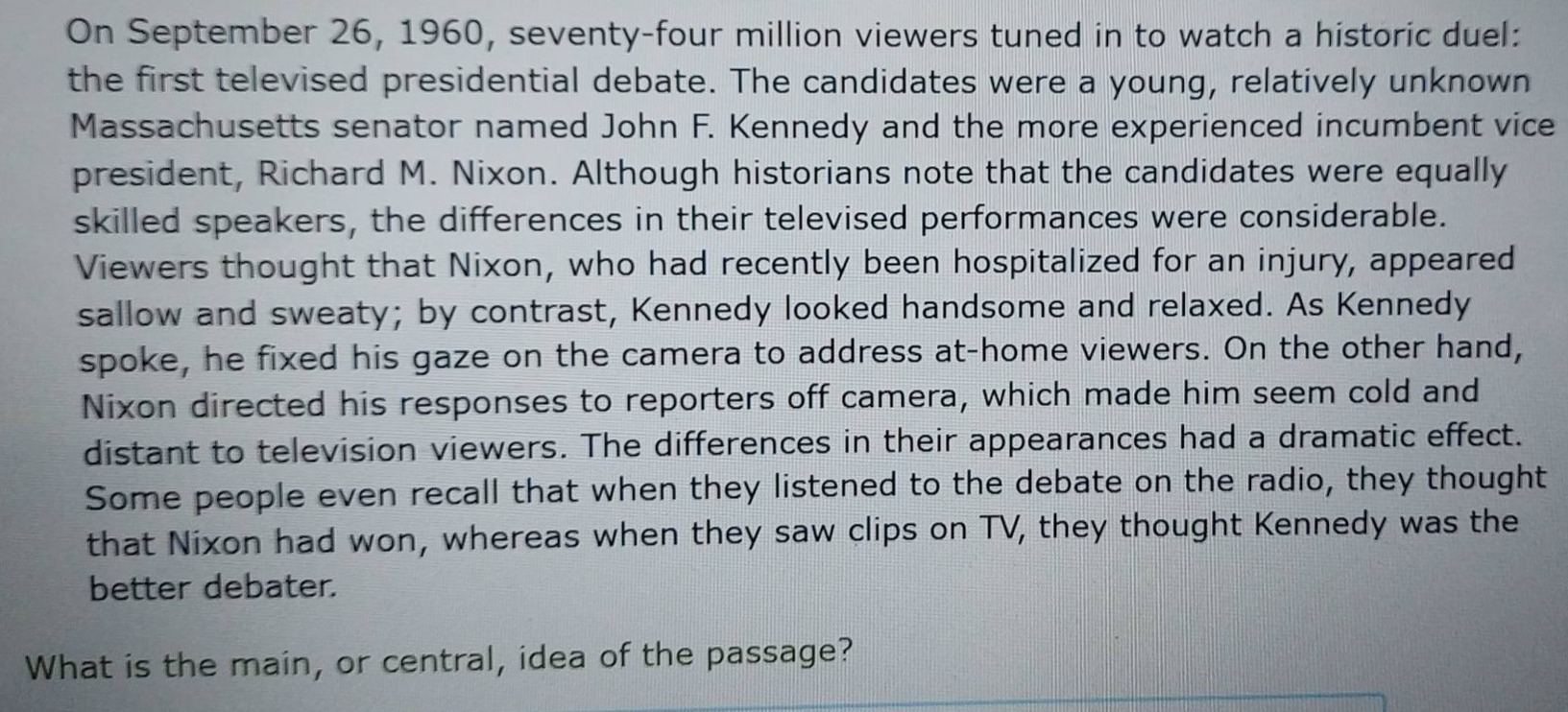
on september 26, 1960, seventy - four million viewers tuned in to watch a historic duel: the first televised presidential debate. the candidates were a young, relatively unknown massachusetts senator named john f. kennedy and the more experienced incumbent vice president, richard m. nixon. although historians note that the candidates were equally skilled speakers, the differences in their televised performances were considerable. viewers thought that nixon, who had recently been hospitalized for an injury, appeared sallow and sweaty; by contrast, kennedy looked handsome and relaxed. as kennedy spoke, he fixed his gaze on the camera to address at - home viewers. on the other hand, nixon directed his responses to reporters off camera, which made him seem cold and distant to television viewers. the differences in their appearances had a dramatic effect. some people even recall that when they listened to the debate on the radio, they thought that nixon had won, whereas when they saw clips on tv, they thought kennedy was the better debater.
what is the main, or central, idea of the passage?
The passage focuses on the 1960 Kennedy-Nixon debate, highlighting how their contrasting TV appearances (Kennedy's relaxed, camera-focused demeanor vs. Nixon's sallow, off-camera focus) shaped viewer judgments, unlike radio listeners who favored Nixon. This central point ties the debate's historic nature to the impact of visual performance on perceptions.

Snap & solve any problem in the app
Get step-by-step solutions on Sovi AI
Photo-based solutions with guided steps
Explore more problems and detailed explanations
The main idea is that the first televised presidential debate (1960 between Kennedy and Nixon) had dramatic effects due to differences in the candidates' televised performances, which influenced viewers' perceptions differently than radio listeners' perceptions.