QUESTION IMAGE
Question
seq set 1 directions (question 20): read and analyze the following documents before writing your essay. you may use the separate paper provided.
document 1
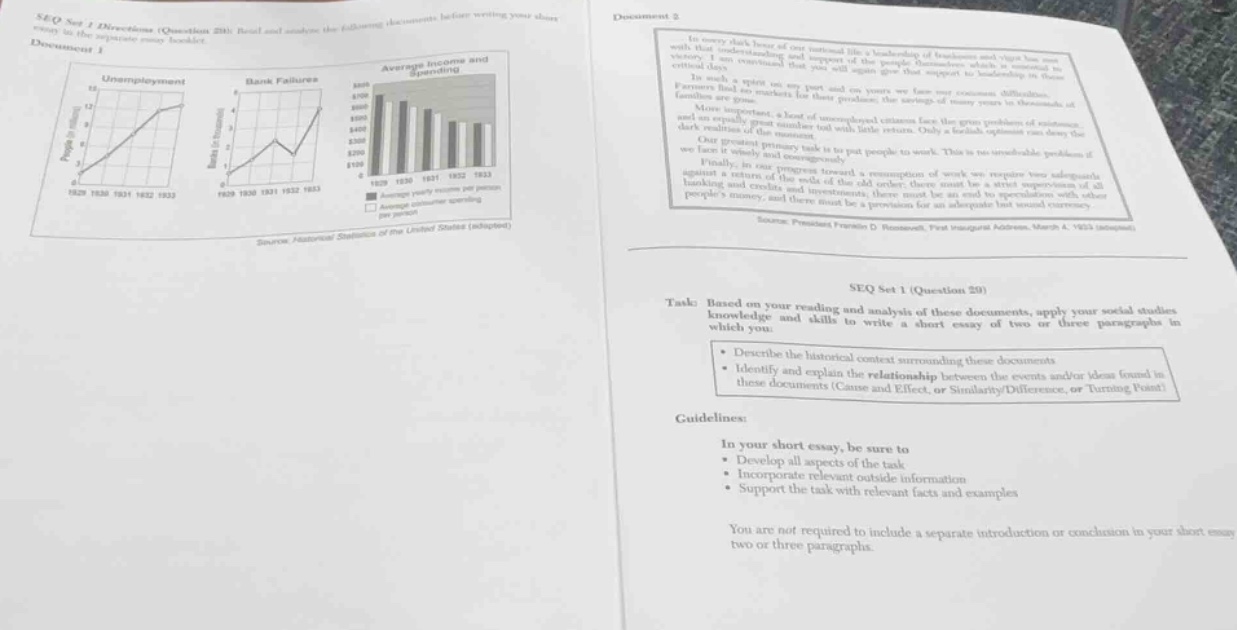
three charts: unemployment (1929 - 1933), bank failures (1930 - 1933), average income and spending (1929 - 1933)
source: historical statistics of the united states (adapted)
document 2
text from president franklin d. roosevelts first inaugural address, march 4, 1933 (excerpted)
in every dark hour of our national life a leadership of frankness and vigor has met with that understanding and support of the people themselves which is essential to victory. i am convinced that you will again give that support to leadership in these critical days.
in such a spirit on my part and on yours we face our common difficulties. they concern, thank god, only material things. values have shrunken to fantastic levels; taxes have risen; our ability to pay has fallen; government of all kinds is faced by serious curtailment of income; the means of exchange are frozen in the currents of trade; the withered leaves of industrial enterprise lie on every side; farmers find no markets for their produce; the savings of many years in thousands of families are gone.
more important, a host of unemployed citizens face the grim problem of existence, and an equally great number toil with little return. only a foolish optimist can deny the dark realities of the moment.
our greatest primary task is to put people to work. this is no unsolvable problem if we face it wisely and courageously. it can be accomplished in part by direct recruiting by the government itself, treating the task as we would treat the emergency of a war, but at the same time, through this employment, accomplishing greatly needed projects to stimulate and reorganize the use of our natural resources.
finally, in our progress toward a resumption of work we require two safeguards against the return of the evils of the old order; there must be a strict supervision of all banking and credits and investments; there must be an end to speculation with other people’s money, and there must be provision for an adequate but sound currency.
source: president franklin d. roosevelt, first inaugural address, march 4, 1933 (excerpted)
seq set 1 (question 20)
task: based on your reading and analysis of these documents, apply your social studies knowledge and skills to write a short essay of two or three paragraphs in which you:
- describe the historical context surrounding these documents
- identify and explain the relationship between the events and/or items found in these documents (cause and effect, or similarity/difference, or turning point)
guidelines:
in your short essay, be sure to:
- develop all aspects of the task
- incorporate relevant outside information
- support the task with relevant facts and examples
you are not required to include a separate introduction or conclusion in your short essay. two or three paragraphs will suffice.
seq set 1 (question 20)
task: based on your reading and analysis of these documents, apply your social studies knowledge and skills to write a short essay of two or three paragraphs in which you:
- describe the historical context surrounding these documents
- identify and explain the relationship between the events and/or items found in these documents (cause and effect, or similarity/difference, or turning point)
guidelines:
in your short essay, be sure to:
- develop all aspects of the task
- incorporate relevant outside information
- support the task with relevant facts and examples
you are not required to include a separate introduction or conclusion in your short essay. two or three paragraphs will suffice.
To solve this task, we analyze the historical context and relationships in the documents:
Step 1: Historical Context
The documents relate to the Great Depression (1929–1933+). Document 1’s graphs show rising unemployment, bank failures, and falling income/spending—key economic impacts of the 1929 stock market crash. Document 2 is President Franklin D. Roosevelt’s 1933 inaugural address, outlining his New Deal agenda to combat the Depression.
Step 2: Relationship (Cause - Effect)
The Great Depression (cause) triggered the crises shown in Document 1: bank failures (due to panicked withdrawals), high unemployment (as businesses collapsed), and plummeting income/spending (from reduced production and consumer confidence). In response, Roosevelt’s address (Document 2) proposed solutions (effect): job creation, economic reform, and social safety nets (e.g., public works, banking regulation, Social Security). His policies aimed to reverse the Depression’s effects by restoring economic stability and public trust.
Step 3: Outside Information Integration
Relevant context: The 1929 crash led to a global economic downturn. Roosevelt’s New Deal included programs like the Civilian Conservation Corps (jobs), the Federal Deposit Insurance Corporation (bank stability), and the Securities and Exchange Commission (market regulation). These addressed the root causes (unregulated finance, lack of social support) identified in Document 1.
Short Essay (2 - 3 Paragraphs)
The documents reflect the Great Depression and its resolution. Document 1’s graphs illustrate the crisis: unemployment soared (from ~3% in 1929 to ~25% by 1933), bank failures eroded savings, and income/spending collapsed. This economic collapse (caused by the 1929 stock market crash, overproduction, and banking instability) created widespread suffering.
Roosevelt’s 1933 inaugural address (Document 2) responded to this crisis. He acknowledged “the withered leaves of industrial enterprise” and proposed bold action: job creation, economic reform, and social security. For example, the New Deal’s public works programs (e.g., Tennessee Valley Authority) created jobs, while banking reforms (e.g., Emergency Banking Act) stabilized finance. This cause - effect relationship—Depression - induced crises (Document 1) spurring Roosevelt’s transformative policies (Document 2)—marked a turning point in U.S. economic history, shifting toward government intervention to protect citizens from market failures.

Snap & solve any problem in the app
Get step-by-step solutions on Sovi AI
Photo-based solutions with guided steps
Explore more problems and detailed explanations
The historical context is the Great Depression (1929–1933), with Document 1 showing its economic toll (unemployment, bank failures, falling income) and Document 2 presenting Roosevelt’s New Deal response. The relationship is cause - effect: the Depression (cause) triggered the crises in Document 1, prompting Roosevelt’s policies (effect) to address these issues and reshape the economy.