QUESTION IMAGE
Question
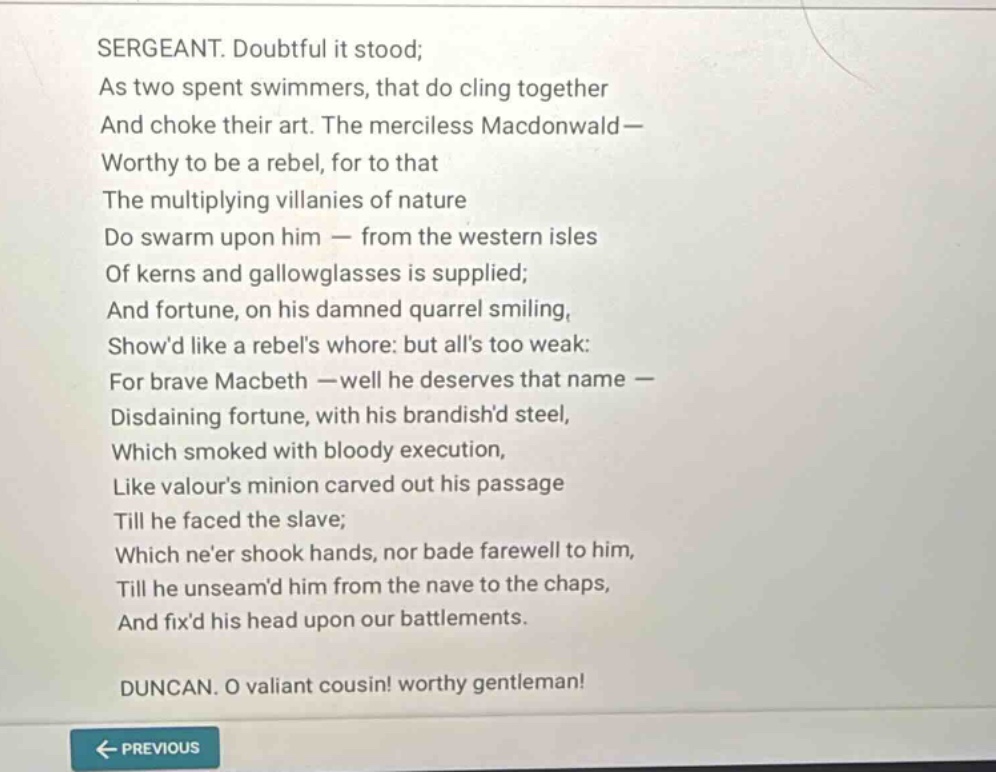
sergeant. doubtful it stood;
as two spent swimmers, that do cling together
and choke their art. the merciless macdonwald—
worthy to be a rebel, for to that
the multiplying villanies of nature
do swarm upon him — from the western isles
of kerns and gallowglasses is supplied;
and fortune, on his damned quarrel smiling,
showd like a rebels whore: but alls too weak:
for brave macbeth —well he deserves that name —
disdaining fortune, with his brandishd steel,
which smoked with bloody execution,
like valours minion carved out his passage
till he faced the slave;
which neer shook hands, nor bade farewell to him,
till he unseamd him from the nave to the chaps,
and fixd his head upon our battlements.
duncan. o valiant cousin! worthy gentleman!
Since no specific question is provided about this Macbeth excerpt, it's hard to give a targeted answer. If you want to analyze the literary devices (like the simile "Show'd like a rebel's whore", "Like valour's minion"), character portrayal (Macbeth as brave, Macdonwald as a rebel), or the historical/Shakespearean context, please clarify your question. For example, if you ask about the literary device in "Like valour's minion carved out his passage", the answer would be:
The phrase "Like valour's minion" uses a simile (comparing Macbeth to valour's minion using "like") to portray Macbeth as a devoted servant of bravery, emphasizing his courageous and fierce nature in battle.

Snap & solve any problem in the app
Get step-by-step solutions on Sovi AI
Photo-based solutions with guided steps
Explore more problems and detailed explanations
The literary device is a simile, comparing Macbeth to "valour's minion" to highlight his bravery in battle.