QUESTION IMAGE
Question
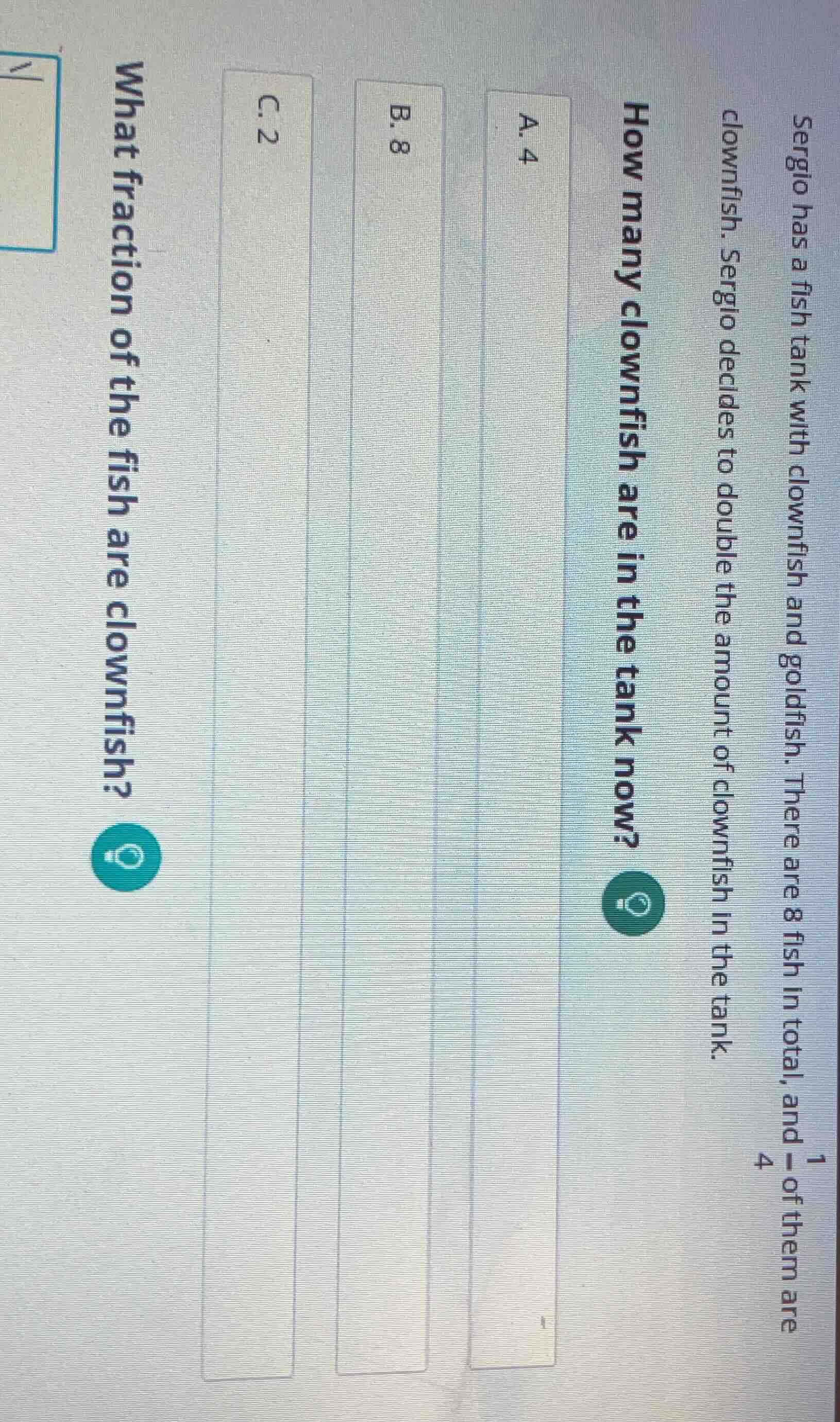
sergio has a fish tank with clownfish and goldfish. there are 8 fish in total, and \\(\frac{1}{4}\\) of them are clownfish. sergio decides to double the amount of clownfish in the tank.
how many clownfish are in the tank now?
a. 4
b. 8
c. 2
what fraction of the fish are clownfish?
First Sub - Question: How many clownfish are in the tank now?
Step 1: Find the original number of clownfish
We know there are 8 fish in total and \(\frac{1}{4}\) of them are clownfish originally. So the original number of clownfish is \(8\times\frac{1}{4}=2\).
Step 2: Double the number of clownfish
Sergio decides to double the amount of clownfish. So the new number of clownfish is \(2\times2 = 4\).
Step 1: Find the new number of clownfish and total number of fish
From the first sub - question, the new number of clownfish is 4. The original total number of fish is 8, and we only doubled the clownfish, so the total number of fish is still 8? Wait, no. Wait, original clownfish: \(8\times\frac{1}{4}=2\), after doubling, clownfish are \(2\times2 = 4\). The total number of fish: original total is 8, and we added \(2\) (since we doubled from 2 to 4, we added 2) clownfish, so total number of fish is \(8 + 2=10\)? Wait, maybe I misread. Wait, the problem says "Sergio has a fish tank with clownfish and goldfish. There are 8 fish in total, and \(\frac{1}{4}\) of them are clownfish. Sergio decides to double the amount of clownfish in the tank."
Original number of clownfish: \(n_{c1}=8\times\frac{1}{4} = 2\)
After doubling, number of clownfish: \(n_{c2}=2\times2=4\)
Number of goldfish: \(n_{g}=8 - 2=6\)
New total number of fish: \(n_{total}=4 + 6 = 10\)
Step 2: Calculate the fraction of clownfish
The fraction of clownfish is \(\frac{n_{c2}}{n_{total}}=\frac{4}{10}=\frac{2}{5}\)? Wait, maybe the problem assumes that the total number of fish remains 8? If we assume that (maybe we just double the clownfish without changing the total? But that doesn't make sense. Wait, maybe the problem is that when we double the clownfish, the total number of fish also changes? Wait, no, the problem says "what fraction of the fish are clownfish" after doubling the clownfish.
Wait, original:
Clownfish: \(8\times\frac{1}{4}=2\)
Goldfish: \(8 - 2 = 6\)
After doubling clownfish:
Clownfish: \(2\times2=4\)
Total fish: \(4 + 6=10\)
Fraction: \(\frac{4}{10}=\frac{2}{5}\). But maybe the problem has a different approach. Wait, maybe the total number of fish is still 8? If we assume that we just replace or something, but that's not logical. Wait, maybe the problem is simpler. Wait, original clownfish: 2, after doubling: 4. Total fish: 8 (maybe the goldfish are still 6 and clownfish are 4, total 10? No, maybe the problem has a typo or I misread. Wait, maybe the original total is 8, and when we double the clownfish, the total number of fish is 8? No, that can't be. Wait, maybe the question is before doubling? No, the first question is after doubling. Wait, maybe the second question is a follow - up. Wait, let's re - examine.
Wait, the first question: after doubling, clownfish are 4 (from original 2). The total number of fish: original 8, and we added 2 clownfish, so total is 10. Then the fraction is \(\frac{4}{10}=\frac{2}{5}\). But maybe the problem expects us to think that the total number of fish is still 8. If we assume that, then the fraction is \(\frac{4}{8}=\frac{1}{2}\). But that's not correct because we added fish.
Wait, maybe the problem is in the original context, when we double the clownfish, the total number of fish is still 8. So original clownfish: 2, after doubling: 4, goldfish: 4. Then the fraction is \(\frac{4}{8}=\frac{1}{2}\). But this is a bit confusing. However, based on the first sub - question, the number of clownfish is 4. If we assume the total number of fish is 8 (maybe the goldfish are reduced, but that's not stated). Alternatively, maybe the problem has a mistake. But if we go with the first sub - question's result (clownfish = 4) and assume total fish is 8 (maybe the problem considers that we just change the number of clownfish and keep total as 8), then the fraction is \(\frac{4}{8}=\frac{1}{2}\). But I think the correct way is:
Original clownfish: \(8\times\frac{1}{4}=2\)
After doubling: 4 clownfish
Total fish: original 8, plus 2 (the…
Step 1: Determine new number of clownfish and total fish
New number of clownfish \(n_{c}=4\) (from first sub - question). Original total fish \(n_{t}=8\), and we added \(2\) clownfish, so new total fish \(n_{t_{new}}=8 + 2=10\).
Step 2: Calculate the fraction
The fraction of clownfish is \(\frac{n_{c}}{n_{t_{new}}}=\frac{4}{10}=\frac{2}{5}\).

Snap & solve any problem in the app
Get step-by-step solutions on Sovi AI
Photo-based solutions with guided steps
Explore more problems and detailed explanations
A. 4