QUESTION IMAGE
Question
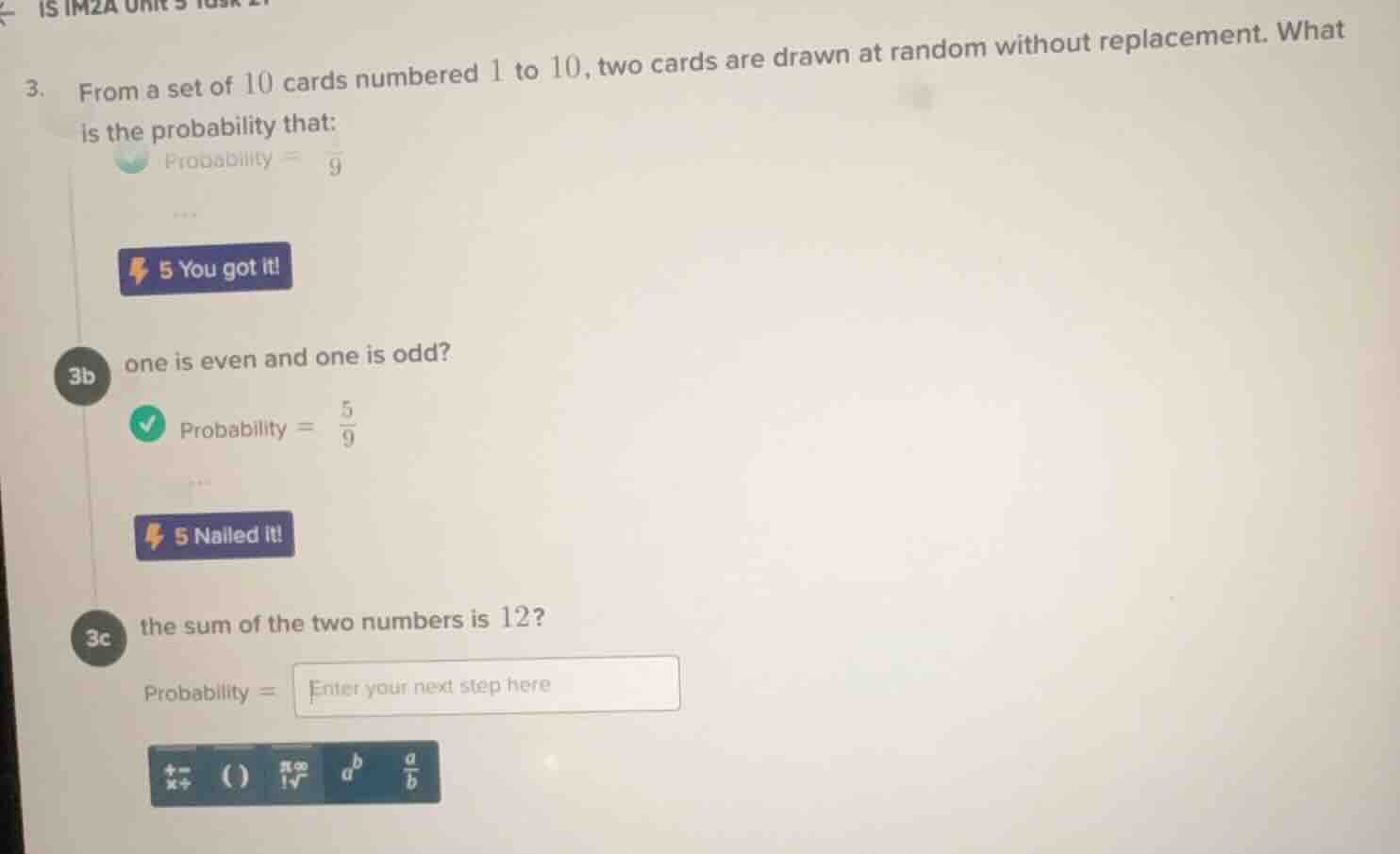
- from a set of 10 cards numbered 1 to 10, two cards are drawn at random without replacement. what is the probability that:
...
3b one is even and one is odd?
probability = \\(\frac{5}{9}\\)
...
3c the sum of the two numbers is 12?
probability = enter your next step here
Step1: Find total number of ways to draw 2 cards
The total number of ways to draw 2 cards from 10 (without replacement) is given by the combination formula \( C(n, k)=\frac{n!}{k!(n - k)!} \), where \( n = 10 \) and \( k=2 \). So \( C(10,2)=\frac{10!}{2!(10 - 2)!}=\frac{10\times9}{2\times1}=45 \).
Step2: Find number of favorable outcomes (sum is 12)
We need to find pairs of numbers from 1 to 10 that add up to 12. The pairs are: (2, 10), (3, 9), (4, 8), (5, 7), (6, 6) but (6,6) is not allowed as we draw without replacement. Wait, actually, (2,10), (3,9), (4,8), (5,7), and also (10,2), (9,3), (8,4), (7,5)? Wait no, in combinations, (a,b) and (b,a) are the same? Wait no, when we draw two cards, the order doesn't matter in combinations, but let's list the unordered pairs: (2,10), (3,9), (4,8), (5,7). Wait, also (6,6) is invalid. Wait, wait, 1 + 11 (but 11 is not in the set), 2+10=12, 3+9=12, 4+8=12, 5+7=12, 6+6=12 (invalid), 7+5=12 (same as 5+7), 8+4=12 (same as 4+8), 9+3=12 (same as 3+9), 10+2=12 (same as 2+10). Wait, actually, the unordered pairs that sum to 12 are (2,10), (3,9), (4,8), (5,7). Wait, is that all? Wait 1+11 no, 2+10, 3+9, 4+8, 5+7, 6+6 (invalid). Wait, also, what about (7,5) is same as (5,7), so the number of unordered pairs is 4? Wait no, wait 2 and 10: one pair, 3 and 9: second, 4 and 8: third, 5 and 7: fourth. Wait, but wait, 12 - 1 = 11 (not in set), 12 - 2 = 10 (in set), 12 - 3 = 9 (in set), 12 - 4 = 8 (in set), 12 - 5 = 7 (in set), 12 - 6 = 6 (in set, but duplicate), 12 - 7 = 5 (already counted), 12 - 8 = 4 (already counted), 12 - 9 = 3 (already counted), 12 - 10 = 2 (already counted). So the number of unordered pairs is 4? Wait no, wait I made a mistake. Wait 2 and 10: sum 12, 3 and 9: sum 12, 4 and 8: sum 12, 5 and 7: sum 12, and also (6,6) is invalid. Wait, but wait, 12 can be formed by (2,10), (3,9), (4,8), (5,7). Wait, that's 4 pairs? Wait no, wait 2+10=12, 3+9=12, 4+8=12, 5+7=12. Wait, is there another pair? 1+11 (no), 6+6 (invalid). So total of 4 unordered pairs? Wait no, wait in combinations, the number of ways to choose (2,10) is 1, (3,9) is 1, (4,8) is 1, (5,7) is 1. Wait, but wait, when we draw two cards, the order doesn't matter, so each pair is unique. Wait, but let's list all possible ordered pairs? No, in probability for combinations, we use unordered pairs. Wait, but let's check again. The numbers are 1 - 10. Let's list all pairs (a,b) where a < b and a + b = 12:
- 2 and 10 (2 + 10 = 12)
- 3 and 9 (3 + 9 = 12)
- 4 and 8 (4 + 8 = 12)
- 5 and 7 (5 + 7 = 12)
So that's 4 pairs? Wait, no, wait 6 and 6: but we can't have two 6s. So total favorable unordered pairs: 4? Wait, no, wait I think I missed (1,11) but 11 is not there, (6,6) is invalid. Wait, no, wait 2+10, 3+9, 4+8, 5+7: that's 4 pairs. Wait, but wait, let's calculate the number of ordered pairs? No, in combinations, the total number of ways is 45 (unordered). Wait, but let's check the number of favorable outcomes. Wait, maybe I made a mistake. Let's list all possible pairs (a,b) with a ≠ b and a + b = 12:
(2,10), (10,2), (3,9), (9,3), (4,8), (8,4), (5,7), (7,5). So that's 8 ordered pairs. But in combinations, we consider unordered, so the number of unordered pairs is 4, but the number of ordered pairs is 8. Wait, but the total number of ordered pairs is 10 * 9 = 90 (since first card 10 choices, second 9). Wait, maybe the problem is using permutations (ordered) or combinations (unordered). Wait, in part 3b, the probability was 5/9. Let's check part 3b: total number of ways to draw two cards without replacement: if we use permutations, it…

Snap & solve any problem in the app
Get step-by-step solutions on Sovi AI
Photo-based solutions with guided steps
Explore more problems and detailed explanations
$\frac{4}{45}$