QUESTION IMAGE
Question
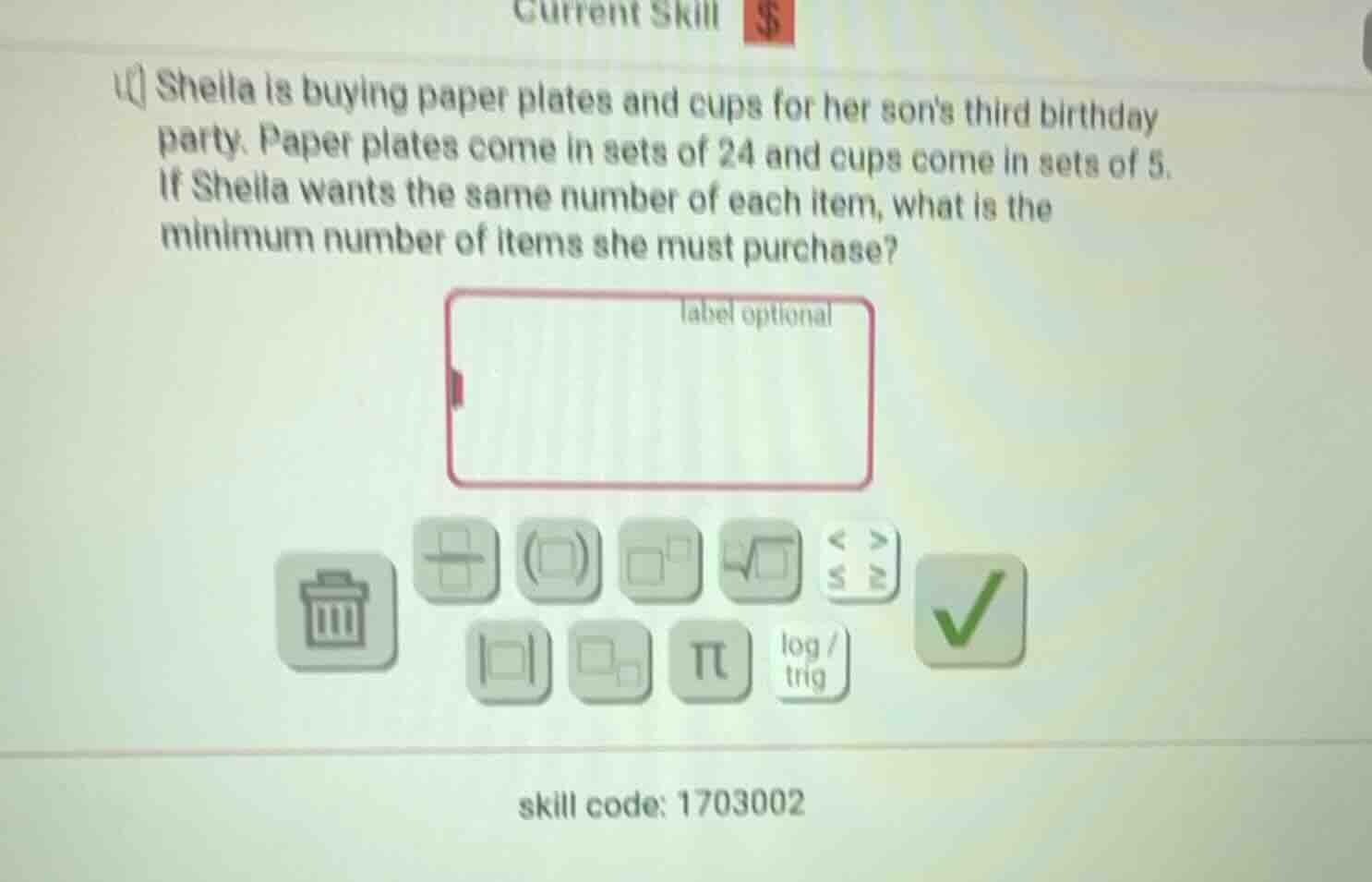
sheila is buying paper plates and cups for her sons third birthday party. paper plates come in sets of 24 and cups come in sets of 5. if sheila wants the same number of each item, what is the minimum number of items she must purchase?
Step1: Find LCM of 24 and 5
Prime factorize 24: \(24 = 2^3\times3\)
Prime factorize 5: \(5 = 5\)
LCM is \(2^3\times3\times5 = 120\) (number of each item).
Step2: Calculate total items
Total items = \(120 + 120 = 240\)? Wait, no. Wait, LCM is the number of each (plates and cups). So plates: \(120\div24 = 5\) sets, cups: \(120\div5 = 24\) sets. Total items: \(120 + 120 = 240\)? Wait, no, each item (plates and cups) has 120, so total is \(120\times2 = 240\)? Wait, no, wait. Wait, the problem says "the same number of each item", so number of plates = number of cups = LCM(24,5)=120. So total items: 120 (plates) + 120 (cups) = 240. Wait, but let's check: 24 and 5 are coprime? No, 24 and 5 have no common factors except 1, so LCM(24,5)=24×5=120. So number of plates: 120, number of cups: 120. Total items: 120+120=240.
Wait, no, wait. Wait, paper plates come in sets of 24, so to get 120 plates, need 120/24=5 sets. Cups come in sets of 5, so to get 120 cups, need 120/5=24 sets. Then total items: 120 (plates) + 120 (cups) = 240. Yes.

Snap & solve any problem in the app
Get step-by-step solutions on Sovi AI
Photo-based solutions with guided steps
Explore more problems and detailed explanations
240