QUESTION IMAGE
Question
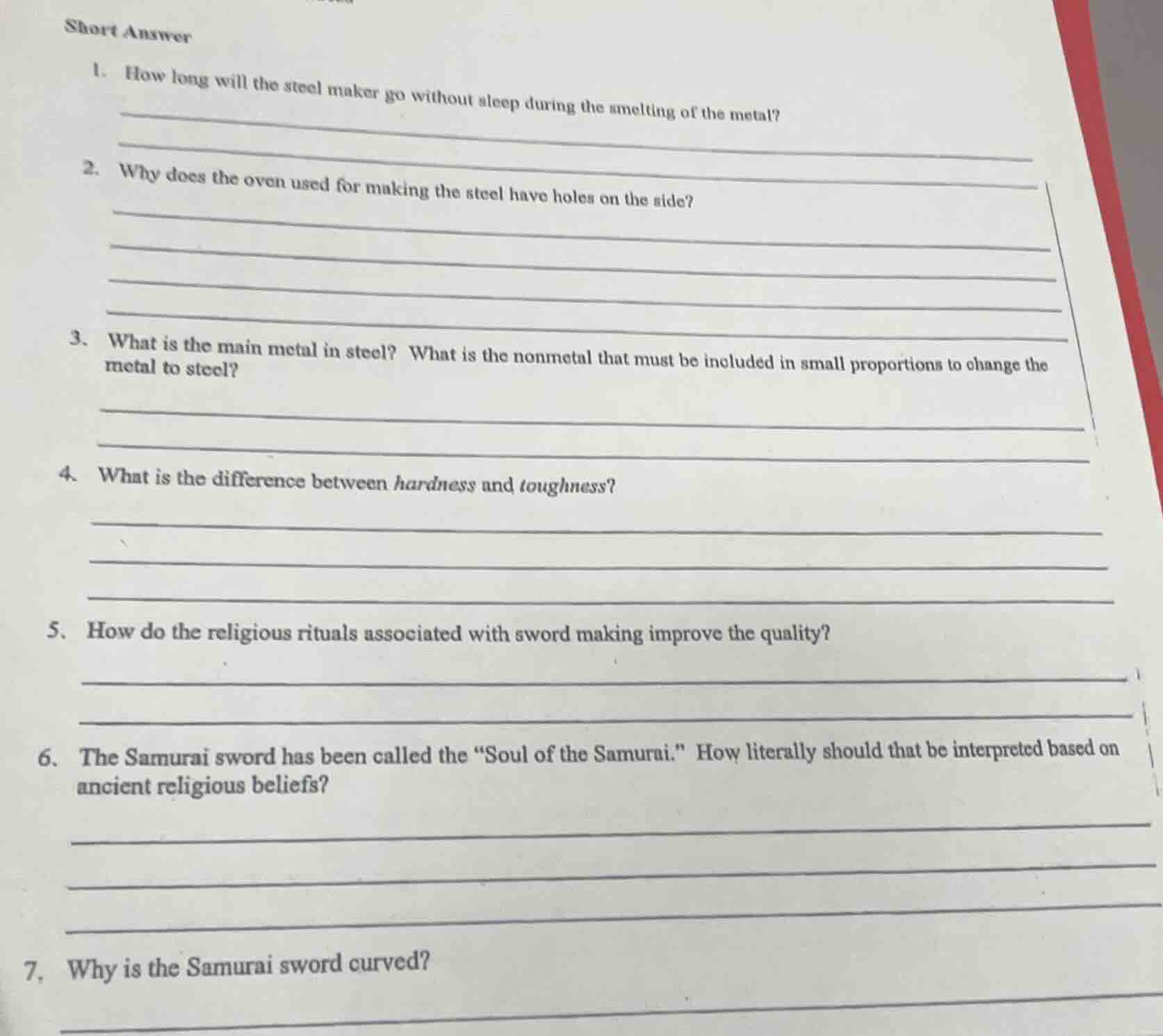
short answer
- how long will the steel maker go without sleep during the smelting of the metal?
- why does the oven used for making the steel have holes on the side?
- what is the main metal in steel? what is the nonmetal that must be included in small proportions to change the metal to steel?
- what is the difference between hardness and toughness?
- how do the religious rituals associated with sword making improve the quality?
- the samurai sword has been called the \soul of the samurai.\ how literally should that be interpreted based on ancient religious beliefs?
- why is the samurai sword curved?
Brief Explanations
- Traditional Japanese steel (tamahagane) smelting for swords requires constant monitoring of the tatara furnace for 3-7 days straight, so the steel maker goes without sleep for this entire period to maintain precise temperature and material conditions.
- The holes allow air (oxygen) to enter the furnace, which fuels the combustion of the charcoal used to heat the iron ore, maintaining the high temperatures needed for smelting steel.
- Steel is primarily composed of iron (the main metal). Carbon is the nonmetal added in small proportions (typically 0.2-2.1% by weight) to transform iron into steel, altering its mechanical properties.
- Hardness is a material's resistance to scratching, indentation, or surface damage. Toughness is a material's ability to absorb energy and resist fracturing or breaking under impact or stress.
- Religious rituals enforce strict, consistent, meticulous work practices (like precise timing, clean working conditions, and focused attention) that reduce errors in the complex sword-making process, indirectly improving quality. Rituals also foster extreme care and discipline in the smith.
- In ancient Shinto beliefs, the sword was seen as a vessel for a kami (spirit/deity). Smiths performed rituals to invite this spirit into the sword, so the phrase was interpreted literally: the sword held a spiritual essence tied to the samurai's identity, honor, and soul.
- The curve forms during differential quenching: the sword's edge is cooled faster than the spine, causing the edge to contract more and pull the blade into a curve. This curve improves slicing efficiency in combat, especially against unarmored or lightly armored opponents.

Snap & solve any problem in the app
Get step-by-step solutions on Sovi AI
Photo-based solutions with guided steps
Explore more problems and detailed explanations
- 3 to 7 consecutive days
- To let in oxygen for charcoal combustion
- Main metal: Iron; Nonmetal: Carbon
- Hardness resists surface damage; toughness resists fracturing
- They enforce strict, precise, disciplined work practices
- Literally—ancient Shinto beliefs held the sword contained a kami (spirit) tied to the samurai's soul
- It forms from differential quenching, improving slicing ability