QUESTION IMAGE
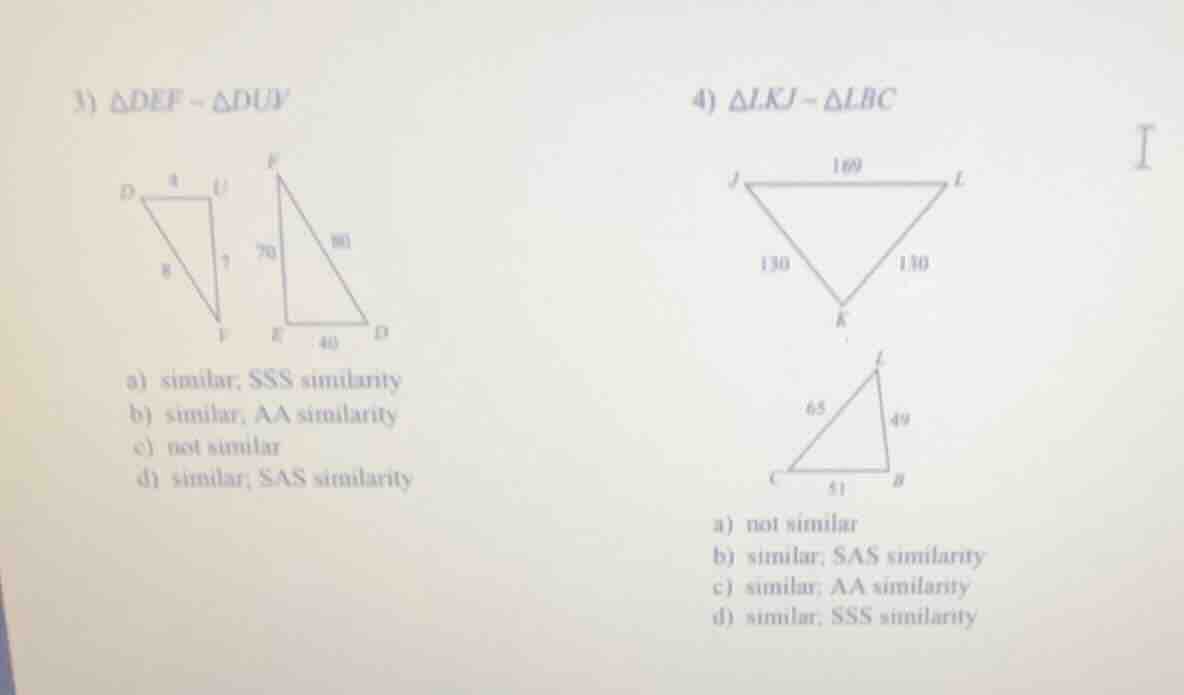
Question
- $\triangle def \sim \triangle duf$
a) similar, sss similarity
b) similar, aa similarity
c) not similar
d) similar; sas similarity
- $\triangle lkj \sim \triangle lbc$
a) not similar
b) similar; sas similarity
c) similar; aa similarity
d) similar; sss similarity
Problem 3:
Step 1: Identify Corresponding Sides
For \(\triangle DEF \sim \triangle DUF\) (assuming a typo, likely \(\triangle DEF \sim \triangle UFV\) or similar, but from the diagram:
- \(\triangle UFV\) sides: \(DU = 4\), \(UF = 7\), \(FV = 8\)
- \(\triangle DEF\) sides: \(DE = 40\), \(EF = 70\), \(FD = 80\)
Step 2: Check Ratios
Calculate ratios of corresponding sides:
\(\frac{DE}{DU} = \frac{40}{4} = 10\), \(\frac{EF}{UF} = \frac{70}{7} = 10\), \(\frac{FD}{FV} = \frac{80}{8} = 10\).
Step 3: Determine Similarity Criterion
All three sides are proportional (ratio \(10\)), so SSS similarity applies. Wait, but wait—wait, the triangles: \(\triangle DUF\) and \(\triangle DEF\) (or \(\triangle EFD\))—wait, actually, the angles: Wait, no, the sides: \(DU = 4\), \(UF = 7\), \(FV = 8\); \(DE = 40\), \(EF = 70\), \(FD = 80\). So ratios are equal (\(40/4 = 10\), \(70/7 = 10\), \(80/8 = 10\)), so SSS? But wait, maybe SAS? Wait, no—wait, the included angle? Wait, maybe I misread. Wait, the triangles: \(\triangle DUF\) has sides \(4\), \(7\), \(8\); \(\triangle DEF\) has sides \(40\), \(70\), \(80\). So all sides proportional, so SSS. But wait, the options: a) similar, SSS; b) AA; c) not; d) SAS. Wait, but maybe the triangles are \(\triangle DUF\) and \(\triangle EFD\) with a right angle? Wait, no, the diagram: \(UF\) and \(EF\) are vertical, \(DU\) and \(DE\) are horizontal. So \(\angle U\) and \(\angle E\) are right angles? Wait, if \(\angle U = \angle E = 90^\circ\), and sides around the right angle: \(DU = 4\), \(UF = 7\); \(DE = 40\), \(EF = 70\). Then ratio \(40/4 = 10\), \(70/7 = 10\), so SAS (since right angle is included). Oh! I made a mistake. The right angle is included, so SAS similarity (two sides proportional, included angle equal). So:
- \(\angle U = \angle E = 90^\circ\) (right angles, equal).
- \(\frac{DE}{DU} = \frac{40}{4} = 10\), \(\frac{EF}{UF} = \frac{70}{7} = 10\).
So two sides proportional, included angle equal (SAS). So the correct option is d) similar, SAS similarity.
Problem 4:
Step 1: Identify Sides of \(\triangle LKJ\) and \(\triangle LBC\) (Wait, \(\triangle LKJ\) has sides \(LJ = 109\)? Wait, no, the diagram: \(\triangle LKJ\) has \(JL = 109\)? Wait, no, the top triangle: \(J\) to \(L\) is \(109\)? Wait, no, the numbers: \(JL = 109\)? Wait, no, the lower triangle: \(C\) to \(B\) is \(51\), \(B\) to \(L\) (wait, no, \(\triangle LBC\) has \(BC = 51\), \(BL = 49\), \(CL = 65\). \(\triangle LKJ\) has \(JL = 109\)? Wait, no, the top triangle: \(J\) to \(L\) is \(109\), \(J\) to \(K\) is \(130\), \(K\) to \(L\) is \(130\). Wait, no, the lower triangle: \(C\) to \(B\) is \(51\), \(B\) to \(I\) (wait, \(L\)) is \(49\), \(C\) to \(L\) is \(65\). Wait, let's list sides:
- \(\triangle LKJ\): \(JL = 109\), \(JK = 130\), \(KL = 130\) (isosceles, \(JK = KL = 130\)).
- \(\triangle LBC\): \(BC = 51\), \(BL = 49\), \(CL = 65\).
Wait, no, maybe \(\triangle LKJ\) and \(\triangle LBC\) are \(\triangle LKJ\) (with \(JL = 109\), \(JK = 130\), \(KL = 130\)) and \(\triangle LBC\) (with \(BC = 51\), \(BL = 49\), \(CL = 65\))? No, that can't be. Wait, maybe a typo: \(\triangle LKJ\) has \(JL = 109\)? Wait, no, the lower triangle: \(BC = 51\), \(BL = 49\), \(CL = 65\). Let's check ratios:
- \(JK = 130\), \(KL = 130\); \(BL = 49\), \(CL = 65\) (not equal).
- \(JL = 109\), \(BC = 51\) (ratio \(109/51 \approx 2.137\)).
- \(JK = 130\), \(CL = 65\) (ratio \(130/65 = 2\)).
- \(KL = 130\), \(BL = 49\) (ratio \(130/49 \approx 2.653\)).
Ratios are not equal. Wait, maybe \(\triangle LKJ\) has \(JL = 109\)? No, maybe the top triangle is \(\triangle LKJ\) with \(JL = 109\), \(JK = 130\), \(KL = 130\), and the lower triangle is \(\triangle LBC\) with \(BC = 51\), \(BL = 49\), \(CL = 65\). Wait, no, maybe the sides are \(JL = 109\), \(JK = 130\), \(KL = 130\); and \(BC = 51\), \(BL = 49\), \(CL = 65\). Let's check SSS:
- \(JL/BC = 109/51 \approx 2.137\)
- \(JK/CL = 130/65 = 2\)
- \(KL/BL = 130/49 \approx 2.653\)
Ratios not equal. SAS: included angle? \(\triangle LKJ\) is isosceles (\(JK = KL\)), \(\triangle LBC\) is not (sides 51, 49, 65—check if isosceles: 51≠49≠65). So angles: \(\angle K\) in \(\triangle LKJ\) is the vertex angle, \(\angle L\) in \(\triangle LBC\)? No. So ratios not equal, angles not necessarily equal. So the triangles are not similar. So option a) not similar.

Snap & solve any problem in the app
Get step-by-step solutions on Sovi AI
Photo-based solutions with guided steps
Explore more problems and detailed explanations
s:
- d) similar; SAS similarity
- a) not similar